


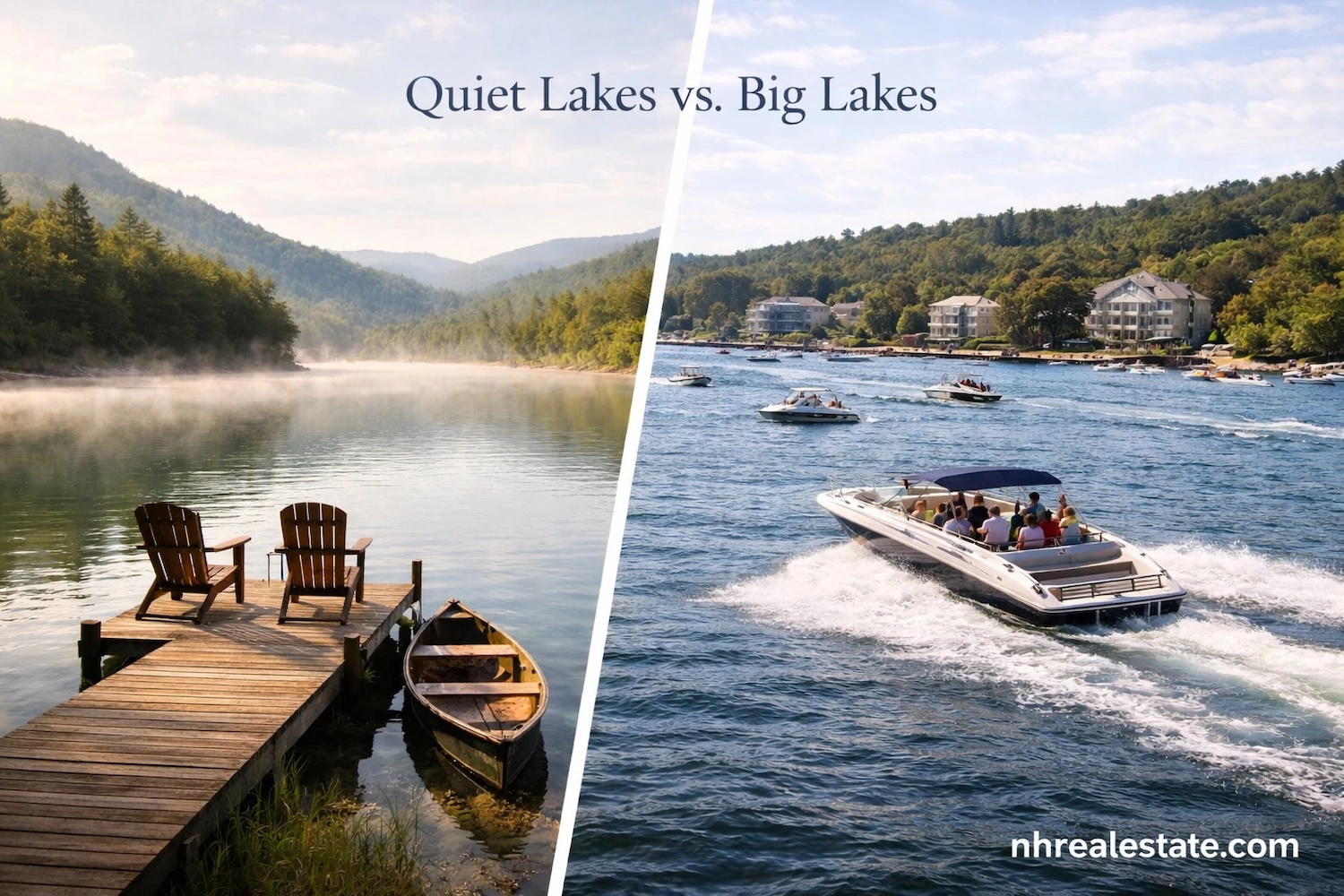
The Two Sides of New Hampshire’s Lakefront Market
New Hampshire is home to more than 1,000 lakes and ponds, but for buyers seeking waterfront property, not all lakes are created equal. The Granite State’s lakefront market splits broadly into two worlds: the big, high-profile lakes—Winnipesaukee, Squam, Sunapee—where median sale prices now range from $2.2 million to $5.9 million, and the quieter, lesser-known bodies of water where a waterfront home can still be found for under $700,000. The lifestyle on each is dramatically different, and so are the long-term financial realities of ownership.
With New Hampshire’s statewide median single-family home price reaching a record $535,000 in 2025 and waterfront inventory hovering near historic lows, understanding the tradeoffs between a prestigious address on a major lake and a peaceful retreat on a smaller one has never been more important. This guide breaks down the costs, regulations, tax implications, and day-to-day experience of each so you can decide which kind of lake life fits your goals.
Defining “Big Lakes” and “Quiet Lakes” in New Hampshire
When we refer to New Hampshire’s big lakes, we mean the handful of large, well-known bodies of water that anchor the state’s tourism economy and command the highest waterfront premiums. Lake Winnipesaukee is the clear headliner at 72 square miles and over 250 miles of shoreline, surrounded by towns like Wolfeboro, Meredith, Moultonborough, Laconia, and Gilford. Squam Lake—made famous as the filming location for On Golden Pond—covers about 6,800 acres across Holderness, Center Harbor, Sandwich, and Moultonborough. Lake Sunapee, at roughly 4,100 acres, anchors the Dartmouth-Lake Sunapee region and draws buyers from both Boston and the Upper Valley.
Quiet lakes, by contrast, are the dozens of smaller ponds and lakes scattered across every corner of the state. Some are well-regarded but less developed—Newfound Lake, known as one of the cleanest lakes in New Hampshire, or Ossipee Lake in the foothills of the White Mountains. Others are truly under the radar: Crystal Lake in Enfield, Pleasant Lake in New London, Halfmoon Lake in Alton, Pine River Pond in Wakefield, or Webster Lake in Franklin. Many of these bodies of water carry state-imposed horsepower limits or complete motorboat bans, which is precisely what attracts a certain kind of buyer.
The Price Gap: What Waterfront Actually Costs on Each
The cost difference between big-lake and quiet-lake waterfront is substantial and has widened considerably since 2020. Here’s where median sale prices stood as of the most recent full-year data:
- Lake Winnipesaukee: $2,750,000 median sale price in 2025, based on 85 closed transactions. Current listings carry a median ask of $3,225,000, with the most coveted properties in Wolfeboro and Moultonborough regularly exceeding $5 million.
- Squam Lake: $5,900,000 median sale price in 2025, though this figure reflects an extremely low volume of just five sales. Squam’s exclusivity and limited inventory push prices to the highest tier in the state.
- Lake Sunapee: $2,175,000 median sale price in 2024 (14 waterfront sales), down from $2,700,000 in 2023 as buyers grew more selective and days on market rose from 11 to 44.
- Lake Winnisquam: $1,800,000 median in 2025, based on four sales. Winnisquam is often described as Winnipesaukee’s more affordable neighbor, though that description requires some context at today’s prices.
- Newfound Lake: $1,120,000 median sale price in 2024, down roughly 19% from 2023. Newfound is highly regarded for water clarity, with pricing that sits meaningfully below the big three.
- Ossipee Lake: Waterfront sales have been extremely limited, with recent transactions ranging from $715,000 to $915,000. The lake’s more rural Carroll County location keeps prices accessible compared to Belknap and Grafton County lakes.
For buyers with a budget in the $400,000 to $800,000 range, the quiet-lake market opens doors that the big lakes have essentially closed. Smaller ponds and lakes in towns like Wakefield, Barnstead, Pittsfield, and Gilmanton still occasionally see waterfront properties trade in that range, particularly for seasonal cottages or homes with deeded beach access rather than direct frontage.
Property Taxes: How Location Shapes Your Annual Bill
New Hampshire funds its public services almost entirely through property taxes—there’s no state income tax and no sales tax—so understanding the tax rate in your lakefront town is critical to calculating true ownership costs. Property taxes are calculated as assessed value divided by 1,000, then multiplied by the local tax rate. Waterfront properties carry naturally higher assessed values due to location premiums, so even in a low-rate town, the dollar amount can be significant.
Tax rates vary dramatically across lake towns. In Belknap County, which runs along the western shores of Lake Winnipesaukee, the average effective property tax rate of roughly 1.12% is among the lowest in New Hampshire, and the typical homeowner pays around $4,827 per year. Moultonborough, home to the highest concentration of Winnipesaukee waterfront, benefits from a broad tax base of high-value lakefront properties, which helps keep the per-thousand rate manageable.
Quiet-lake towns present a more varied picture. Some, like Hebron and Bridgewater near Newfound Lake, carry rates as low as $10 per $1,000 of assessed value. Others, particularly in northern Coos County or more rural Sullivan County towns, may have higher rates that offset any savings on purchase price. A $500,000 home in a town with a $25-per-thousand rate costs $12,500 per year in property taxes, while a $2,000,000 home in a $12-per-thousand town costs $24,000. The big-lake home costs more in absolute dollars, but the quiet-lake home may actually carry a higher effective tax rate as a percentage of value.
Reassessments pose a particular risk for waterfront owners on any lake. When municipalities conduct their periodic revaluations—typically every five years—waterfront properties often see the steepest increases. Owners on Lakes Region forums have reported assessed values that doubled in a single cycle, pushing annual tax bills from $8,600 to over $15,000. Homeowners who believe their assessment is too high can file an abatement request with their municipality by March 1 of the tax year under RSA 76:16.
Boating, Motors, and Lake Regulations
The regulatory environment on the water is one of the starkest differences between big lakes and quiet lakes, and for many buyers, it’s the deciding factor.
New Hampshire’s big lakes are essentially open water. Lake Winnipesaukee allows motorboats of any horsepower, with a prima facie speed limit of 45 mph during daylight hours and 30 mph from half an hour after sunset to half an hour before sunrise. Squam Lake is somewhat more restrained, with a 40 mph daytime speed limit and 20 mph at night. Lake Sunapee also permits motorboats without horsepower restrictions, though local ordinances govern wake zones and proximity to shore. On all three, you’ll share the water with ski boats, pontoons, jet skis, and sailboats throughout the summer season.
Quiet lakes tell a very different story. The NH State Police Marine Patrol maintains a detailed list of restricted bodies of water, and the restrictions range from moderate to absolute:
- Horsepower caps: White Oak Pond in Holderness and Lees Pond in Moultonborough limit motors to 7.5 HP. Bradley Lake in Andover caps petroleum-powered motors at 30 HP. Garland Pond in Moultonborough restricts all power to electric motors of 5 HP or less.
- Complete motor bans: Bear Pond in Alton, Berry Pond in Moultonborough, and Mount William Pond in Weare prohibit motorboats entirely.
- Speed-restricted lakes: Back Lake in Pittsburg and Bearcamp Pond in Sandwich limit motorboats to 10 mph.
- White Mountain National Forest waters: All streams and lakes within the national forest boundaries prohibit mechanically powered boats, with limited exceptions.
For buyers who envision weekends of kayaking, paddleboarding, fishing from a canoe, or swimming in water undisturbed by boat wakes, these restrictions aren’t limitations—they’re the entire point. For families who want to waterski, wakeboard, or cruise the lake in a 24-foot bowrider, a restricted lake would be a poor fit.
Privacy, Density, and the Day-to-Day Experience
The lifestyle contrast between big-lake and quiet-lake living extends well beyond what happens on the water. Lake Winnipesaukee’s shoreline is densely developed, particularly in the southern basin around Laconia, Gilford, and Weirs Beach. Summer weekends bring tourist traffic, crowded boat launches, and the bustle of resort-town commerce. Wolfeboro and Meredith offer walkable downtowns with restaurants, shops, and cultural amenities, but they also come with the noise and congestion that accompanies a thriving tourism economy. The annual Laconia Motorcycle Week, which draws over 300,000 visitors, transforms the area for nine days each June.
Squam Lake is the exception among big lakes. Its shoreline is heavily protected through conservation easements held by the Squam Lakes Conservation Society, and development is tightly controlled. This explains the scarcity of listings—properties on Squam simply don’t come to market often—and the eye-watering prices when they do.
Quiet lakes, by nature, offer the opposite experience. A home on Ossipee Lake or Pleasant Lake means fewer neighbors, less boat traffic, darker night skies, and the kind of silence that urban refugees specifically seek. Many smaller lake communities have active, close-knit associations that maintain shared beaches, manage water quality testing, and organize modest social events—a potluck supper rather than a waterfront gala. The tradeoff is fewer nearby amenities: no lakeside restaurants, no marinas with fuel docks, and often a 20- to 30-minute drive to the nearest grocery store.
For year-round residents, this distinction matters even more in winter. Big-lake towns like Wolfeboro and Meredith maintain services and businesses through the off-season. Many quiet-lake communities thin out dramatically after Columbus Day, with seasonal cottages shuttered and road maintenance reduced. If you plan to live lakeside full-time, make sure the town’s infrastructure supports year-round occupancy.
Water Quality and Environmental Stewardship
New Hampshire’s lakes benefit from relatively strong environmental protections, but water quality varies by lake and is closely tied to development density and motorboat activity.
Newfound Lake consistently ranks among the cleanest lakes in New Hampshire, with exceptional water clarity attributed in part to the Newfound Lake Region Association’s aggressive invasive-species monitoring and the lake’s relatively low level of motorized traffic. Squam Lake also maintains exceptional water quality, supported by stringent development controls and active conservation efforts.
Lake Winnipesaukee’s water quality remains good overall, but the volume of boat traffic—including two-stroke engines that release fuel into the water—and shoreline development create greater pressure on the ecosystem. Cyanobacteria blooms, while still uncommon, have been reported with increasing frequency on sections of Winnipesaukee and other heavily used lakes during warm summers.
For buyers who prioritize pristine water—whether for health reasons, aesthetic preference, or simply the joy of swimming in crystal-clear conditions—smaller, motor-restricted lakes often deliver a measurably superior experience. NH DES monitors lake water quality through the Volunteer Lake Assessment Program (VLAP), and transparency readings for restricted lakes frequently exceed those of their larger, busier counterparts.
Insurance and Waterfront-Specific Costs
Waterfront homeowners face insurance costs that inland buyers don’t encounter. A standard HO-3 homeowners policy for a lakefront property in New Hampshire typically runs higher than a comparable inland home due to water damage risk, and many carriers require supplemental coverage.
Flood insurance is a particular consideration. Properties in FEMA-designated flood zones along lakeshores require flood insurance if they carry a federally backed mortgage. Annual flood insurance premiums in New Hampshire range from approximately $1,000 to $1,700 depending on elevation, proximity to shore, and the property’s flood zone classification. Properties on smaller, higher-elevation ponds are less likely to fall within mapped flood zones, which can mean meaningful savings.
Big-lake properties often carry additional costs related to docks, boathouses, and marine infrastructure. A seasonal dock on Winnipesaukee might cost $3,000 to $10,000 to install and maintain, while a permanent crib dock or boatlift can run $15,000 to $40,000. On a quiet lake where you’re launching a canoe from a shoreline clearing, these expenses simply don’t exist.
Rental Income Potential
If offsetting ownership costs through short-term rentals is part of your plan, the big lakes hold a clear advantage. Lake Winnipesaukee waterfront homes can generate $15,000 to $25,000 or more in seasonal rental income during the peak summer weeks from late June through Labor Day. Wolfeboro, Meredith, and Weirs Beach properties with docks and lake access are in high demand on vacation rental platforms.
Quiet-lake properties can also generate rental income, but the demand is more modest and the nightly rates lower. A well-maintained cottage on a lesser-known lake might bring in $5,000 to $10,000 for the season, depending on the property’s condition and proximity to other attractions like hiking trails or ski areas. Properties near the White Mountains or in the Mount Monadnock region can perform well across multiple seasons, not just summer.
Keep in mind that several New Hampshire towns have enacted or are considering short-term rental regulations. Check local ordinances before factoring rental income into your purchasing math. Some lakefront communities have covenants that restrict or prohibit short-term rentals entirely.
Investment Trajectory: Appreciation and Resale
Over the past five years, big-lake waterfront has appreciated at an extraordinary pace. Lake Winnipesaukee’s median sale price roughly doubled between 2020 and 2025, driven by pandemic-era migration, remote-work flexibility, and constrained inventory. Squam and Sunapee followed similar trajectories, though with far fewer data points due to limited transaction volume.
Heading into 2026, market observers expect price growth to moderate but not reverse. Some major price reductions are already appearing on listings where sellers overshot the market, and days on market are lengthening—Winnipesaukee listings now average 66 days compared to single-digit days at the market’s peak. Mortgage rates hovering between 5.7% and 6.4% are keeping some buyers on the sidelines, but inventory remains tight at roughly two months’ supply statewide.
Quiet-lake properties have appreciated as well, though from a lower base and with less dramatic gains. Their resale market is inherently thinner: fewer buyers are searching for waterfront on a lake they may never have heard of, and the pool of comparable sales for appraisals is slim. This can work in your favor on the buy side—less competition and more negotiating leverage—but it may slow your exit if you need to sell quickly. Properties on well-known quiet lakes like Newfound tend to hold value more reliably than those on truly obscure ponds.
Seasonal vs. Year-Round Considerations
Many quiet-lake properties were originally built as seasonal camps—simple structures on concrete-block foundations with minimal insulation, well water, and aging septic systems. Converting a seasonal cottage to a year-round residence involves meaningful cost: insulation and weatherization ($15,000 to $40,000), heating system installation ($8,000 to $20,000), septic system upgrade ($9,000 to $26,000 for replacement, with an average of $12,000 to $15,000), and potentially well drilling or water treatment ($3,750 to $15,300 for a new well).
Big-lake properties are more likely to already be year-round homes, particularly in established towns like Wolfeboro, Meredith, and Sunapee. However, even on Winnipesaukee, plenty of older cottages exist that would require substantial investment to convert to four-season use. In either case, buyers should budget for a thorough inspection that covers the septic system, well water quality (including testing for arsenic, radon, and PFAS), structural integrity, and insulation.
Who Should Buy on a Big Lake?
Big-lake waterfront makes sense for buyers who want a fully realized lakefront lifestyle with social activity, boating, dining, and tourism-town amenities within walking or boating distance. It’s ideal for families with teenagers who want to waterski and tube, for buyers who plan to generate rental income, and for those who view their lakefront property as a long-term investment with strong resale fundamentals. You’ll pay more upfront, carry higher annual costs, and share the water with hundreds of other boaters—but you’ll own a piece of New Hampshire’s most iconic real estate.
Who Should Buy on a Quiet Lake?
Quiet-lake waterfront is for buyers who prioritize peace, privacy, and a genuine escape from noise and crowds. It appeals to paddlers, anglers, bird-watchers, swimmers, and families with young children who want a safe, calm water environment. It’s also the more accessible entry point for buyers whose budget doesn’t extend to seven figures, or for those who’d rather invest in the property itself than in the prestige of the address. You’ll sacrifice convenience and rental income potential, but you’ll gain the kind of solitude that’s becoming increasingly rare in southern New Hampshire.
Finding the Right Lake with Bean Group
Whether you’re drawn to the energy of Winnipesaukee or the stillness of a motor-restricted pond in the foothills, the right waterfront purchase starts with understanding what each lake actually delivers on a Tuesday in October, not just a Saturday in July. Bean Group’s agents live and work across New Hampshire’s lake communities and can help you evaluate not just the property, but the lake itself—its regulations, water quality, tax environment, and long-term market dynamics. Reach out to Bean Group to start exploring the lake that fits your life.