New - 1 Hour Ago





|
There are very few places in New Hampshire where you can walk out your front door, grab a coffee, browse a bookshop, eat dinner at a nationally recognized restaurant, and catch a live show — all without getting in your car. Downtown Portsmouth is one of them. And within downtown, the South End and Bow Street corridor represent the most desirable blocks in the entire city.
This article is a deep dive into what it's actually like to live in the South End and along Bow Street — the real estate, the lifestyle, and the trade-offs that come with choosing the most walkable address on the New Hampshire seacoast.
The South End is loosely defined as the area south of Market Square, stretching from State Street and Pleasant Street down through Marcy Street to the Prescott Park waterfront. Bow Street runs parallel to the Piscataqua River, connecting the commercial heart of downtown to the working wharves and the Ceres Street dining row. It's a compact area — you can walk end to end in about ten minutes — but it packs an outsized amount of Portsmouth's cultural and residential identity into those few blocks.
The streets here are a living catalog of American architecture. Federal-era mansions on Pleasant Street sit a short walk from the brick commercial buildings on Market Street that have been reimagined as condominiums and loft spaces. The oldest structures in the neighborhood predate the American Revolution, while some of the condo conversions are less than twenty years old.
The downtown core — State Street, Market Street, Bow Street, Congress Street, Pleasant Street, and the surrounding side streets — accounts for roughly 853 properties with a median assessed value just over $1 million. That number can be misleading, though, because the range here is enormous. Studio condos on Congress Street trade in the mid-$300Ks, while the grand single-family homes along Pleasant Street and the South End can command $3M to $5M or more.
Condominiums dominate the housing stock — about 522 of the 853 properties downtown are condos, many of them carved from historic commercial buildings and converted warehouses. Single-family homes are genuinely rare, with only about 157 in the entire downtown area, which is why they tend to sell quickly and at premium prices when they do come to market.
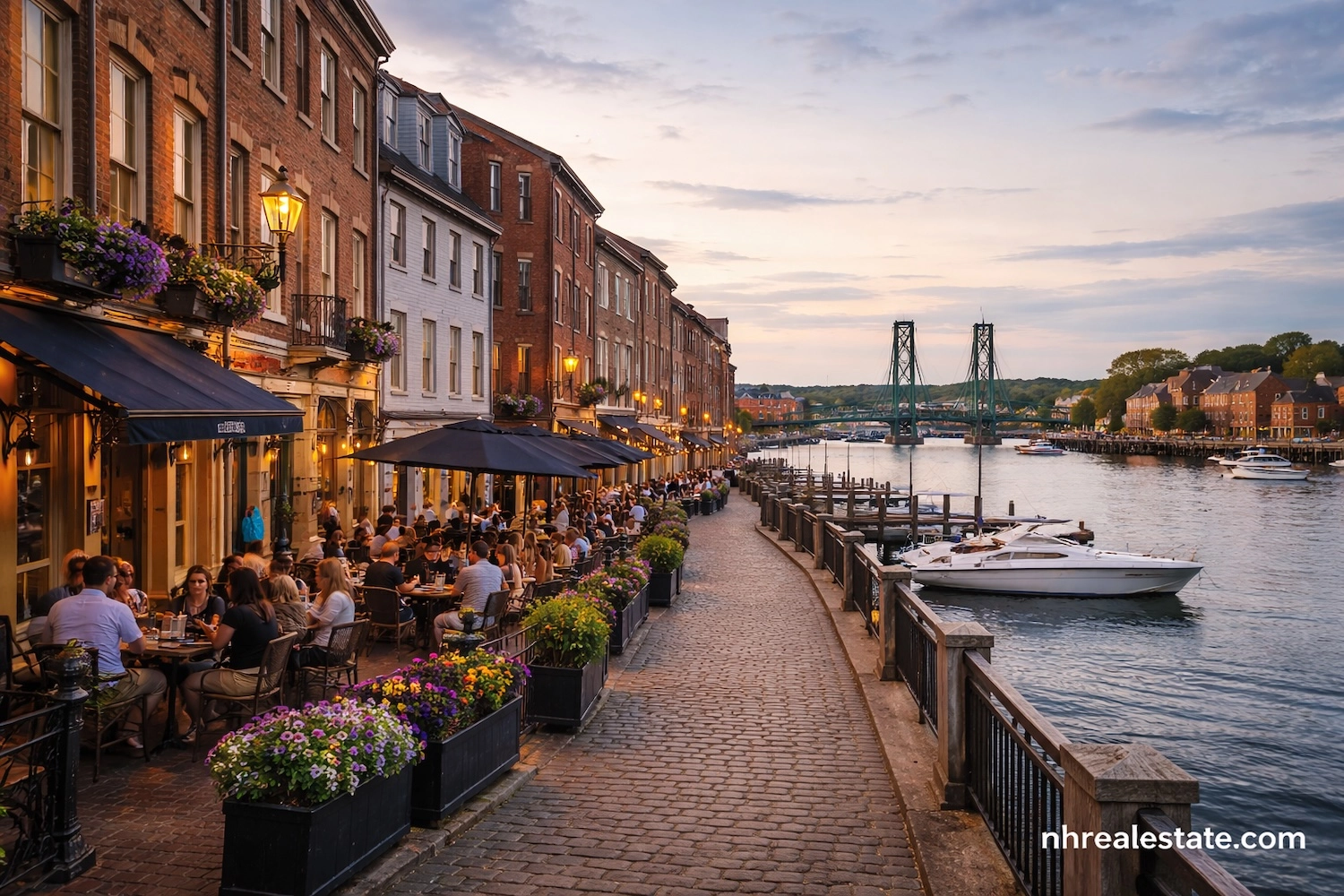
Bow Street deserves its own section because it occupies a singular position in the Portsmouth market. With 64 properties and a median value near $1.48M, this short stretch along the river blends residential living with some of the city's best dining, galleries, and the historic Music Hall. The 44 condo units on Bow Street tend to be larger and more upscale than typical downtown condos, many offering direct water views across to Kittery, Maine.
The appeal of Bow Street is the combination of waterfront setting, walkability, and cultural access that's essentially impossible to replicate anywhere else in the region. The trade-off is price — and the fact that living above a restaurant district means summer weekends can be lively late into the evening.
Running along the southern waterfront, Marcy Street (57 properties, median value $1.17M) is where the South End transitions from commercial downtown into a quieter residential character. Prescott Park — one of the most photographed public spaces in New England — sits at the heart of this stretch, and living near it means summer concerts, waterfront gardens, and a front-row seat to the annual Prescott Park Arts Festival.
The housing along Marcy Street is a mix of historic single-family homes, some of Portsmouth's most architecturally significant properties, and newer condo developments. It's one of the few streets in the South End where you can find homes with actual yards — small by suburban standards, but meaningful by downtown metrics.
People don't buy in the South End for the square footage or the lot size. They buy for the lifestyle. And that lifestyle is genuinely distinctive: a walkable, independent-business-driven, culturally rich small city that punches well above its weight.
Within a five-minute walk of most South End addresses, you'll find the restaurants along Ceres Street, the independent shops on Congress and Market, the Seacoast Repertory Theatre, Prescott Park, and the Portsmouth Harbor Trail. The South End is also where the city's gallery scene is concentrated, particularly along Market Street and around the Button Factory building.
The food scene alone is a draw. Portsmouth has an extraordinary density of acclaimed restaurants for a city its size, and the South End / Bow Street area is the epicenter. Whether that's a draw or a nuisance depends on your tolerance for weekend foot traffic and the occasional live music drifting through your windows on a summer Saturday.
Parking is a real consideration. Most downtown properties have limited or no dedicated parking. Street parking is metered and time-limited in many areas, and a residential parking permit doesn't guarantee a spot close to home. Some condo buildings include garage spaces, but they add significantly to the purchase price. If you need two cars, this is a meaningful constraint.
The investor presence is significant. Only about 35% of downtown properties are owner-occupied. The remaining 65% are owned by investors, second-home buyers, or LLCs. This affects the community dynamic — fewer year-round neighbors, more short-term rental activity, and a different feel in the off-season compared to the bustling summer months.
Historic properties require informed buyers. With a median build year of 1900, most properties here come with the maintenance realities of historic construction: older mechanicals, potential lead paint and asbestos considerations, and the occasional structural surprise during renovation. A thorough inspection — ideally with an inspector experienced in historic buildings — is essential.
Lot sizes are tiny. If outdoor space matters to you, understand that downtown lots are a fraction of what you'd get in the suburban neighborhoods. Many condos have no private outdoor space at all beyond a balcony or shared courtyard.
The South End is ideal for buyers who prioritize walkability, cultural access, and a low-maintenance lifestyle over space and privacy. It works particularly well for people who are downsizing from larger homes and want to trade a lawn mower for a restaurant reservation. It also attracts buyers relocating from cities like Boston, Portland, or New York who want a small-city version of the urban lifestyle they're accustomed to.
It's less ideal for buyers who need significant indoor or outdoor space, dedicated parking for multiple vehicles, or a quiet residential setting. The energy that makes the South End appealing is the same energy that makes it less suited to buyers who want a peaceful retreat.
| Price Range | What You'll Find |
|---|---|
| $300K–$500K | Studio to 1-bedroom condos on Congress, Hanover, or upper State Street. Smaller units in older buildings. Parking typically not included. |
| $500K–$900K | Larger 1–2 bedroom condos with better finishes. Units in converted historic buildings. Some Bow Street and Marcy Street options at the upper end. |
| $900K–$1.5M | Premium condos with water views on Bow Street. Smaller single-family homes or townhomes on side streets. Some of the best condo stock in the city. |
| $1.5M–$3M+ | Historic single-family homes on Pleasant Street, State Street, or Marcy Street. Large waterfront condos. Properties with significant architectural detail and provenance. |
The South End and Bow Street represent the best of what downtown Portsmouth has to offer — and the premium that comes with it. With 155 properties valued above $2 million, this is the city's luxury epicenter. But the range of condo options means the area isn't exclusively for high-end buyers; there are meaningful entry points in the $300K–$500K range for those willing to trade space for location.
If you're considering the South End, the best advice is to spend time there before you buy — walk the streets on a quiet Tuesday morning and a busy Saturday evening. The neighborhood delivers a very different experience depending on the season and the day of the week, and the buyers who are happiest here are the ones who went in with their eyes open about what the lifestyle actually entails.
This article is one of 13 in-depth neighborhood profiles based on our analysis of 9,324 property records in Portsmouth, NH. Read the full Portsmouth NH Neighborhoods Guide →
Related Articles
Historic Homes in Portsmouth NH: What Buyers Need to Know → Condo vs. House in Portsmouth: Which Is Right for You? → Portsmouth NH Neighborhoods Guide →We are committed to compliance with all federal, state, and local fair housing laws. We do not discriminate against any person because of race, color, religion, sex, handicap, familial status, national origin, age, marital status, sexual orientation, or gender identity. All neighborhoods in Portsmouth are open to all persons.