


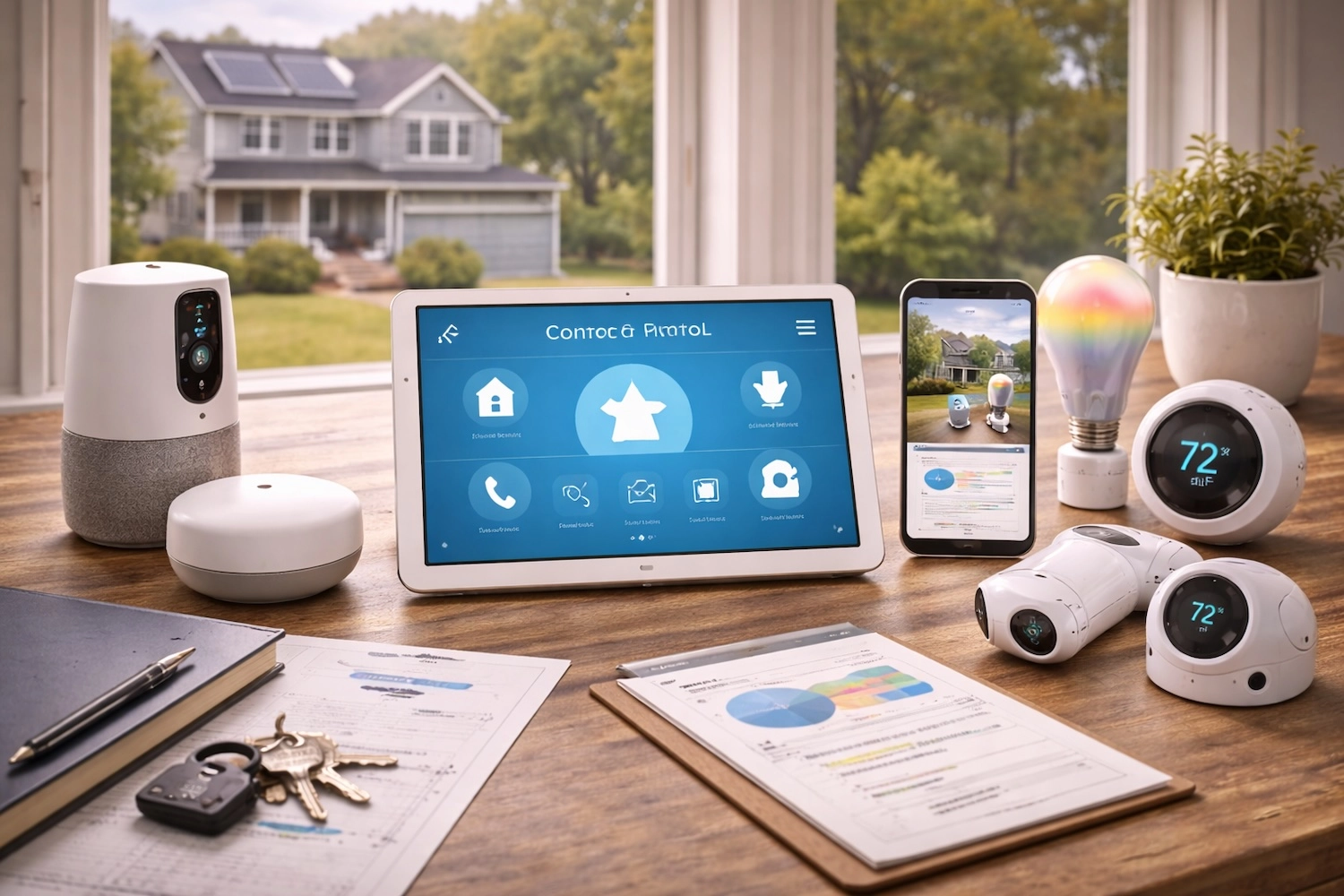
Smart Home Technology in New Hampshire: Comprehensive Guide to Security, Energy Efficiency & Property Value
The New Hampshire luxury real estate market is experiencing unprecedented adoption of smart home technology, driven by both immediate lifestyle benefits and significant property value enhancements. As of 2026, over 57% of U.S. households have adopted at least one smart home device, with adoption rates reaching 59% nationally and expected to accelerate further. For discerning New Hampshire homeowners evaluating properties or planning upgrades, understanding current smart home technology landscape is essential to maximizing both comfort and investment returns.
From the rolling hills of Hanover to the coastal elegance of Portsmouth, affluent New Hampshire homeowners are integrating cutting-edge smart home systems into properties with median values around $535,000. This integration transcends simple gadgetry—it represents a fundamental shift toward creating sophisticated living environments that enhance security, streamline daily operations, optimize energy consumption, and align with sustainability values.
The Current Smart Home Market: Scale and Growth
The global smart home market reached $147.52 billion in 2025 and is projected to grow to $180.12 billion in 2026, with forecasts extending to $848.47 billion by 2034, representing a compound annual growth rate of 21.40%. Within the United States specifically, the smart home market is projected to expand from $34.7 billion in 2023 to $55 billion by 2028.
The typical smart home environment now contains 15 to 20 connected devices, reflecting a significant shift from just five years ago. This expansion demonstrates that smart home technology has moved beyond novelty status to become integrated infrastructure in modern luxury properties. For New Hampshire homeowners, this acceleration in adoption means more mature product ecosystems, better interoperability, and stronger competitive pricing.
Enterprise-Grade Security Solutions for New Hampshire Properties
Security represents the top consumer priority in smart home adoption, with 55.9% of homeowners citing safety and security as their primary motivation. Leading platforms including ADT Command, Vivint, and Ring Alarm Pro now offer comprehensive systems that integrate multiple security layers into unified, intuitive interfaces.
Current Pricing for Enterprise Systems (2026):
- ADT Home Security: Equipment costs range from $325 to $1,500, with professional installation averaging $99. Monthly monitoring ranges from $28 to $60+, typically under a 1-3 year contract.
- Vivint Home Security: Equipment and installation typically cost $700 to $1,800, with monthly monitoring fees from $29 to $50. Vivint requires professional installation.
- Ring Alarm Pro: Ring's Active Guard Outdoor Protection plan costs $99 per month, representing a premium option for comprehensive video monitoring.
Modern smart security extends far beyond traditional alarm systems. Advanced cameras with 4K resolution and night vision provide crystal-clear monitoring of expansive properties, whether managing a lakefront estate in Wolfeboro or a mountain retreat in North Conway. Artificial intelligence-powered facial recognition technology can distinguish between family members, guests, and potential threats, sending customized alerts accordingly.
Smart locks from August, Yale, and Schlage represent a critical evolution in access control. These systems offer temporary access codes for service providers, automatic locking when inhabitants leave the property, and seamless integration with smart doorbells for comprehensive entry management. For high-end New Hampshire properties, biometric access control systems provide ultimate security while enhancing convenience—eliminating physical keys entirely while maintaining detailed audit trails of all property access.
Perimeter monitoring has become increasingly sophisticated, with smart sensors that differentiate between wildlife activity, weather events, and human presence. This distinction is particularly valuable for New Hampshire's rural luxury properties, where false alarms from deer or weather-triggered motion detection were historically common concerns.
Energy Efficiency and Smart Climate Control in Cold Climates
Environmental comfort represents the second priority for smart home adopters, with 36.6% of homeowners citing it as a key consideration. Smart thermostats deliver particularly strong performance in New Hampshire's demanding climate, where heating represents a significant annual expense.
Energy Savings Quantified: Research from ENERGY STAR and independent studies demonstrates that smart thermostats deliver measurable savings in cold climates:
- Average savings of approximately 8% of heating and cooling bills annually
- Heating-specific savings of 10-12% in typical installations
- Winter heating reductions reaching 10-23% annually for homes with high heating demands
- For a home spending $2,500 annually on heating (typical for NH), smart thermostat optimization could generate $250-$575 in annual savings
Leading platforms including Nest, Ecobee, and Honeywell offer room-by-room temperature management, humidity control, and integration with weather forecasting to proactively adjust settings. This is particularly valuable for large New Hampshire properties with varying sun exposure and multiple thermal zones.
Winter-Specific Smart Thermostat Features: Cold climate smart thermostats calculate extended heat-up times required in extreme cold and adjust heating cycles accordingly, preventing wasted energy while maintaining comfort. Vacation mode automatically maintains minimum temperatures to prevent catastrophic pipe freezing while maximizing savings when properties are unoccupied. For seasonal New Hampshire properties, this feature is invaluable for preventing winter damage.
Smart lighting systems from Lutron and Philips Hue provide particular advantages during New Hampshire's lengthy winter months. These systems automatically adjust color temperature throughout the day to support natural circadian rhythms and combat seasonal affective disorder by gradually increasing illumination during darker periods. Users report both improved mood regulation and reduced energy consumption through optimized lighting schedules.
Backup Power and Resilience for New Hampshire's Weather Challenges
New Hampshire experiences regular power disruptions from ice storms, heavy snow, high winds, and other severe weather. Trees and vegetation in close proximity to electrical infrastructure represent the leading cause of power outages. Smart home systems require backup power infrastructure to maintain critical functions during extended outages.
Essential Backup System Features for NH Properties:
- Smart home panels with battery backup that detect outages in 10 milliseconds and switch to battery power automatically
- Cold-weather rated batteries with internal heaters that function below freezing temperatures
- Weather-responsive charging that automatically charges battery systems to full capacity before storms arrive
- Freeze-prevention monitoring that prioritizes heating system power during winter outages to protect pipes
- Generator integration that automatically activates backup generators when battery capacity reaches critical levels
This resilience infrastructure is especially critical for New Hampshire's seasonal properties and homes in rural areas where outages may persist for extended periods. A properly configured backup system ensures that heating systems, security infrastructure, and water pumping systems remain operational throughout outages.
Renewable Energy Integration and Sustainability
Environmental responsibility now ranks as a significant priority among affluent homeowners, with 38.8% of adopters citing air and water quality concerns as important considerations. Solar integration systems from Tesla, Enphase, and SolarEdge offer seamless connectivity between solar panels, battery storage, and home energy management systems.
Smart energy monitoring provides real-time insights into power consumption patterns, identifying opportunities for efficiency improvements. These systems automatically shift energy usage to times when renewable generation is highest or utility rates are lowest, significantly reducing both environmental impact and operating costs. For New Hampshire properties with solar installations, integrated monitoring can optimize self-consumption rates and maximize utility bill reductions.
Water management technology has become particularly relevant for New Hampshire properties with private wells or lake access. Smart irrigation systems from Rain Bird and Hunter adjust watering schedules based on weather forecasts, soil moisture levels, and plant-specific needs, while leak detection systems immediately alert homeowners to plumbing issues, preventing costly water damage and waste.
Smart Home Device Adoption and Consumer Preferences
Among smart home adopters, device adoption patterns reveal clear priorities:
- Smart televisions and displays: 70% of smart homes (most widely adopted category)
- Home security cameras: 66% of smart homes
- Sound systems and speakers: 57% of smart homes
- Doorbells and door cameras: 52% of smart homes
- Smart thermostats: 34% of smart homes
- Smart lights and light controllers: 31% of smart homes
- Access control and recognition systems: 25% of smart homes
This distribution demonstrates consumer focus on security and entertainment first, with energy management and climate control following. For New Hampshire properties targeting affluent buyers, comprehensive security systems combined with entertainment infrastructure and energy management represents optimal market positioning.
Property Value Impact and Return on Investment
Smart home technology delivers substantial property value enhancement, making it one of the most attractive residential upgrades for New Hampshire homeowners.
Documented Property Value Increases:
- General market increase: 3-5% property value enhancement through quality smart home integration
- Specific monetary example: On a $500,000 New Hampshire home (near the state median of $535,000), smart technology integration could increase value by $15,000 to $25,000
- Rental market premium: Smart apartments command 20% higher rental rates, with 86% of millennial renters willing to pay premiums for smart features
- Sales velocity: In competitive markets, homes with smart technology have 40% greater probability of selling quickly at premium prices
- Multifamily ROI: Smart home technology creates average ROI of 30% in multifamily property contexts
Return on investment is typically recouped through utility savings within 5-7 years, after which enhancements represent pure property value appreciation. Combined with immediate lifestyle improvements and increased marketability, smart home integration represents one of the most effective property enhancement strategies available to New Hampshire homeowners.
Advanced Health, Wellness, and Air Quality Systems
Air and water quality concerns rank as important considerations for 38.8% of smart home adopters. Advanced air quality systems monitor and automatically adjust filtration, humidity, and circulation to maintain optimal indoor environments. Companies like Molekule and IQAir offer smart purification systems particularly valuable during New Hampshire's high pollen seasons or when wildfire smoke drifts from other regions.
Sleep optimization technology represents another growing trend in luxury smart homes. Smart mattresses from brands like Sleep Number and Eight Sleep track sleep patterns, automatically adjust firmness and temperature, and integrate with other smart home systems to optimize bedroom conditions for rest and recovery. These systems appeal to affluent homeowners seeking to maximize wellness investments.
Voice Assistant Integration and Natural Control Interfaces
Voice control through Amazon Alexa, Google Assistant, and Apple HomeKit has matured significantly and now supports complex multi-room commands and customized routines. The global voice recognition market is growing from $10.7 billion in 2020 to projected $27.16 billion by 2026, with voice assistants expected to be used in 75% of American households by 2026.
Sophisticated voice control now enables complex scenarios: arriving at a Hanover estate and saying “Welcome home” simultaneously disarms the security system, adjusts lighting throughout the house, sets temperature to preferred evening settings, and begins playing favorite playlists. This level of sophistication has transitioned from novelty to expected functionality in luxury properties.
Entertainment and Lifestyle Enhancement Systems
Home theater technology has reached cinema-quality standards, with 8K projection systems, Dolby Atmos surround sound, and automated screening rooms becoming increasingly common in high-end New Hampshire properties. Integration with streaming services and smart home systems enables seamless entertainment experiences across multiple rooms.
Smart wine storage and home brewing systems cater to sophisticated tastes, with precise temperature and humidity control for wine cellars and automated brewing systems for craft beer enthusiasts. These systems monitor collections, suggest optimal serving times, and even reorder favorites automatically—catering to discerning homeowners who view such systems as lifestyle investments.
Whole-home intercom systems have evolved into sophisticated communication platforms supporting video calling between rooms, integration with smartphones for remote communication, and automatic announcements for arrivals or scheduled events. For large properties or multi-building estates, these systems ensure seamless communication across the entire property.
Professional Installation and Integration Services
Successful smart home implementation requires experienced professionals who understand both cutting-edge technology and the unique requirements of luxury New Hampshire properties. Look for certified installers with experience in leading brands including Control4, Savant, and Crestron, supported by strong references from comparable properties.
The best integration partners offer comprehensive services including system design, professional installation, programming, and ongoing support. They should design systems capable of growing and evolving with changing technology and homeowner preferences. For New Hampshire properties, installers experienced with historic structures and traditional architecture are particularly valuable, as they can integrate technology while maintaining architectural character.
Maintenance and Support Considerations: Smart home systems require ongoing maintenance and security updates to remain functional and protected. Professional support services can monitor systems remotely, apply security patches, and troubleshoot issues before they affect daily life. Many affluent homeowners opt for comprehensive service contracts including regular system health checks, seasonal adjustments for New Hampshire's dramatic climate changes, and priority support during system failures.
Cost Barriers and Market Accessibility
Despite strong growth, cost remains the primary barrier to smart home adoption, with 46% of current adopters and 52% of non-adopters citing cost as the main obstacle. However, rapidly decreasing equipment prices and wider product selection are improving accessibility. Entry-level smart home systems can now be installed for under $2,000, while comprehensive luxury installations may exceed $50,000.
For New Hampshire homeowners evaluating smart home investments, phased implementation strategies often make sense. Beginning with high-ROI categories including security systems, smart thermostats, and energy monitoring, then expanding to entertainment, convenience, and wellness systems as budgets allow.
Emerging Technologies and Future Innovation
The next wave of smart home technology will be driven by advanced artificial intelligence that learns and adapts to homeowner preferences without explicit programming. These systems will predict needs based on patterns, weather conditions, calendar events, and biometric data to create truly personalized living environments.
Predictive maintenance will become standard, with AI systems monitoring all connected devices and infrastructure to predict failures before they occur. For New Hampshire homeowners with seasonal properties, this technology will be invaluable for preventing issues during extended absences.
Emerging augmented reality technologies will transform how homeowners interact with their properties. Smart mirrors and surfaces will display information, control interfaces, and virtual artwork. Homeowners will visualize renovations, monitor property conditions, and access information simply by looking at connected surfaces throughout their homes.
Snow removal automation represents a particular opportunity for New Hampshire properties, with emerging robotic systems designed to handle significant snowfall automatically, clearing driveways and walkways without human intervention. Domestic robotics will expand beyond simple vacuum cleaners to comprehensive property maintenance systems.
Historic Property Considerations and Architectural Integration
Many luxury New Hampshire properties feature historic or traditional architectural styles requiring careful technology integration. Wireless systems often work better than hardwired solutions in these contexts, and careful attention to aesthetic integration ensures smart home technology enhances rather than detracts from architectural character.
Hidden wiring, concealed sensors, and discrete mounting systems allow properties to maintain traditional charm while gaining modern functionality. Professional installation teams experienced with historic properties can navigate unique challenges of integrating technology into older structures, preserving both functionality and historical integrity.
Connectivity Infrastructure and Rural Considerations
Rural and lakefront properties in New Hampshire may face connectivity challenges affecting smart home performance. Ensuring robust internet infrastructure through fiber connections where available, or high-quality satellite internet services, is essential for reliable system operation. Mesh networking systems can extend reliable connectivity throughout large properties, ensuring smart home devices function consistently whether in the main house, guest quarters, or outbuildings.
For properties in areas with limited broadband infrastructure, evaluating connectivity options before committing to extensive smart home systems is prudent. Local integrators can assess available options and recommend solutions appropriate for specific property locations.
Investment Strategies and Future-Proofing
The most valuable smart home investments are those built on open platforms capable of integrating new technologies as they become available. Systems relying on proprietary protocols or closed ecosystems may become obsolete more quickly than those based on industry standards.
Infrastructure investments including comprehensive networking, robust electrical systems, and flexible mounting solutions provide foundation for future technology upgrades without requiring major renovations. These foundational investments typically cost less upfront but deliver substantially greater long-term value.
Conclusion: Smart Living in the Granite State
Smart home technology has evolved from luxury novelty to essential infrastructure for discerning New Hampshire homeowners. Integration of advanced security, convenience, and sustainability features creates living environments adapting to granite state requirements while providing sophisticated functionality expected in luxury properties. With over 57% of U.S. households now adopting smart technology, and adoption rates accelerating, smart homes represent the defining residential market trend of the 2020s.
For New Hampshire homeowners considering smart home upgrades or evaluating technology features in luxury purchases, the investment in intelligent home systems represents commitment to enhanced security, unparalleled convenience, and environmental responsibility aligning perfectly with values and lifestyle expectations of the state's most discerning residents.
Bean Group | brokered by eXp Realty specializes in helping New Hampshire homeowners evaluate and implement smart home technology that aligns with their lifestyle goals and property investment strategies. Our experienced team understands both cutting-edge technology and the unique characteristics of New Hampshire's real estate market, from lakefront properties in Wolfeboro to mountain estates in North Conway. Contact Bean Group today to discuss how smart home integration can enhance your property's value, security, and sustainability.