


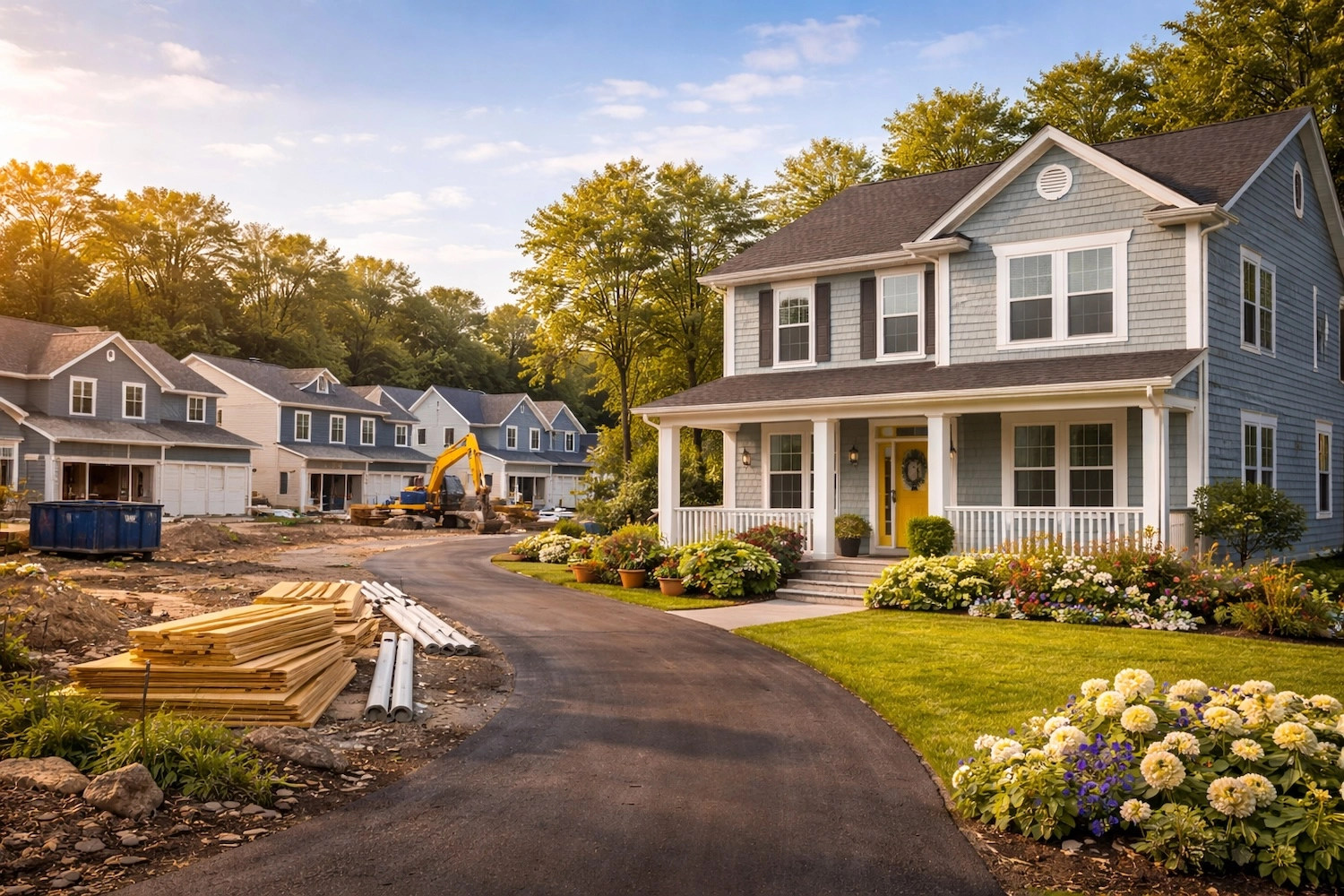
New construction homes are surging in popularity across New Hampshire—and for good reason. With the statewide median single-family home price hitting a record $535,000 in 2025 (a 3.9% increase over 2024, according to the New Hampshire Association of Realtors), inventory stuck at roughly two months’ supply, and an affordability index of just 58 (meaning the median household income covers only 58% of what’s needed to qualify for the median-priced home), many Granite State buyers are turning to new construction as a way to find the home they want in a market where resale options are scarce and fiercely competitive. Whether you’re drawn to the energy efficiency of a brand-new build, the ability to customize finishes, or the appeal of a low-maintenance home with modern systems and a builder warranty, understanding the new construction landscape in New Hampshire will help you make a smarter investment.
The New Construction Boom: What the Data Shows
New Hampshire’s building activity has reached levels not seen in nearly two decades. According to a February 2026 report from the state Department of Business and Economic Affairs, municipalities issued permits for 5,822 housing units in 2024—the highest annual total since 2005. That’s a meaningful acceleration: prior to the launch of the state’s $100 million InvestNH housing program, the average annual increase in permits over a 10-year period was just 9.5%. The majority of 2024 permits in Hillsborough, Rockingham, Strafford, Merrimack, and Grafton counties were for multi-family housing, a shift the state attributes largely to InvestNH funding from the federal American Rescue Plan Act.
Still, production hasn’t kept pace with demand. Since 2020, New Hampshire has added approximately 25,688 housing units—about 80% of the 32,704 units that NH Housing identified as necessary during that period to achieve a balanced market by 2040. To meet the state’s long-term goal, an additional 62,676 units are needed between now and 2040. Construction activity is concentrated in the Southern Tier and Seacoast, with Dover, Londonderry, Manchester, Rochester, and Portsmouth issuing the most building permits. Just over 20 towns and cities—home to roughly half of the state’s population—accounted for nearly two-thirds of all new housing built in 2025.
What’s Driving Demand for New Builds
Several forces are pushing buyers toward new construction in New Hampshire:
- Critically low resale inventory: With just two months’ supply of existing homes on the market statewide (compared to the national average of 4.3 months), many buyers simply cannot find a suitable resale home. Homes go pending in roughly 7 days on average according to Zillow, and 33.7% of homes sold above list price in December 2025 per Redfin data.
- Persistent in-migration: New Hampshire’s quality of life, absence of state income or sales tax, low crime rates, and proximity to Boston continue to attract residents from Massachusetts, Connecticut, and other neighboring states. U.S. News & World Report ranks New Hampshire fourth overall in its “Best States” ranking and first in the nation for low crime.
- Legislative zoning reforms: In 2025, Governor Kelly Ayotte signed 10 bipartisan bills aimed at loosening local zoning restrictions to encourage more construction. House Bill 577, effective July 1, 2025, expanded the state’s accessory dwelling unit (ADU) law to allow detached ADUs by right on any single-family lot—previously only attached units were permitted. House Bill 631 now requires towns to allow multi-family residential development in commercial zones, opening the door for mixed-use housing in downtown areas.
- Cost competitiveness: While new construction carries a higher upfront price, the math can be favorable when you consider what resale buyers typically spend on renovations, deferred maintenance, and energy inefficiency. The average New Hampshire home value is approximately $504,000 (Zillow), while new construction costs average $175–$300 per square foot for standard builds and $200–$350 per square foot for custom homes, excluding land and site work. A 2,000-square-foot new build at the $238/sq ft average comes to roughly $476,000 for construction alone.
Understanding New Construction Costs in New Hampshire
Building a new home in the Granite State involves several layers of cost that buyers need to understand before committing. Construction costs in 2025 typically break down as follows:
- Standard production builds: $175–$300 per square foot, depending on location, finish level, and builder
- Custom homes: $200–$350 per square foot for mid-range custom builds, and up to $400+ per square foot for high-end Seacoast custom homes with premium finishes
- Land costs: Vary dramatically by location—urban lots in Manchester, Nashua, and Portsmouth often exceed $100,000, while rural parcels may run $3,000–$25,000 per acre
- Site preparation: $1,500–$3,000 for clearing and grading on a straightforward lot, but substantially more in rocky or sloped terrain common in many NH locations
- Well and septic: Most rural and suburban lots require private systems, adding $15,000–$30,000 to the total budget
- Permits: Vary by municipality, but typically run up to $4,900
As a practical example, a 1,800-square-foot colonial with standard finishes might pencil out at approximately $330,000 for construction, plus $50,000 in allowances for cabinets, countertops, flooring, and fixtures, $25,000 for landscaping and exterior features, and $25,000 in contingency reserves—bringing the total budget (excluding land) to roughly $430,000–$610,000 depending on finish level and site conditions. Buyers building in the Seacoast or Southern Tier should budget toward the higher end of these ranges.
Types of New Construction
Not all new builds follow the same model. Understanding the differences helps you choose the right path for your timeline, budget, and level of involvement:
Custom Homes are designed and built entirely to a buyer’s specifications on their own lot. You’ll work with an architect (whose fees typically run 5%–15% of the total build cost), select every material and system, and oversee the project from permitting through certificate of occupancy. Custom homes offer maximum personalization but require the most time, coordination, and budget flexibility. Expect 9–12 months of construction, and sometimes longer when permitting, weather, or material delays arise.
Semi-Custom Homes are part of a planned community but still offer meaningful flexibility. You’ll choose from multiple floor plans and customize finishes, upgrades, and design packages. This approach balances personalization with the efficiency and cost predictability of working within a builder’s established system.
Production Homes are built by volume builders using standardized floor plans in larger developments. Customization is limited—typically you can choose from a handful of finish packages—but production homes are generally more affordable per square foot and move-in ready sooner than custom or semi-custom builds.
Spec Homes are built by a developer without a committed buyer, using popular finishes and floor plans designed to appeal to a broad audience. Purchasing a spec home is the fastest path to a brand-new home since construction is already underway or complete. In a market with two months’ inventory, spec homes can be especially attractive to buyers who need to move quickly.
Modular and Prefabricated Homes are built in sections at a factory and assembled on site. This method is gaining traction in New Hampshire for good reason: modular construction is typically 10–25% less expensive than comparable site-built homes, construction timelines are 40–50% shorter (often 3–4 months from factory to move-in versus 7–12 months for stick-built), and factory-controlled environments eliminate weather delays while producing tighter, more energy-efficient construction. Modular homes in NH are built to the same state building code as site-built homes and are not restricted by building or zoning regulations—they look and appraise like any other home. Several NH modular dealers serve the state, and factory-built homes are approximately 90% complete when set on the foundation, with final button-up taking one to two months.
Energy Efficiency and Building Codes
One of the strongest arguments for new construction is energy performance. New homes built to current codes are significantly more efficient than the average existing home in the state, which translates directly to lower monthly operating costs—an increasingly important factor as New Hampshire’s winters remain cold and energy prices fluctuate.
New Hampshire’s residential energy code is based on the 2018 International Energy Conservation Code (IECC), with the state Building Code Review Board voting to maintain this standard rather than adopt the more stringent 2024 IECC, citing concerns about construction cost impacts on housing affordability. The broader NH State Building Code was updated to the 2021 International Residential Code (IRC) and 2021 International Building Code (IBC) effective July 1, 2024, with additional amendments taking effect October 15, 2025.
In practice, new homes built to these standards feature better insulation values, tighter construction (verified by blower door testing at no more than 5 air changes per hour at 50 pascals), high-efficiency HVAC systems, and modern windows that collectively deliver energy savings estimated at 30–50% compared to older homes. Many builders go beyond code minimums by offering Energy Star certification, solar-ready roof designs, geothermal heating systems, and smart-home energy monitoring as standard or optional upgrades. These features not only reduce utility bills but also enhance long-term resale value in a market increasingly attuned to sustainability.
New Construction vs. Existing Homes: A Market Comparison
When deciding between a new build and an existing home, consider the full financial picture:
- Upfront cost: New construction typically costs more per square foot initially, but buyers avoid the immediate renovation, system replacement, and deferred maintenance costs that frequently accompany older homes. In a state where the median existing home price is $535,000, the gap between new and resale is narrower than many assume once you factor in typical post-purchase renovation expenses.
- Operating costs: New homes deliver measurably lower utility costs through modern insulation, windows, and mechanical systems. The difference can be substantial in New Hampshire’s climate zone, where heating is a major annual expense.
- Timeline: Existing homes close in roughly 30–60 days. New construction ranges from immediate (spec homes) to 9–12 months (custom builds) or 3–4 months for modular construction. In today’s tight market, many buyers find that waiting for a new build is more realistic than competing for the limited resale inventory available.
- Warranty protection: Reputable builders provide warranties covering structural defects (typically 10 years), mechanical systems (2 years), and workmanship (1 year). Some partner with third-party warranty companies for additional coverage. Existing homes offer no such protection beyond what a home inspection reveals.
- Customization: Existing homes require costly renovations to match your preferences. New builds let you choose layouts, finishes, and systems from the start—and upgrades selected during construction cost far less than equivalent after-the-fact renovations.
Financing New Construction
Financing a new build works differently from purchasing an existing home, and understanding the options is essential for budgeting:
Construction-to-Permanent Loans are the most common financing vehicle for new builds. These single-close loans cover both the construction phase and the permanent mortgage in one product, saving you from paying closing costs twice. During construction, you make interest-only payments on funds disbursed to date. Upon completion, the loan automatically converts to a standard mortgage. As of late 2025, construction loan interest rates in the NH market generally range from 6% to 8%, with construction-to-permanent 30-year rates in the 6.5%–7.5% range depending on creditworthiness. Several NH-based lenders specialize in these products, including St. Mary’s Bank, Merrimack County Savings Bank, Kennebunk Savings, Service Credit Union, and Lighthouse Credit Union.
Construction-Only Loans cover only the build phase and must be refinanced into a permanent mortgage at completion, which means two sets of closing costs and the risk that rates may change between closing dates. These loans are less common but may suit buyers who expect to pay cash at completion or who want to shop for the best permanent mortgage rate after the home is finished.
For standard purchase mortgages on completed new construction (spec homes or finished production homes), current New Hampshire rates as of late January 2026 average 6.19% for a 30-year fixed mortgage and 5.44% for a 15-year fixed, according to Bankrate. Most construction loans require 20–30% down, though some NH credit unions offer financing up to 90% of the construction cost or appraised value, with private mortgage insurance required above 80%.
Navigating the New Construction Process
Buying a new construction home involves several steps that differ from a typical resale purchase. Here’s how to approach each stage:
Research Builders and Communities. Explore builders’ portfolios, customer reviews, and completed projects. Visit model homes and active construction sites to evaluate workmanship firsthand. Check the builder’s financial stability—this affects warranty support and project completion. Ask for references from recent buyers and inquire about the builder’s subcontractor relationships, as quality and timeliness often depend on the trades the builder works with.
Set a Realistic Budget. Account for the full scope of costs: land, site preparation, construction, allowances, soft costs (surveys, architectural fees, permits), furnishings, landscaping, and a contingency reserve of at least 5–10% of the total project cost. Change orders after the contract is signed can be expensive—finalizing design selections early is one of the most effective ways to avoid cost overruns.
Evaluate the Lot Carefully. Lot selection influences sunlight exposure, privacy, drainage, and long-term property value. In New Hampshire, pay particular attention to soil conditions (rocky terrain is common and can dramatically increase excavation costs), well yield potential, septic system feasibility, and distance from utility connections. Corner and cul-de-sac lots often command premiums but provide extra space and fewer neighbors.
Hire Your Own Representation. Builder sales agents work for the builder. Hiring your own real estate agent ensures you have independent representation during contract negotiations, inspections, and closing. Similarly, engage a real estate attorney to review the builder’s contract, deposit schedules, completion timelines, and warranty terms before you sign.
Prioritize Smart Upgrades. Builder design centers offer extensive finish options, and it’s easy to overspend. Focus your upgrade budget on items that are difficult or expensive to change later: kitchen layout and cabinetry, hardwood flooring, energy-efficient windows, electrical outlet placement, and rough-in plumbing for future additions. Cosmetic items like light fixtures, window treatments, and appliances can often be sourced independently at lower cost after closing.
Monitor Construction and Inspect Independently. Stay engaged throughout the build. Conduct walkthroughs at key milestones: foundation completion, framing, pre-drywall (when insulation, wiring, and plumbing are visible), and final. Even on a brand-new home, schedule an independent home inspection before closing. Inspectors routinely identify issues—missing insulation, incorrect grading, plumbing or electrical concerns, code compliance gaps—that the builder can correct before you take ownership.
Zoning Reform and the ADU Opportunity
New Hampshire’s 2025 zoning reforms have opened significant new possibilities for both builders and homebuyers. The most impactful change is the expansion of accessory dwelling unit rights under House Bill 577, effective July 1, 2025. Under the new law, every property owner in a zone that permits single-family dwellings can build one attached or detached ADU by right—requiring only a building permit, not a conditional use permit or special exception. ADUs must be at least 750 square feet (the state minimum) and cannot exceed 950 square feet unless the municipality authorizes a larger size. Municipalities may require owner-occupancy of either the principal or accessory unit but cannot dictate which one the owner must occupy.
For new construction buyers, this means a home built today on a qualifying lot includes the built-in option to add a detached ADU in the future—a potential income source, guest quarters, or multi-generational living arrangement. ADU construction in NH typically costs $50,000–$200,000, and the New Hampshire Homebuilders Association has predicted an initial surge in ADU development following the law’s enactment. Buyers considering future ADU construction should factor septic capacity and lot layout into their initial home purchase decision.
Emerging Trends and Community Types
New construction across the state reflects shifting buyer demographics and lifestyle preferences:
- 55+ active adult communities: Age-restricted developments offering single-level living, community amenities, and low-maintenance exteriors are expanding in towns like Bedford, Salem, and communities throughout the southern tier, catering to New Hampshire’s growing retiree population.
- Urban townhomes and mixed-use developments: House Bill 631’s requirement that towns permit residential development in commercial zones is expected to accelerate mixed-use projects in cities like Portsmouth, Nashua, Manchester, and Dover, bringing modern housing to walkable downtown locations near dining, shopping, and transit.
- Energy-forward and net-zero homes: Builders are increasingly offering solar-ready roofs, heat pump systems, EV charging infrastructure, and high-performance building envelopes. Some developments target net-zero energy performance, producing as much energy as they consume annually.
- Modular and factory-built communities: As construction costs and labor availability remain challenging, modular building is gaining market share. Factory-built homes are delivered in roughly one-third the time of site-built construction, with tighter quality control and 10–25% cost savings.
- Multi-generational and flexible floor plans: In response to changing household compositions, builders are incorporating first-floor primary suites, in-law arrangements, and home office spaces as standard or optional features in many new developments.
Common Pitfalls and How to Avoid Them
New construction purchases carry specific risks that informed buyers can mitigate:
Cost creep is the most common surprise. Upgrades, change orders, and allowance overages can add 10–20% to the original contract price if not managed carefully. Set a firm budget, finalize selections as early as possible, and verify that builder allowances realistically reflect the quality level you expect. A $5,000 kitchen cabinet allowance, for instance, may cover basic stock options but not the semi-custom or custom millwork many buyers envision.
Unrealistic timelines can disrupt your plans. Weather (particularly New Hampshire winters), labor shortages, permit delays, and supply chain disruptions are common causes of construction delays. Build flexibility into your move-in date and secure written provisions in your contract for how delays are handled, including any rate-lock extension policies on your construction loan.
Skipping the independent inspection is a costly mistake. Never assume a new home is defect-free. Independent inspections at framing, pre-drywall, and final stages protect your investment and give the builder the opportunity to correct issues before closing.
Overlooking site work costs catches many first-time builders off guard. In New Hampshire, where ledge, granite, and variable soil conditions are common, excavation and site preparation can approach or even exceed the cost of the home’s vertical construction in extreme cases. Always obtain detailed geotechnical information and a thorough site plan before finalizing your budget.
State Investment in Housing Development
New Hampshire has invested significantly in housing production through several programs. The InvestNH program—a $100 million initiative funded through the federal American Rescue Plan Act—provided capital grants for multi-family rental development and municipal grants to encourage construction in communities across the state. The more recent Housing Champions Program, enacted in late 2024, designated 28 municipalities as “housing champions” based on their housing-friendly zoning practices, granting them preferential access to $5 million in grants for development and infrastructure projects. These 28 communities were responsible for approving 45% of the units built in 2025. While the program’s funding future remains uncertain in the current legislative session, the zoning reforms these communities have adopted are likely to continue encouraging development regardless of state incentive funding.
Looking Ahead: New Hampshire’s New Construction Outlook
New Hampshire’s new construction market faces both strong demand signals and persistent challenges. On the demand side, the state needs an additional 62,676 housing units by 2040 to reach a balanced market, in-migration continues, and resale inventory remains critically low at roughly one-third the level from a decade ago. The 2025 zoning reforms—particularly the ADU expansion, commercial-zone residential development, and loosened restrictions on minimum lot sizes—are expected to unlock meaningful new building activity. On the supply side, construction costs remain elevated, labor availability is constrained, and the state’s energy code debates reflect ongoing tension between affordability and performance standards.
For buyers evaluating the market today, the fundamentals support new construction as a viable—and in many cases preferable—path to homeownership. With mortgage rates currently averaging 6.19% for a 30-year fixed, new home prices that are competitive with resale-plus-renovation costs, builder warranties that provide years of peace of mind, and energy savings that compound every month, new construction deserves serious consideration from anyone navigating New Hampshire’s tight housing market.
Ready to explore your new construction options? Contact us to discuss available communities, connect with reputable builders, or begin planning your custom home in the Granite State.