Open: Sat 11:00 AM - 1:00 PM




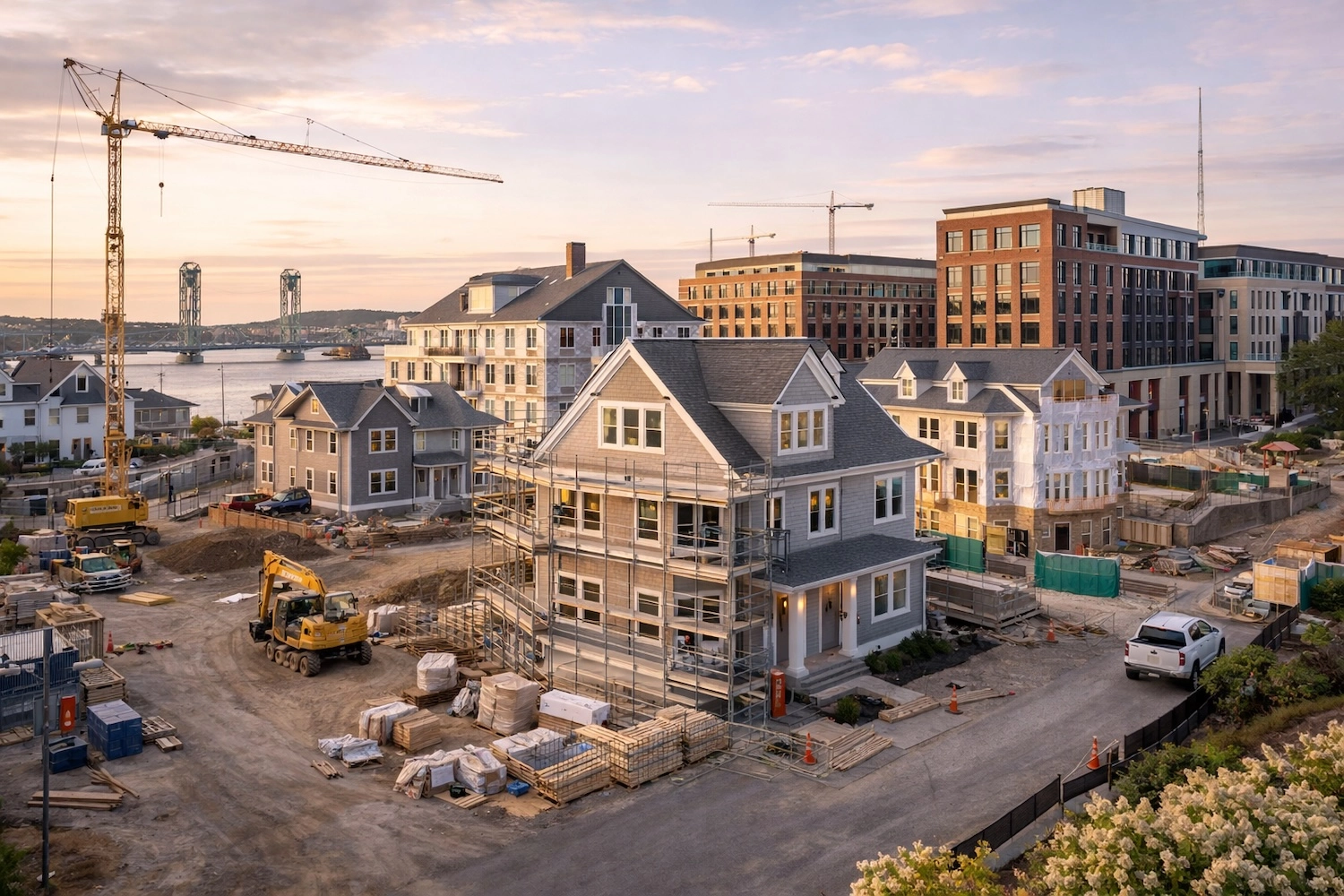
Portsmouth, New Hampshire has emerged as one of the most dynamic real estate markets on the New England seacoast. With a median home price reaching $875,000 as of December 2025—reflecting a 4.2% year-over-year increase—the city represents a premium coastal lifestyle destination attracting buyers, investors, and developers alike. Portsmouth’s perfect balance of historic character, vibrant downtown amenities, proximity to Boston, and strong employment base continues to fuel both housing demand and significant new construction activity.
The city’s development pipeline has reached an inflection point. With the state’s HB 631 legislation taking effect on July 1, 2026—which mandates that municipalities like Portsmouth permit multifamily and mixed-use development on commercially zoned properties as a matter of right—developers are accelerating projects that capitalize on this new regulatory landscape. Combined with record housing production across New Hampshire (reaching a 20-year high in 2025) and improving affordability conditions in early 2026, Portsmouth is positioned for transformational growth.
This comprehensive guide explores current and upcoming residential projects throughout Portsmouth, highlighting specific developments, unit counts, amenities, timelines, and pricing. We examine the market forces driving expansion, zoning changes enabling mixed-use development, and critical factors homebuyers and investors should consider when evaluating new construction opportunities in this premium coastal market.
Portsmouth’s real estate market reflects broader seacoast demand dynamics, but with notable premium pricing. The median sale price for a Portsmouth home stands at $875,000, with average home values around $678,428, up 4.0% over the past year. More significantly, median price per square foot has climbed to $561, a 6.0% year-over-year increase, indicating strong appreciation in the high-quality segment of the market.
Market activity demonstrates competitive conditions and robust buyer interest. In December 2025, 42 homes sold in Portsmouth, compared to 31 homes in December 2024—a 35% increase in transaction volume. However, homes are taking longer to sell on average; the median days on market extended to 59 days compared to 49 days in the prior year, reflecting the building inventory and more selective buyer behavior as mortgage rates stabilized.
The 2026 outlook signals a significant turning point for the New Hampshire seacoast. Buyers now have increased purchasing power, with data from Redfin demonstrating that a $3,000 monthly budget stretches approximately $25,000 further than it did a year ago. Inventory levels are returning to levels not seen in six years, easing the acute supply constraints that characterized 2023–2024. This inventory recovery, combined with moderating interest rates and improved affordability, positions new construction projects to attract both owner-occupants and investors seeking direct exposure to Portsmouth’s premium market.
Portsmouth’s waterfront represents the city’s most transformational development opportunity. City leadership is actively planning major changes to the waterfront district, with the objective of selecting a master developer for the 6-acre Crawford Bay site—the location of the former Holiday Inn—by November 2026. This project carries particular significance given the site’s prominence and size within Portsmouth’s downtown geography.
The waterfront initiative includes phased development of multiple municipal properties. The second phase encompasses changes to the Civic Center and City Hall properties, with Portsmouth’s fiscal budget allocating funding to demolish the former jail and relocate City Hall by 2028. These municipal actions will unlock additional waterfront acreage for private development while repositioning public assets.
In parallel, the Portsmouth Casino and its operators are advancing a $65 million hotel expansion, with plans to break ground on a new 106-room property during 2026. This hospitality investment underscores the city’s international appeal and tourism infrastructure demand, factors that support residential real estate values in proximity to entertainment, dining, and convention facilities.
The waterfront transformation reflects Portsmouth’s vision of "transformational" development that respects historic character while modernizing infrastructure and creating vibrant mixed-use districts. Waterfront and adjacent downtown projects will collectively add hundreds of new residential units, retail space, and office facilities to the market over the next 3–5 years.
A significant trend reshaping Portsmouth’s downtown housing landscape is the rise of co-living developments—modern residential concepts that emphasize shared common spaces, flexible lease terms, and community-oriented amenities. These projects attract young professionals, service workers, and individuals seeking affordable entry points into Portsmouth’s premium market.
Developer Mark McNabb has positioned himself as the leading proponent of this housing typology, with two major downtown projects receiving city approval. His Congress Street project—a conversion of the former J.J. Newberry department store—gained final approvals and will accommodate up to 125 residents in shared co-living units. The property’s prime downtown location provides direct pedestrian access to restaurants, shops, the waterfront, and cultural venues.
McNabb’s second major initiative involves 55 new co-living units proposed at 134 Pleasant Street in downtown Portsmouth. The project features two connected buildings, individual studios, and underground parking, with a rooftop deck offering city and waterfront views. The 134 Pleasant Street development still requires final approvals from city boards before construction commences.
Collectively, these two projects represent nearly 180 co-living units planned for Portsmouth’s downtown core. Rents for co-living units in Portsmouth typically range from $1,200 to $1,800 per month, making them more accessible than traditional apartments while offering a more engaged community experience than standard rental housing. The projects appeal to employers across Portsmouth’s robust sectors—technology, healthcare, education, and tourism—seeking to attract talent to the region.
Beyond co-living, adaptive reuse represents another significant redevelopment strategy. Historic industrial buildings, retail structures, and underutilized commercial properties throughout Portsmouth’s downtown and waterfront are being converted to mixed-use developments combining loft-style residential units, restaurants, retail shops, and office space. These projects appeal to preservationists while addressing housing supply constraints through infill development on already-urbanized parcels.
Portsmouth’s development pipeline includes numerous projects at varying stages of planning, approval, and construction. The following represents the most significant residential and mixed-use initiatives:
A major proposed mixed-use development along Maplewood Avenue will transform a prominent downtown corridor location. The project consists of two components: a five-story, 124-room hotel combined with a four-story mixed-use building featuring ground-level commercial spaces and 32 market-rate apartments. The development spans addresses at 203 Maplewood Avenue, 1 Raynes Avenue, and 31 Raynes Avenue.
The hotel component addresses Portsmouth’s documented need for additional quality hospitality inventory, while the residential component provides downtown housing on a highly walkable block served by municipal water, sewer, and transportation infrastructure. Expected pricing for market-rate apartments in this location ranges from $600,000 to $1.2 million, depending on unit size and location within the building.
The project represents a typical Portsmouth approach: integrating hospitality, retail, and residential uses within a transit-oriented downtown location. Ground-floor retail will include restaurants, specialty shops, and service establishments creating evening and weekend activity on Maplewood Avenue, one of Portsmouth’s primary commercial corridors.
Harborcorp, LLC is advancing a major mixed-use development on the site of the Sheraton parking lot bounded by Russell Street, Deer Street, Maplewood Avenue, and railroad tracks. The project encompasses multiple components: a hotel and event center, residential condominiums, a retail supermarket, and an integrated parking garage serving all uses.
This development exemplifies the shift toward true mixed-use urbanism on previously underutilized commercial sites. The supermarket component addresses retail gaps in downtown Portsmouth while the residential units provide housing proximate to employment, shopping, dining, and entertainment. The event center facilities enhance Portsmouth’s capacity to host conferences, weddings, and cultural gatherings.
The project remains in active planning and design phases, with developers working through site plan review and design approval processes with city boards. When completed, the development is expected to attract both primary residents and secondary-market buyers seeking investment properties with hospitality or retail management potential.
Located on the corner of Maplewood Avenue and Deer Street, a proposed development will feature ground-floor retail space accommodating a pharmacy and bank, with approximately 45 residential units distributed across upper floors. The project includes five units designated as workforce housing, addressing Portsmouth’s documented need for affordability.
This project exemplifies the integration of neighborhood retail services with residential infill development. The pharmacy and bank will serve both residential occupants and broader downtown patrons, while the residential component activates a prominent intersection and supports Main Street retail vitality.
Still in early planning phases, Bridge Street Commons represents an ambitious mixed-use development near the Memorial Bridge. The project aims to create new commercial space and approximately 30 apartments, with explicit commitments to incorporate public art installations and community gathering areas.
The Memorial Bridge location positions this development as a gateway to downtown Portsmouth and the waterfront district. Developers are pursuing early engagement through public hearings scheduled throughout 2025, with potential groundbreaking anticipated in 2026 pending final approvals. The project emphasizes placemaking and community integration, suggesting pricing and unit mix targeting both market-rate and moderate-income buyers.
Lafayette Square Lofts represents a proposed adaptive reuse of a former industrial building on Lafayette Road. The project plans to create 25 loft-style condominiums and a restaurant occupying the ground floor. The development strategy emphasizes preservation of the building’s historic industrial character while integrating modern energy-efficient systems, climate control, and contemporary building systems.
The loft-style unit format appeals to buyers seeking authentic urban living, industrial aesthetics, and premium finishes. Pricing for similar loft units in Portsmouth typically ranges from $500,000 to $900,000 depending on square footage and building location. Community feedback on the Lafayette Square project has been notably positive, particularly from preservation advocates who recognize the value of retaining historic structures.
South Mill Pocket Neighborhood represents a more intimate development approach, proposing 12 single-family homes and cottages designed as a walkable pocket community with shared green space and a community pavilion. The project responds to documented market demand for smaller, efficient homes within walking distance of downtown Portsmouth and its restaurants, shops, and cultural attractions.
The pocket neighborhood typology appeals to downsizers, empty nesters, and young families seeking lower-maintenance housing with strong community amenities. Zoning approval hinges on demonstrating design compatibility with surrounding neighborhoods and adequately addressing traffic and parking considerations. Expected pricing for cottages in this development typically ranges from $550,000 to $750,000, depending on square footage and amenities.
New Hampshire House Bill 631, which becomes effective on July 1, 2026, represents a watershed moment for Portsmouth development. The legislation requires municipalities classified as urban areas by the U.S. Census Bureau—including Portsmouth—to permit multifamily and mixed-use developments on commercially zoned properties as a matter of right.
Prior to HB 631, developers needed to obtain special exceptions or conditional use permits to construct residential or mixed-use projects in commercial zones, a process involving extensive public hearings, design reviews, and mitigation negotiations. The new requirement transforms these projects into permitted uses, streamlining approvals and reducing development timelines and costs.
The bill specifies that developers can construct or rehabilitate multifamily or mixed-use structures on parcels zoned for commercial, office, retail, or parking uses provided that the parcels are serviced by municipal water and sewer infrastructure. Portsmouth’s extensive infrastructure networks mean that substantial acreage throughout the downtown and waterfront meets these requirements.
Municipalities retain limited authority to regulate projects under HB 631, including requirements that developers dedicate up to 20% of ground-floor space to retail uses, provide on-site vehicle parking, and comply with siting and design regulations that do not unreasonably discourage residential development through excessive costs or approval delays.
For Portsmouth, HB 631 has already accelerated developer activity. Companies are fast-tracking projects planned for 2026 and beyond, recognizing that the shift from discretionary approvals to permitted-use status will reduce development risk and enhance project economics. Real estate professionals and developers expect 30–40% increases in residential unit production following July 2026 as co-living, mixed-use, and adaptive-reuse projects move from planning phases into active construction.
Portsmouth’s investment in public infrastructure demonstrates the city’s commitment to accommodating planned growth. Utility replacement on Congress Street began on January 5, 2026, and will extend through early June 2026, including complete replacement of sewer collection, water distribution, and stormwater infrastructure. These improvements enhance capacity for downtown and waterfront development.
The city has also launched the Portsmouth Master Plan, a comprehensive long-range planning initiative that commenced in Spring 2025 and is anticipated to conclude in late 2026. The Master Plan process engages the community in addressing housing supply, transportation access, economic development, climate resilience, urban form, and land use—all critical factors supporting sustainable growth.
The Hanover Garage renovation project continues in its second year of a planned three-year update, improving this important downtown parking facility and supporting retail vitality. The Maplewood Avenue Downtown Complete Street Project is reconstructing infrastructure on this primary commercial corridor, incorporating sidewalk widening, on-street parking, street trees, street lighting, bike amenities, crosswalk improvements, and traffic calming measures.
These infrastructure investments represent hundreds of millions of dollars in public capital supporting private development. Cities that upgrade water, sewer, transportation, and public realm infrastructure create the conditions necessary for density and mixed-use development to succeed.
Portsmouth’s development surge reflects deep structural factors supporting long-term demand for housing. The city’s strong job market, anchored by technology, healthcare, education, and tourism sectors, drives persistent housing demand from professionals seeking to minimize commute times.
Demographic shifts strongly favor Portsmouth development patterns. Millennials and Generation Z cohorts increasingly prioritize walkable, amenity-rich urban environments over single-family suburban homes. Retirees and empty nesters similarly seek low-maintenance housing proximate to dining, cultural, and recreational amenities. Both demographics value transit-oriented development, pedestrian infrastructure, and authentic community character over sprawling suburban development.
Portsmouth’s position as a premium coastal destination within 90 minutes of Boston provides exceptional accessibility to a 5-million-person metropolitan region. The city’s historic charm, waterfront setting, cultural institutions, and vibrant downtown make it increasingly attractive to remote workers, telecommuters, and professionals with geographic flexibility.
The New Hampshire seacoast continues to outperform the broader regional real estate market. While national housing production in 2025 reached a 20-year high, supply remains constrained relative to demographic demand, particularly in premium coastal markets. Inventory is slowly rebuilding in early 2026, but long-term undersupply supports steady price appreciation and strong developer returns.
Purchasing new construction in Portsmouth requires careful analysis and professional guidance. New construction typically commands premium pricing relative to comparable existing homes, reflecting building-cost inflation, developer overhead, and market desirability premiums. Pre-sales allow buyers to secure units at lower prices, but require close review of contracts, homeowner association documents, builder disclosures, and financing terms.
HOA fees vary significantly among Portsmouth developments. Luxury mixed-use properties with rooftop decks, fitness centers, co-working space, and concierge services typically charge $300–$500 monthly per unit, while more modest developments may charge $150–$250. Request detailed fee schedules and understand what services are included. Verify whether future special assessments are anticipated to complete amenities, address structural issues, or maintain common elements.
Thoroughly vet builders and developers before committing to purchase. Request references from previous projects, speak directly with buyers in existing buildings, and review builder litigation history and warranty claims. Strong builders provide comprehensive warranties covering structural systems, mechanical systems, and finishes during initial years following occupancy.
Financing new construction often differs from existing-home purchases. Builders typically require larger down payments (15–25%) during construction phases. Interest-rate lock periods and "float down" options may be unavailable, exposing buyers to rate fluctuations during construction. Builder financing incentives may offset rate increases, but require careful comparison to market financing alternatives.
Consider the development timeline carefully. Projects experiencing permitting delays, supply-chain disruptions, or financing challenges may extend completion dates substantially beyond initial projections. Evaluate builder contingencies, including buyout provisions allowing buyers to exit sales contracts without penalty if closings extend beyond specified dates.
Portsmouth’s premium pricing creates genuine affordability challenges for service workers, educators, healthcare providers, and other essential professions. While median home prices exceed $875,000, workforce housing programs attempt to preserve affordability for lower-income households.
Many new developments include workforce housing components, sometimes mandated by local regulations and sometimes included voluntarily. These units typically are deed-restricted to households earning 60–80% of area median income, preserving affordability for 15–30 years or longer. Workforce housing units allow Portsmouth to maintain socioeconomic diversity while accommodating growth.
However, workforce housing represents a small percentage of overall development. Most new construction targets market-rate buyers, reflecting developer economics and municipal incentive structures. Advocates continue pressing for increased affordability requirements, while developers argue that aggressive affordable-housing mandates diminish project economics and reduce development supply.
Portsmouth’s new developments increasingly incorporate sustainable design and green building standards. Many projects pursue LEED certification or similar environmental rating systems, incorporating features such as high-performance insulation, renewable energy systems, rainwater harvesting, permeable pavements, and electric vehicle charging infrastructure.
Environmental consciousness reflects both developer marketing and genuine community values. Portsmouth residents, on average, demonstrate strong environmental awareness and preference for sustainable development patterns. Walkable, dense development inherently reduces automobile dependency and carbon emissions relative to suburban sprawl alternatives.
Developers often market sustainability features as premium amenities, justifying higher pricing and marketing to environmentally conscious buyers. Whether these sustainability features justify premium pricing remains debatable, but consumer demand supports continued integration of green building practices throughout Portsmouth’s development pipeline.
The Portsmouth development timeline extends through 2028 and beyond, with major projects progressing through planning, permitting, construction, and occupancy phases. Waterfront projects are expected to select master developers by late 2026, with construction potentially commencing in 2027–2028.
Downtown mixed-use projects on Maplewood Avenue, Deer Street, and other core locations are advancing toward late-2026 groundbreaking, with initial occupancy likely in 2028–2029. Co-living developments are moving fastest, with several projects potentially opening in late 2026 or early 2027.
The HB 631 effective date of July 1, 2026, will serve as an inflection point, after which developers expect streamlined approvals and accelerated project launches. Real estate professionals anticipate substantial increases in residential unit production, groundbreakings, and construction activity during 2027–2029 as projects move from planning phases into physical development.
Market pricing is expected to remain firm through this development cycle. Strong demand, improving affordability conditions, increasing inventory, and high-quality development pipeline position Portsmouth for stable to appreciating values. New construction pricing may experience modest pressure in 2027–2028 if unit deliveries significantly exceed demand, but supply constraints and demographic drivers suggest continued strength.
New construction purchase decisions require professional guidance from real estate agents specializing in new construction markets, lenders experienced with builder financing, and occasionally attorneys familiar with purchase agreement nuances. Portsmouth’s premium market and complex development projects justify professional expertise investment.
Real estate professionals specializing in new construction understand builder incentive structures, market positioning, comparable pricing, and timing strategies that individual buyers may miss. These agents negotiate aggressively on pricing, included upgrades, closing costs, and contract terms, frequently justifying their compensation through negotiated savings.
Lenders experienced with new construction financing understand builder financing programs, interest-rate protection features, and contingency provisions that general mortgage officers may overlook. New construction lending differs meaningfully from existing-home financing, and specialized expertise reduces closing risks and costs.
Consider working with an attorney if purchasing premium new construction exceeding $750,000. Attorneys review purchase agreements, identify unfavorable terms, negotiate protections, and advise regarding contingencies, escrow, and closing logistics. The relatively modest attorney fee investment (typically $1,000–$3,000) protects substantial property values and mitigates contractual risks.
Portsmouth, New Hampshire stands at the threshold of transformational development. A combination of favorable zoning reforms (HB 631), improving affordability conditions, strong demographic demand, and substantial public infrastructure investment has positioned the city for a multi-year residential development cycle. Waterfront, downtown, and infill projects will collectively deliver hundreds of new residential units by 2029, reshaping Portsmouth’s housing stock and character.
For buyers and investors, Portsmouth’s development pipeline offers unprecedented opportunities to own new construction in a premium coastal market benefiting from strong employment, vibrant downtown vitality, cultural amenities, and authentic New England character. Whether your interest involves downtown co-living, luxury mixed-use condominiums, loft-style adaptive-reuse units, or pocket-neighborhood cottages, Portsmouth’s development diversity accommodates varied preferences and budgets.
The premium pricing reflects real factors: limited developable coastal land, strong demographic demand, superior employment base, and authentic community character that cannot be replicated. While new construction pricing in Portsmouth commands premiums relative to inland markets, the underlying value fundamentals support long-term appreciation and buyer satisfaction.
If you are considering investment in Portsmouth new construction, now represents an opportune moment. Early projects are moving forward, pricing is establishing market benchmarks, and HB 631 implementation will accelerate development cycles in coming months. Working with experienced professionals specializing in Portsmouth real estate and new construction markets will help you navigate options, negotiate effectively, and identify projects aligned with your investment objectives and lifestyle preferences.
Bean Group | brokered by eXp Realty specializes in Portsmouth real estate across all property types and market segments. Our team combines decades of local market expertise with cutting-edge tools and resources supporting client success in this dynamic market. Whether you are exploring new construction opportunities, evaluating investment potential, or seeking representation in competitive waterfront or downtown transactions, we are committed to exceeding your expectations and delivering exceptional results.
Contact Bean Group today to discuss your Portsmouth real estate goals and learn how our expertise can help you achieve your objectives in this premier New England coastal market.