


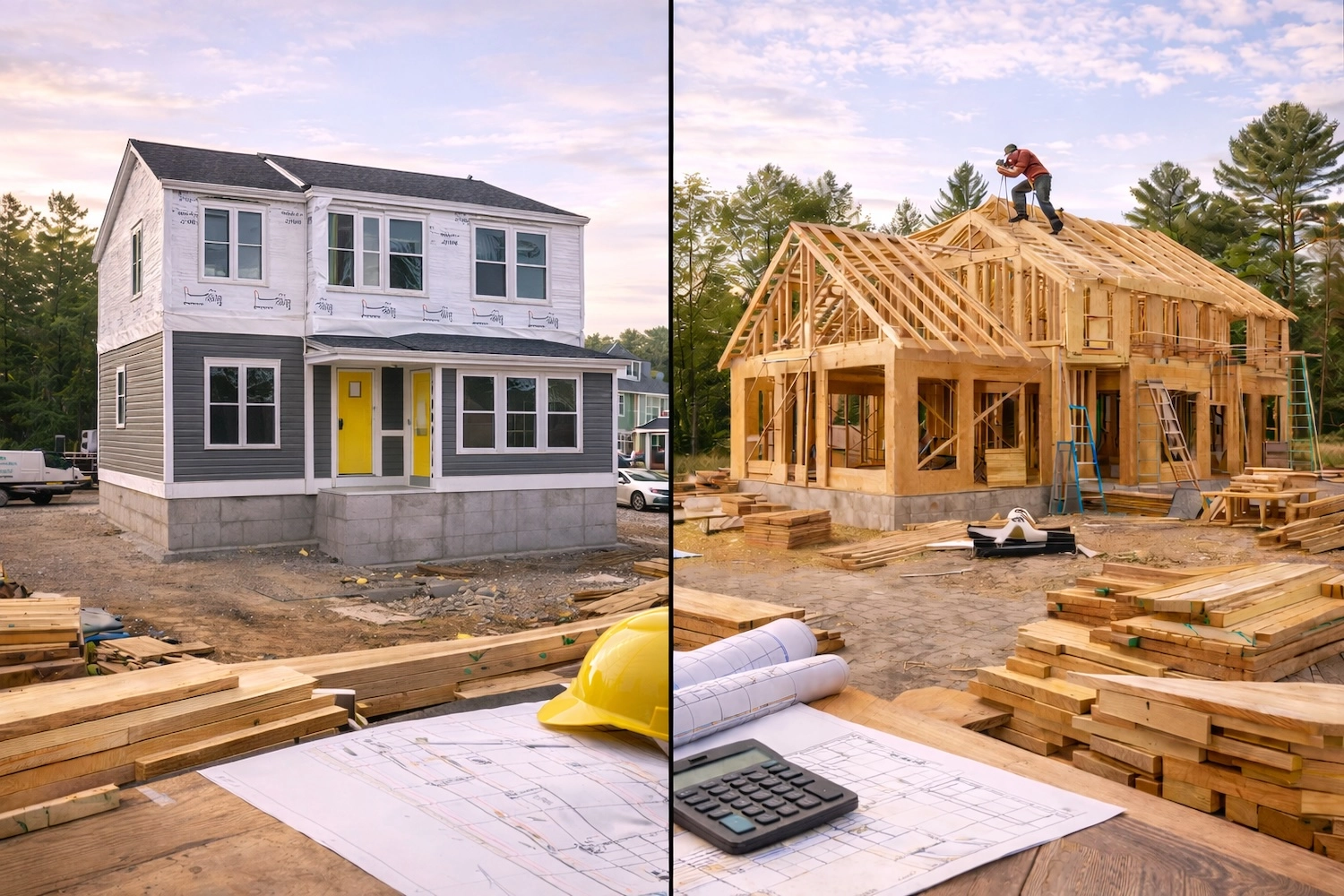
Modular vs. Stick-Built Homes in New Hampshire: Comprehensive 2025-2026 Guide to Costs, Builders, and Timelines
Choosing how to build a home in New Hampshire involves more than selecting paint colors and floor plans. One of the most fundamental decisions is the construction method itself—whether to go with modular or stick-built construction. Modular homes are built in sections in a controlled factory environment and assembled on-site, while stick-built homes are constructed entirely on the building site, framed piece by piece. Both methods can deliver beautiful, durable homes, but each has unique benefits, costs, timelines, and trade-offs. This comprehensive guide examines the differences between modular and stick-built homes based on 2025-2026 market data and New Hampshire specifics, helping you decide which approach aligns with your budget, schedule, design aspirations, and lifestyle.
Understanding the Construction Methods
What Are Modular Homes?
Modular homes use modern manufacturing techniques to build major components—often entire rooms or sections—in an indoor factory setting. These modules are transported to the building site on trucks and craned onto a prepared foundation, where they are joined, sealed, and finished. Because construction occurs indoors, materials are protected from weather, and work can continue year-round regardless of rain or snow. Modular homes must meet the same building codes as site-built homes and are inspected both at the factory and on-site. Under New Hampshire law (RSA 205-C, Modular Building Standards), modular homes that are permanently affixed to foundations are classified as real property and are indistinguishable from stick-built houses once completed.
Understanding Stick-Built Homes
Stick-built homes are the traditional method of construction, assembled entirely on the building site. Carpenters frame walls, floors, and roofs piece by piece, from laying the sill plates to fastening rafters. Because each home is effectively built from scratch on-site, this approach allows for infinite customization during the design and construction process. Changes can be accommodated mid-build, although they may increase costs and timeline. Stick-built construction also supports complex architecture, including unusual angles, intricate rooflines, and custom features. Weather, labor availability, and supply logistics significantly affect stick-built timelines in New Hampshire, where winter weather can halt progress for extended periods.
The 2025-2026 Cost Landscape
Modular Home Costs
Current pricing data shows that modular homes cost significantly less than stick-built homes. According to 2025-2026 market analysis, modular homes are 15 to 20 percent cheaper than traditional stick-built construction. The average modular home costs $50 to $100 per square foot for the factory-built unit alone, or $80 to $160 per square foot total when including site preparation, installation, and finishing. This translates to an average total price range of $160,000 to $320,000 for a completed modular home, depending on size, finishes, and site complexity.
For a 2,000-square-foot modular home in New Hampshire, homeowners typically budget between $160,000 and $320,000 for the home itself, not including land. The cost advantage stems from factory economies of scale, reduced labor expenses (factory work typically costs less than on-site labor), lower material waste, and more predictable timelines that reduce carrying costs.
Stick-Built Home Costs
Stick-built homes in New Hampshire carry higher construction costs. In 2025, builders estimate construction costs ranging from $200 to $350 per square foot for custom builds, not including site work and land. This means a comparable 2,000-square-foot stick-built home would cost $400,000 to $700,000 just for construction labor and materials, before foundation, utilities, and site preparation. The higher costs reflect on-site labor expenses, material exposure to weather, longer timelines, and complexity of coordinating multiple subcontractors.
A typical 2,000-square-foot modular home might cost $240,000 to build, while the same home stick-built could exceed $400,000 to $450,000 in construction costs alone. This represents the substantial cost savings modular construction offers.
Additional Costs to Budget
Regardless of construction method, New Hampshire homeowners must budget for site work, foundation, utilities, and permitting. These costs include:
- Land preparation: $4,000 to $11,000
- Foundation work: $6,000 to $20,000
- Utility connections (electrical, water, sewer, gas): $2,500 to $25,000
- Permits and inspections: $500 to $5,000
- Site access for cranes/trucks (modular): $1,000 to $5,000
- Septic system (if applicable): $3,000 to $15,000
These ancillary costs often total $20,000 to $75,000, which must be added to the home construction cost regardless of method. Understanding the full scope of costs is critical for accurate budgeting.
Timeline Comparison: Speed and Predictability
Modular Construction Timeline
One of modular construction's greatest advantages is speed and predictability. A typical modular home timeline is 3 to 4 months from order to occupancy. The process unfolds in parallel: while your factory begins building modules (typically completed in 4 to 6 weeks), your site team simultaneously prepares the foundation, grades the property, and installs utilities. This parallel processing means the foundation and site work happen concurrently with factory construction, dramatically reducing total timeline.
Once modules arrive on-site, assembly typically takes 1 to 2 weeks. After assembly, on-site finishing (roofing tie-ins, siding, decks, interior trim) usually requires 4 to 8 weeks depending on complexity. The entire process from design to occupancy averages 3 to 4 months, making modular an excellent choice for buyers with tight timelines.
Stick-Built Construction Timeline
Stick-built construction follows a sequential process, with each phase dependent on completion of the previous one. A typical stick-built home takes 6 to 12 months or longer from groundbreaking to occupancy. The timeline generally breaks down as:
- Foundation and site prep: 4 to 8 weeks
- Framing: 4 to 8 weeks
- Rough-in (electrical, plumbing, HVAC): 2 to 4 weeks
- Insulation and drywall: 3 to 6 weeks
- Flooring, cabinets, interior trim: 4 to 8 weeks
- Final inspections and punch-list: 2 to 4 weeks
In New Hampshire, weather delays can significantly extend timelines. Winter weather (November through March) often halts exterior work, pushing spring projects into summer or fall projects into the following spring. Snow, ice, and cold temperatures affect material delivery, subcontractor availability, and construction progress, easily adding 1 to 3 additional months to a project.
Quality, Customization, and Precision
Modular Home Quality and Engineering
Modular homes benefit from precise fabrication in climate-controlled factory environments. Manufacturing facilities use engineered jigs and equipment to keep walls square and plumb, and materials are stored indoors, eliminating warping and moisture issues common in outdoor storage. Many modular factories incorporate quality-control inspections at every production stage, ensuring consistency and adherence to building codes. New Hampshire modular homes must comply with the State Building Code (based on the International Residential Code) and local zoning ordinances, ensuring quality parity with stick-built homes.
Modules are engineered to withstand transportation stress, resulting in robust structural design that may actually exceed standard framing requirements. This engineering rigor can produce homes with tighter building envelopes and superior energy performance compared to some site-built homes.
Stick-Built Customization and Artistry
Stick-built homes rely on the skill and expertise of local contractors and subcontractors. A well-managed crew using quality materials can produce outstanding craftsmanship with artistic details like built-in cabinetry, exposed beams, and elaborate trim work. On-site construction allows artisans to adapt designs to site conditions, create one-of-a-kind features, and respond to owner preferences mid-project. Customization is virtually limitless with stick-built construction, as changes can be made at nearly any stage.
The downside is that quality varies significantly depending on the builder's attention to detail, material sourcing, and on-site conditions. Rain, snow, and temperature swings can impact materials during construction, and schedules can be delayed by bad weather or labor shortages.
Building Code Compliance and Inspections
Both modular and stick-built homes in New Hampshire must comply with the State Building Code and local zoning ordinances. New Hampshire's regulatory framework includes:
- RSA 205-C: Modular Building Standards, governing factory-built homes permanently affixed to foundations
- RSA 674:31-32: Zoning requirements mandating reasonable opportunities for modular homes in residential districts
- HB 577 (2025): New ADU regulations requiring municipalities to allow one accessory dwelling unit per single-family lot by right, opening opportunities for modular ADUs
Modular homes undergo rigorous factory inspections for code adherence and quality control. Local building officials then inspect the foundation and module connections on-site, plus electrical, plumbing, and mechanical systems. Stick-built homes are inspected at multiple stages: foundation, framing, rough-in utilities, insulation, and final occupancy. Both pathways ensure full code compliance and public safety.
Leading Modular Home Builders in New Hampshire
Several established modular builders serve New Hampshire with quality homes and reliable service:
- New Hampshire Modular Homes: Factory-built homes via Professional Building Systems (PBS), serving central New Hampshire with competitive pricing and local support.
- Lakes Region Modular Homes: Specializing in land and modular home packages with typical completion timelines of 2 to 3 months. Strong reputation in the Lakes Region.
- Millbrook Homes: A leading custom modular builder capable of factory-completing homes in six weeks, with on-site assembly and finishing managed by local crews. Known for quality craftsmanship and personalized service.
- Seacoast Modular: Offering custom, high-performance, and net-zero modular homes for New Hampshire, Maine, and Massachusetts. Excellent for energy-efficient builds.
- Impresa Modular: The only national custom modular builder with significant New Hampshire presence, providing design flexibility and premium construction quality.
- Westchester Modular Homes: Operating a network of independent builders throughout New Hampshire and the Northeast, offering diverse floor plans and pricing.
When selecting a modular builder, request references, tour completed homes, ask detailed questions about timelines and inclusions, and ensure you understand what is provided by the factory versus what remains your responsibility (site work, utility connections, porches, garages).
Financing Modular and Stick-Built Homes
Financing Options and Loan Products
Financing modular and stick-built homes follows similar pathways. Most buyers use construction-to-permanent loans, where the lender releases funds (draws) as milestones are completed, then converts the loan to a standard mortgage at closing. Conventional financing requires:
- Credit score: Minimum 620 (680+ for better rates)
- Down payment: 3 to 20 percent depending on first-time buyer status and loan type
- Debt-to-income ratio: Maximum 43 to 50 percent
- Interest rates (2026): Approximately 6.25 to 7.5 percent depending on credit profile and down payment
Banks and lenders may have slight preferences for modular projects because construction timelines are shorter and more predictable, reducing interest carry costs. However, both modular and stick-built homes qualify for conventional, FHA, VA, and USDA financing provided they meet permanent foundation and code requirements.
Appraisal Considerations
Appraisals for both modular and stick-built homes consider design, quality, materials, energy efficiency, location, and comparable sales in the market. A critical requirement: modular homes must be installed on permanent foundations and classified as real property to qualify for conventional financing. An appraisal will assess the home's "subject to completion" value, estimating what the finished home will be worth in the current market.
Appraisers are increasingly experienced with modular homes as the industry has grown, but some appraisers remain unfamiliar with modular construction. Educating your appraiser with factory documentation, inspection reports, and comparable modular sales in your area helps ensure accurate valuation. In areas where modular construction is less common, appraisals may initially come in conservative; providing market data and specifications can help appraisers establish appropriate value for your home.
Resale Value and Market Appreciation
Appreciation Rates and Long-Term Performance
Modular homes have historically appreciated at rates comparable to stick-built homes. Current market data shows that quality modular homes in stable housing markets appreciate at 3 to 5 percent annually, aligning closely with traditional home appreciation. Long-term data from 2000 to 2024 demonstrates remarkable parity: site-built homes appreciated approximately 212.6 percent over the period, while modular homes (on owned land with permanent foundations) appreciated 211.8 percent—virtually identical performance.
This means a well-maintained modular home purchased today should experience similar appreciation to a comparable stick-built home in the same market. Given that modular homes typically cost 15 to 20 percent less to build, you may have instant equity: a $250,000 modular home might appraise for $300,000 in a market where comparable stick-built homes sell for $320,000 to $350,000.
Factors Affecting Resale Value
Several conditions determine whether modular homes retain and appreciate value:
- Foundation type: Permanent foundations are essential. Homes on permanent foundations are treated as real property and appreciate like stick-built homes.
- Land ownership: Modular homes on owned land perform better than leased land scenarios. Land typically appreciates over time, boosting overall property value.
- Location and market: A modular home in a desirable neighborhood with good schools, walkable amenities, and strong job markets will appreciate more than one in declining areas.
- Maintenance and updates: Regular maintenance and strategic updates (kitchen, bathrooms, HVAC, roofing) preserve and enhance value.
- Design and aesthetics: Homes with timeless design (colonial, farmhouse, contemporary) appeal to more buyers than trendy styles that date quickly.
The consensus from 2025-2026 market data is that properly constructed, well-maintained modular homes on owned land with permanent foundations perform as solid investments, comparable to traditional homes.
Pros and Cons: A Detailed Analysis
Modular Homes: Advantages
- Faster build time: Construction of modules and site prep happen simultaneously, reducing total timeline to 3 to 4 months.
- Weather protection: Factory construction reduces delays and material damage from rain, snow, and temperature extremes.
- Factory precision: Controlled environments and engineered jigs yield tight tolerances and energy-efficient homes.
- Lower labor costs: Factory labor is typically less expensive than skilled on-site labor in New Hampshire.
- Cost certainty: Fixed factory pricing reduces change-order surprises and budget overruns.
- Reduced waste: Industrial processes yield less waste and better recycling of materials.
- Energy efficiency: Factory control enables consistent insulation, air sealing, and HVAC installation for superior thermal performance.
- Quality consistency: Factory inspections and quality-control processes ensure consistency across all modules.
Modular Homes: Disadvantages
- Transportation and logistics: Large trucks and cranes require site access, which may be challenging on remote or steep lots.
- Limited modifications post-fabrication: Changes after factory production can be costly or impossible; planning ahead is critical.
- Design constraints: While improving, modular design options may not match the unlimited customization of stick-built.
- Site access requirements: Modular delivery requires adequate road width, clear craning space, and proper foundation access.
- Public misconceptions: Some buyers conflate modular homes with manufactured/mobile homes, potentially affecting perceived value despite quality parity.
- Appraiser education: Some appraisers are less familiar with modular construction and may undervalue homes.
Stick-Built Homes: Advantages
- Unlimited customization: Design and construction changes can be made at virtually any stage to reflect your preferences.
- Complex architecture: Unusual angles, intricate rooflines, vaulted ceilings, and custom features are easily accommodated.
- Adaptive to challenging sites: Steep slopes, rocky ledge, poor access, and irregular lot shapes present fewer obstacles for experienced builders.
- Mid-project flexibility: Material selections, finishes, and features can be adjusted as construction progresses.
- Artisan craftsmanship: Skilled carpenters can incorporate bespoke details, built-ins, and fine finishes that reflect your personality.
- Builder variety: Wide availability of local builders and specialty trades provides options and competitive pricing.
- Familiarity: Traditional construction method is well-understood by homeowners, lenders, and appraisers.
Stick-Built Homes: Disadvantages
- Longer timeline: Sequential construction and weather delays often extend timelines to 6 to 12 months or longer in New Hampshire.
- Weather exposure: Rain, snow, and temperature swings can damage materials during construction and delay progress.
- Higher labor costs: On-site labor in New Hampshire is more expensive than factory work, increasing overall costs.
- Cost uncertainty: Change orders, material price fluctuations, and labor unavailability can increase budget beyond initial estimates.
- Contractor coordination: Multiple subcontractors (excavation, foundation, framing, electrical, plumbing, finish) require careful coordination and oversight.
- Quality variability: Results depend heavily on builder skill, oversight, and subcontractor quality; performance varies more widely than factory-built.
- Waste and environmental impact: On-site construction generates more waste and may have greater environmental footprint than factory production.
Environmental Considerations and Sustainability
Modular Construction and Eco-Friendly Practices
Modular construction often produces less waste because unused materials can be recycled at the factory rather than discarded at job sites. Controlled factory environments reduce air leaks and enable precise insulation installation, improving thermal performance and reducing operational energy consumption. Many modular factories incorporate eco-friendly practices such as water recycling, efficient waste management, and optimized HVAC systems. Seacoast Modular and other New Hampshire builders now offer net-zero modular homes with integrated solar-ready roofs, battery storage, and geothermal loop systems.
Modular homes often achieve high energy ratings more reliably than stick-built homes because factory quality control ensures consistent insulation installation, air sealing, and mechanical system performance. Over a home's 30+ year lifespan, superior energy efficiency translates to significant operational cost savings and reduced carbon footprint.
Stick-Built Green Homes
Stick-built homes can be built to exacting green standards as well, but success depends entirely on the builder's practices and commitment. Energy-efficient windows, high-performance insulation, HVAC systems, renewable energy (solar panels, geothermal), and water conservation systems can be incorporated into any stick-built home. However, achieving consistent performance requires careful material selection, skilled installation, and rigorous quality control. Some New Hampshire builders specialize in green construction and produce homes that rival or exceed modular energy performance; others prioritize cost over efficiency.
The Future of Homebuilding in New Hampshire
The modular industry continues to evolve rapidly, embracing design innovation and customization that narrows the gap with stick-built flexibility. Designers and manufacturers now offer wider arrays of floor plans, architectural styles (colonial, farmhouse, modern, cottage), and high-end finishes. Some firms produce bespoke modules for custom aesthetics, and advances in 3D design allow visualization before production begins.
New Hampshire's 2025 housing market, characterized by median home prices of $535,000 and building permits at a 20-year high (5,822 permits), is driving innovation in construction methods. Modular construction is increasingly attractive as labor shortages, supply chain volatility, and weather delays make traditional stick-built construction more expensive and unpredictable. Meanwhile, stick-built techniques are incorporating off-site elements; panelized construction and pre-cut framing kits shorten build times and improve precision without sacrificing customization.
Advances in building information modeling (BIM), digital design, and even 3D printing may further blur the lines between modular and stick-built construction in coming years. Hybrid approaches that combine factory efficiency with on-site customization may become increasingly common.
Case Study: Modular Success in the Lakes Region
Anna and Dave, a couple from the Lakes Region, wanted a vacation home on a sloping, wooded lot near a pristine lake. They selected a modular Cape-style design with a first-floor master suite, two upstairs bedrooms, and a cozy fireplace nook. The factory began modules while site work prepared the foundation, septic system, and gravel driveway on the sloping terrain. The modules arrived on a calm spring morning, and a crane set them in place and secured connections within a single day. Local crews managed the roof tie-in, siding, composite decking, and interior trim over the next six weeks. Total construction time from permit approval to occupancy was just under four months.
The predictable timeline allowed Anna and Dave to schedule their lender's final inspection, arrange movers, and plan their summer opening with confidence. The finished home features 10-foot ceilings, energy-efficient triple-pane windows, in-floor heating from an efficient heat pump, and cathedral ceilings with skylights that frame mountain views. They report that visitors frequently remark on the home's quality, spaciousness, and design, and many are surprised to learn it's modular. The home cost approximately $280,000 to build (including all site work and finishes), a significant savings compared to stick-built alternatives in their market.
Case Study: Stick-Built Customization in Southern New Hampshire
Jamie and Kim built a custom stick-built farmhouse on three acres in southern New Hampshire with spectacular views toward the Mount Monadnock region. They worked closely with an architect to design a sprawling 3,200-square-foot layout with a charming farmer's porch, cathedral ceilings in the great room, exposed hand-hewn beams salvaged from a local mill, and a three-car garage with a workshop. Construction began in April and finished the following April, spanning eleven months of seasonal weather challenges.
Along the way, they decided to upgrade to wide-plank reclaimed hardwood floors throughout the main level and add custom built-ins with leaded-glass doors around an oversized fireplace. These changes delayed progress but resulted in bespoke features they cherish. Their steep, rocky site had significant ledge outcroppings requiring professional blasting and custom foundation engineering—challenges that modular builders had estimated would be prohibitively expensive. The stick-built approach accommodated these complexities seamlessly.
Although the timeline stretched beyond initial estimates and costs reached $580,000 for construction alone (approximately $181 per square foot), Jamie and Kim feel their home perfectly reflects their lifestyle and connection to the land. The architectural character, salvaged materials, and custom craftsmanship would have been difficult or impossible to achieve through modular construction, and the home is now the centerpiece of their property and personal brand in their community.
Making Your Decision: Key Considerations
Choosing between modular and stick-built requires honest assessment of your priorities:
- Budget: Are you seeking cost predictability and maximum savings (modular advantage), or are you willing to invest premium dollars for ultimate customization and artisan craftsmanship (stick-built advantage)?
- Timeline: Do you need to move in within a tight window of 3 to 4 months (modular strength), or is a longer, more flexible build spanning 6 to 12+ months acceptable (stick-built flexibility)?
- Design complexity: Is your dream home a simple colonial with conventional proportions (modular can handle), or a complex custom design with unique rooflines, vaulted spaces, and bespoke features (stick-built specialty)?
- Site conditions: Does your lot provide easy access for large trucks and 80-foot cranes with clear craning space, or is it remote, steeply sloped, and difficult to access (stick-built adapts better)?
- Personal involvement: Do you enjoy visiting a site frequently and tweaking details mid-construction, or would you prefer a streamlined, factory-coordinated process with minimal site visits?
- Energy efficiency priorities: If operational energy costs and carbon footprint are top concerns, modular homes often deliver superior thermal performance more reliably.
- Resale and market perception: In your target market, how are modular homes perceived? In Lakes Region communities, modular homes have strong acceptance; in rural areas, traditional stick-built may command higher perceived value.
Some sophisticated buyers pursue hybrid approaches: using modular components for efficiency and speed while adding custom on-site details (extensive porches, garages, landscaping, interior finishing) that reflect their personality. This combines modular speed and predictability with stick-built customization potential.
Selecting Your Builder: Critical Success Factors
Whether modular or stick-built, selecting the right builder is the single most important decision you'll make. Look for companies with:
- Solid reputation and longevity: Builders in business for 10+ years with consistent positive feedback.
- Customer references: Request and actually contact recent clients. Ask about timeline adherence, budget management, communication, quality, and post-completion support.
- Completed homes to tour: Visit finished projects in neighborhoods similar to where you want to build. Judge materials, finishes, craftsmanship, and attention to detail firsthand.
- Transparent, detailed pricing: Obtain written specifications line-by-line, including insulation R-values, roofing materials, windows (brand and ratings), mechanical systems, and finish allowances. Hidden costs or vague budgets are red flags.
- Factory tours (modular): For modular, visit the factory where your modules will be built. Meet the workforce, see quality control processes, and ensure the facility aligns with your standards.
- Clear communication practices: How often will you receive updates? Will the builder provide a construction manager? What's the process for change orders, unexpected conditions, and problem resolution?
- Insurance and licensing: Verify current general liability insurance, workers' compensation, and proper state licensing. Request evidence of bonding and warranties.
- Local relationships: For stick-built, ask about established relationships with subcontractors, material suppliers, and local building officials. These relationships can smooth timelines and problem resolution.
For modular builds specifically, clarify what is included from the factory and what remains your responsibility. Typical items requiring owner coordination include site work (grading, drainage), utility connections (electrical, water, sewer), porches, decks, garages, landscaping, and driveway. Understanding this division prevents surprise costs and delays.
New Hampshire Market Context and Opportunities
New Hampshire's real estate market in 2025-2026 presents unique opportunities for both modular and stick-built construction. The state's median home price of $535,000 combined with housing shortages and building permits at a 20-year high (5,822 permits) create strong demand for new construction. New Hampshire's lack of state income and sales tax makes home ownership more attractive, and recent legislative changes (HB 577, effective July 2025) allowing accessory dwelling units by right opens new possibilities for modular ADUs on existing properties.
The strong market favors modular builders, whose predictable timelines and costs align well with financing requirements and buyer certainty. Stick-built builders benefit from strong demand but face tight labor markets and material cost volatility. Either path can succeed, but careful builder selection and realistic expectation-setting are essential.
Getting Started: Your Action Plan
If you're excited about building a new home in New Hampshire, start by assembling your team:
- Interview both modular manufacturers and traditional stick-built builders. Request proposals, references, and examples of recent work. Compare pricing models, warranties, and timelines.
- Hire an independent construction consultant or architect to help interpret bids, review specifications, and protect your interests throughout the building process.
- Investigate your land and site conditions. Soil composition, slopes, ledge presence, access roads, and utility proximity all influence foundation design, building logistics, and costs. A professional survey and geotechnical assessment are wise investments.
- Work with your lender early. Explore construction financing options specific to your situation, understand draw schedules, and obtain pre-approval. Some lenders specialize in modular or custom stick-built financing; find the right fit.
- Schedule site visits to completed homes. For modular, visit homes built by your target builder. For stick-built, spend time on active job sites observing craftsmanship and management. Talk with homeowners about their experiences, surprises, and satisfaction.
- Document your vision. Create a detailed wish list of design elements, finishes, energy features, and lifestyle priorities. This guides your builder selection and design process.
- Understand local codes and permitting. Contact your town's planning and building department early to understand zoning requirements, septic regulations, setbacks, and typical permit timelines. Some towns process permits quickly; others move slowly.
Conclusion
New Hampshire homebuilders have more options than ever when it comes to construction methods. Modular homes provide speed, precision, cost efficiency, and predictable budgets, while stick-built homes offer boundless customization, artisan craftsmanship, and adaptability to challenging lots and detailed designs. Current 2025-2026 market data shows that modular homes cost 15 to 20 percent less to build, can be completed in 3 to 4 months versus 6 to 12+ months for stick-built, and appreciate at rates comparable to traditional homes when properly maintained on owned land with permanent foundations.
By understanding the distinctions in quality, cost, timeline, flexibility, and long-term value, you can choose the right path for your dream home. Evaluate your priorities honestly, research local builders thoroughly, and consider touring both modular factories and stick-built job sites. With thoughtful planning, expert guidance from trusted builders and consultants, and clear vision for your home, whether your residence arrives on wheels or grows piece by piece on your foundation, it will provide comfort, beauty, and lasting value for years to come.
Ready to Build in New Hampshire? Connect with Bean Group
At Bean Group, brokered by eXp Realty, we specialize in new construction and custom home development throughout New Hampshire. Our team understands the nuances of modular versus stick-built construction, local building codes, financing options, and the New Hampshire market landscape. Whether you're considering a factory-built modular home for speed and predictability or a custom stick-built design reflecting your unique lifestyle, we can guide you through every step: land selection, builder vetting, financing, and final closing.
We work with the region's leading modular manufacturers (Millbrook Homes, Lakes Region Modular, Seacoast Modular, and others) and established stick-built builders to deliver quality homes on budget and on schedule. Our deep community roots, lender relationships, and construction expertise ensure your building journey is smooth, transparent, and successful.
Ready to start your New Hampshire home-building journey? Contact Bean Group today for a free consultation. Let's discuss your vision, budget, timeline, and priorities to identify whether modular or stick-built construction is the right fit. Schedule a property tour, builder meeting, or financing consultation with our experienced team. Your dream home awaits.