


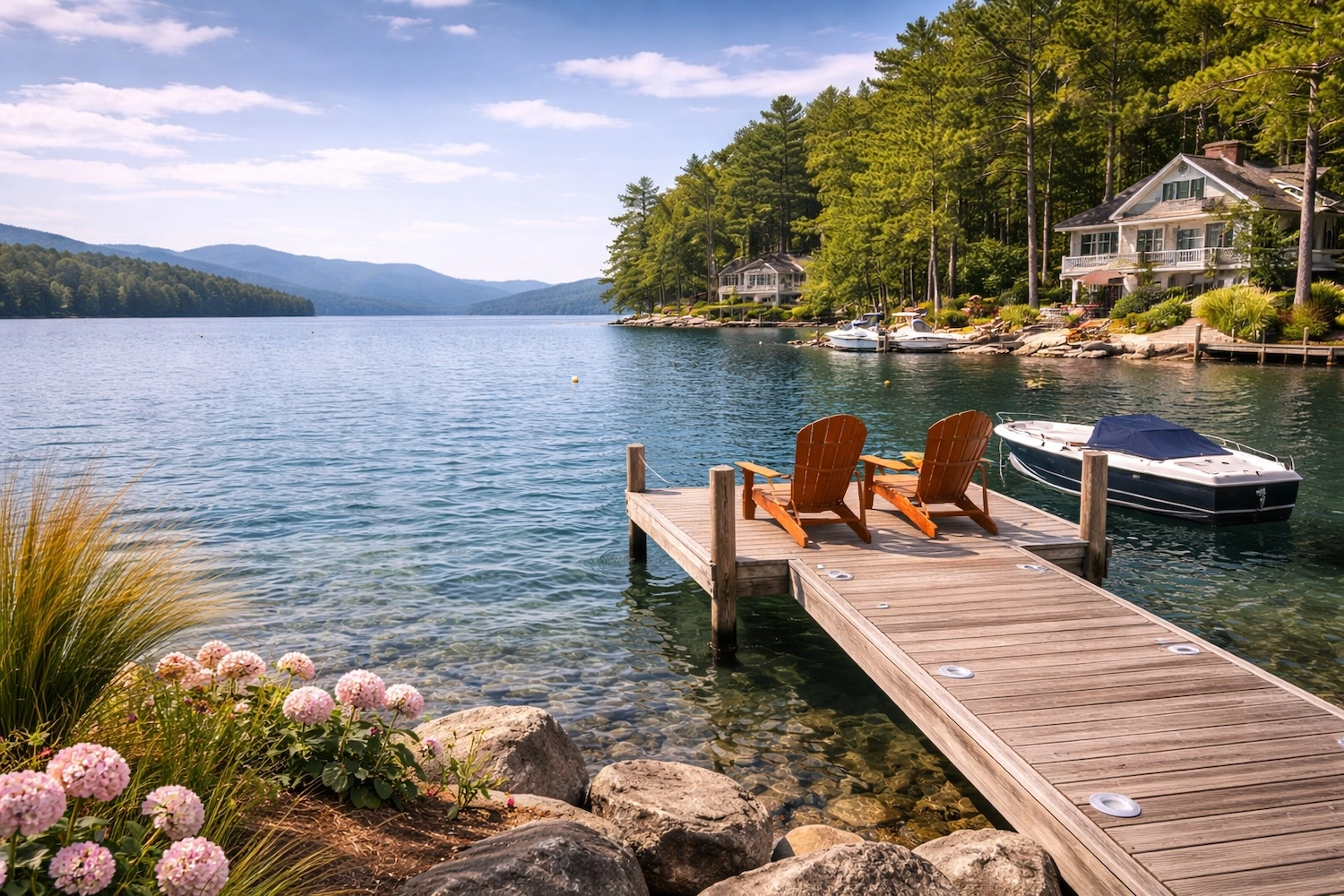
Lake Winnipesaukee Waterfront: Your Complete Buying Guide for 2026
Lake Winnipesaukee remains one of New England's most coveted waterfront destinations, and for good reason. Spanning 44,586 acres across multiple New Hampshire towns with over 200 miles of shoreline, this remarkable body of water offers diverse waterfront lifestyles. Whether you envision a quiet cove retreat, a bold waterfront estate with panoramic views, or a boat-centric compound, Lake Winnipesaukee delivers. However, purchasing waterfront property here demands far more sophistication than typical residential transactions. Understanding local regulations, dock permitting, shoreline protections, and town-specific characteristics separates successful buyers from those who face costly surprises. This comprehensive guide walks you through the essential considerations for 2026.
The Lake Winnipesaukee Market in 2025–2026
Lake Winnipesaukee's real estate market shows remarkable strength heading into 2026. In 2025, the market ended on a very positive note with improved activity compared to 2024. November 2025 saw 13 homes sold (up from 10 in November 2024), with an average sales price of $3.76 million, representing a substantial jump from $2.74 million in November 2024. Year-over-year, the 2025 median sales price for Lake Winnipesaukee waterfront homes reached approximately $2.75 million, with sales ranging from $665,000 to $8.1 million.
Current market conditions favor updated, move-in-ready homes in desirable locations. Higher-end sales continue to guide overall pricing trends. Over the past five years, prices have climbed significantly, though the market is beginning to stabilize as sellers adjust to realistic market expectations. For context, New Hampshire's statewide median home price sits around $535,000, making Lake Winnipesaukee waterfront properties command a premium of 5 to 50 times that baseline, depending on location, frontage, and amenities. With 48 waterfront listings currently available, the median listing price stands at $3.22 million, with days on market averaging 66 days.
Understanding Lake Winnipesaukee's Towns and Their Characteristics
Lake Winnipesaukee stretches across eight primary municipalities: Alton, Gilford, Laconia, Meredith, Moultonborough, Center Harbor, Tuftonboro, and Wolfeboro. Each brings distinct character, tax rates, and amenity profiles.
Wolfeboro: Historic Charm and Accessibility
Known as America's oldest resort town, Wolfeboro offers elegant waterfront estates alongside cozy cottages. The town features a vibrant downtown with shops, restaurants, and cultural events. Average home prices in Wolfeboro hover around $588,000, with waterfront condo listings showing a median of $725,000. Wolfeboro attracts families, retirees, and seasonal visitors who value charming village character and established infrastructure. The town's east-facing orientation provides beautiful sunrises over the water, and many properties benefit from protected coves ideal for swimming and kayaking.
Moultonborough: Low-Tax Appeal and Scenic Variety
Moultonborough is renowned as a low-tax area within the Lake Winnipesaukee region, making it particularly attractive for long-term investors and full-time residents. Average home prices in Moultonborough reach approximately $679,555, with waterfront condo listings showing a median of $1.05 million. The town encompasses a wide variety of shoreline: from sandy beaches ideal for families to dramatic rocky outcroppings with sweeping views. Moultonborough also includes several Lake Winnipesaukee islands, offering ultimate privacy and seclusion for those willing to embrace boat-dependent living.
Laconia, Gilford, and Alton: Diverse Opportunities
Laconia, the largest city in the Lakes Region, provides urban amenities alongside its waterfront properties. Gilford offers a mix of family-oriented neighborhoods and upscale estates, with strong school systems. Alton features quieter, more residential character with several picturesque coves. These towns typically offer more accessible entry points for first-time waterfront buyers while still delivering the Lake Winnipesaukee experience.
Shoreland Water Quality Protection Act: What Every Buyer Must Know
New Hampshire's Shoreland Water Quality Protection Act (SWQPA), codified as RSA 483-B, represents one of the most important regulations affecting waterfront properties. This law establishes a protected shoreland zone extending 250 feet landward from the waterline of all lakes and ponds exceeding 10 acres. Lake Winnipesaukee, obviously, falls squarely within its scope.
The SWQPA regulates vegetation removal, excavation, fill, and development within this zone. It requires that vegetation management maintain a woodland buffer within 150 feet of the water's edge, mixing trees, shrubs, and groundcover. Natural plantings serve critical ecological functions: they absorb excess nutrients before they reach the lake, stabilize banks against erosion, and filter stormwater runoff. The Act also restricts impervious surfaces such as patios, driveways, and decks within the protected zone.
Fertilizer application is prohibited within 25 feet of the water's reference line, and septic systems must maintain specific minimum distances from the shoreline. These restrictions may seem onerous, but they protect both your investment and the water quality that makes Lake Winnipesaukee special. Before purchasing, request a shoreland compliance report and understand exactly which portions of your prospective property fall within regulated zones. Any improvements you envision—whether a stone patio, new landscaping, or building addition—will be subject to SWQPA review and approval through the New Hampshire Department of Environmental Services (DES).
Dock Types, Permitting, and Grandfathered Status
Docking is often the defining feature of a Lake Winnipesaukee purchase, and the permitting landscape is complex. New Hampshire law prohibits private property owners from constructing structures over public waters without a permit. Wetlands permitting is required for all new docking structures, modifications to existing docks, and all boat and jet-ski lifts.
Docks fall into two primary categories: seasonal and permanent. Seasonal (removable) docks are simpler to permit and may qualify for exemptions if they meet specific criteria. To qualify for the seasonal dock exemption, the dock must be removed for a minimum of five months during the non-boating season, be no more than six feet wide by 40 feet long on waterbodies exceeding 1,000 acres (which includes Lake Winnipesaukee), and be installed on a parcel with at least 75 feet of shoreline frontage.
Permanent docks, cradled on pilings year-round, are ideal for deeper water or exposed sites but require full permitting and are subject to stricter dimensional limitations. Crucially, many existing docks on Lake Winnipesaukee are "grandfathered," meaning they were installed before current regulations and may not meet today's standards. This grandfathered status is tremendously valuable—it can allow greater square footage or different configurations than new rules permit. However, grandfathered status does not automatically permit expansion or rebuilding in a different footprint. Always request complete permit history and documentation of when the dock was constructed and what types of modifications, if any, are permissible.
House Bill 99, effective July 13, 2025, requires that anyone seeking to anchor floating docks, seasonal platforms, inflatable platforms, or floats on public waters must observe requirements specified by the New Hampshire Department of Safety. This represents evolving regulation that affects docking options and requires consultation with current experts.
Beyond the dock itself, moorings and boat lifts require separate approvals. Boat slip dimensions on Lake Winnipesaukee (a waterbody exceeding 10,000 acres) are specified as 25 feet long, eight feet wide, and three feet deep. Many towns maintain mooring waiting lists, and availability can be limited. Consult the local harbor master or town authorities before assuming you can accommodate multiple watercraft.
Water Access and Deed Considerations
Not all waterfront purchases involve direct shoreline access. Water-access properties represent a category between fully landlocked and true waterfront ownership. These properties provide documented, deeded rights to use and access the water for recreational activities—swimming, kayaking, fishing, or boating—but do not include direct shoreline frontage. Water-access properties typically cost substantially less than direct waterfront while retaining valuable water recreation rights. Some include moorings or dock slips, while others offer beach access through shared facilities. Understanding the specific rights conveyed by your deed is essential; these rights may be limited to certain seasons, specific activities, or particular areas of the lake.
Septic Systems, Wells, and Water Quality
Most Lake Winnipesaukee waterfront homes rely on private septic systems rather than municipal sewer, making system assessment critical. Verify the age and condition of any septic system, its distance from the water (minimum distances are mandated by SWQPA), and whether its capacity matches the number of bedrooms. Some older lakeside camps or cottages operate with outdated systems requiring replacement. During the due diligence period, hire a qualified septic inspector and obtain a detailed evaluation. Budget for potential system upgrades—replacing a system can cost $15,000 to $30,000 or more depending on soil conditions and site accessibility.
Similarly, verify the water supply source. Many properties have drilled wells; ensure the well is deep enough to handle winter freezing, properly sealed, and tested for contamination. Request water quality testing results, particularly for private wells. The Lake Winnipesaukee region has excellent water quality overall, but local geology and aging infrastructure can occasionally create issues.
Flood Risk, Insurance, and Water Level Fluctuations
While Lake Winnipesaukee rarely experiences the catastrophic flooding seen in coastal areas, waterfront properties should still be evaluated for flood risk. Property elevation, proximity to the shoreline, and historical water-level records all factor into your assessment. Importantly, Lake Winnipesaukee's water level is regulated by the state through a series of dams, which prevents the extreme fluctuations found in uncontrolled water bodies. However, seasonal variations do occur—typically highest in spring after snowmelt and lowest in late summer and fall.
Flood insurance is not automatically required for all waterfront properties but is strongly recommended. Consult your insurance broker early in your purchasing process to understand premiums for your specific property. Request documentation of past flooding from the seller, and ask whether the property has ever been damaged by water or experienced record-high water events. This historical data, combined with current flood maps, provides realistic risk assessment.
Exposure, Orientation, and View Quality
On the water, exposure and orientation transcend aesthetics—they directly impact daily living and boating safety. North-facing properties receive less direct sunlight, creating cooler microenvironments ideal during peak summer but potentially less appealing during spring and fall shoulder seasons. South-facing properties capture maximum sunlight throughout the day and command corresponding premiums in the market. East-facing homes enjoy tranquil sunrises and cooler afternoons, while west-facing properties deliver dramatic sunset views and afternoon warmth.
Prevailing winds significantly affect docking practicality and water conditions. Properties exposed to strong wind channels may experience wave action that complicates boat operations, whereas protected coves remain calm. The "big lake" properties—those fronting the wide, open portions of Winnipesaukee—command premium pricing because of far-reaching vistas and deeper water. Back-bay and cove properties offer more protected waters, often more private settings, and sometimes less expensive pricing.
View quality deserves careful consideration. Some properties offer panoramic lake vistas from elevated terrain but involve steep walks to water access. Others provide direct, level access but are hemmed in by neighboring houses. Ideally, look for combinations: elevated home sites with sweeping views paired with accessible docking areas. "Look-back" vistas—where mountains or distant islands frame the horizon—often create more dramatic and valued views than simple lake-level perspectives. Walk the property at different times of day to understand how light, shadow, and seasonal conditions affect your experience.
Four-Season Living and Winterization Considerations
Lake Winnipesaukee offers four distinct seasons: summer boating and swimming, autumn foliage and fishing, winter snowmobiling and ice fishing, and spring renewal. Each season brings different uses and demands.
Seasonal cottages—used primarily from late May through September—can have water lines installed above frost depth, requiring drainage each fall to prevent pipe freezing. If you intend year-round occupancy, the home must be properly insulated, heated, and equipped with a drilled well deep enough to serve throughout winter. Winterization preparation includes removing window screens, servicing docks, storing boats, and ensuring all plumbing is protected from freeze damage.
Winter access depends heavily on road maintenance. Many lake roads are privately maintained rather than town-plowed. Inquire about winter plowing fees and maintenance standards. Some roads are not cleared regularly, effectively preventing winter visits unless you're prepared for significant snow navigation. Additionally, waterfront properties sometimes experience ice heaves—uneven uplift from expanding ice—that can damage docks, seawalls, and retaining walls. Ask local specialists about protective measures such as bubble systems that circulate warmer water to prevent ice accumulation around critical infrastructure.
Pricing Drivers and Valuation Metrics
Lake Winnipesaukee waterfront pricing reflects multiple variables. Frontage length, lot depth, shoreline type (sandy beach, rocky, or vegetated), home size and condition, dock infrastructure, town tax rate, and privacy all influence value. As a practical benchmark, properties on the "big lake" (wide, open portions) command premium pricing compared to bay or back-channel properties due to expansive views and deeper water. Island properties, conversely, sometimes show lower purchase prices but require boat ownership and logistics costs for year-round accessibility.
Other value drivers include existing infrastructure quality (modern septic systems, drilled wells, new roofs), privacy (distance from neighbors), and expansion potential. A modest cabin with a grandfathered U-shaped dock might command higher value than a larger house with no existing dock, because dock acquisition costs and permitting timelines are eliminated. Price-per-foot-of-frontage metrics, while useful, should be analyzed alongside interior square footage. A 100-foot narrow lot may actually provide less usable waterfront experience than 75 feet of broad-facing shoreline. Work with an agent experienced in Lake Winnipesaukee transactions to analyze comparable sales and understand micro-neighborhood pricing variations.
Professional Inspections and Environmental Due Diligence
Comprehensive waterfront inspections extend beyond standard home inspections. Hire specialists to evaluate dock structures, retaining walls, seawalls, boat lift systems, and outbuildings. These waterfront elements can require significant capital investment; assessing their condition upfront prevents post-closing budget surprises.
Request water quality testing if the property has a private well. Verify septic system function and capacity through professional inspection. Confirm property lines with a current survey, particularly on irregular shorelines, islands, or peninsulas where boundary disputes can arise. Property line surveys cost $500 to $2,000 but prevent costly disputes later.
If the property is part of a homeowners' association, thoroughly review fees, budgets, reserve funds, and rules regarding rentals, docks, and water access. Some associations levy special assessments for dock repairs or shoreline maintenance; understanding these financial obligations prevents surprises. Request copies of recent meeting minutes and financial statements.
Financing Waterfront Properties
Financing waterfront homes involves standard mortgage underwriting with occasional waterfront-specific requirements. Some lenders require additional documentation such as current surveys, shoreland permits, or flood insurance verification. Work with a lender experienced in lakefront New Hampshire properties; they understand local documentation requirements and can streamline the process.
Many high-value waterfront properties require 20% to 25% down payments due to their specialized nature and limited comparable sales. Interest rates may vary slightly from standard mortgages. Private lending or portfolio lenders sometimes offer more flexibility for unique waterfront properties that don't fit standard lending boxes.
The Broader Lake Winnipesaukee Community
Beyond real estate mechanics, Lake Winnipesaukee waterfront living connects you to a vibrant, engaged community. Summer brings boat parades, water-skiing competitions, fishing tournaments, and lakeside festivals. The Lake Winnipesaukee Association, formed in 1817, advocates for water quality and access rights. Local volunteer fire departments maintain swift-water rescue capabilities. Towns support marinas, boat launches, and waterfront parks. This community infrastructure, maintained by passionate residents and professionals, protects both property values and the water quality that defines the region.
Action Plan: Your Waterfront Purchase Journey
Begin your Lake Winnipesaukee waterfront search by identifying which towns and shoreline character appeal most to your lifestyle. Are you drawn to bustling Wolfeboro's walkability or Moultonborough's quieter coves? Do you prioritize deep-water boating or protected swimming areas?
Next, engage a buyer's agent with intimate Lake Winnipesaukee knowledge. They can assess your budget against realistic pricing, coordinate water-based showings, and explain town-specific regulations. Request a shoreland consultant review your prospective property to identify potential building or improvement limitations. Understanding regulatory constraints before making an offer prevents costly surprises.
During due diligence, request complete permit histories, septic system documentation, well water testing, dock surveys, and property boundary surveys. Budget an additional 10 to 15% for potential waterfront infrastructure upgrades—docks, septic systems, and shoreline stabilization costs can escalate quickly.
Be patient. Waterfront inventory remains limited, and demand consistently outpaces supply. You may wait through an entire season to find the right combination of lot size, exposure, dock status, and price. By conducting thorough due diligence and working with experienced professionals, you'll build confidence in your investment and ensure that your Lake Winnipesaukee waterfront dream delivers joy and financial wisdom for decades.
Ready to Explore Your Lake Winnipesaukee Waterfront Options?
At Bean Group, brokered by eXp Realty, we specialize in Lake Winnipesaukee waterfront transactions. Our team combines deep local knowledge, regulatory expertise, and access to off-market opportunities. Whether you're searching for a summer cottage, year-round residence, or investment property, we'll guide you through every step. Contact us today to schedule a waterfront consultation and begin your journey to lakeside living on New Hampshire's most iconic water body.