


|
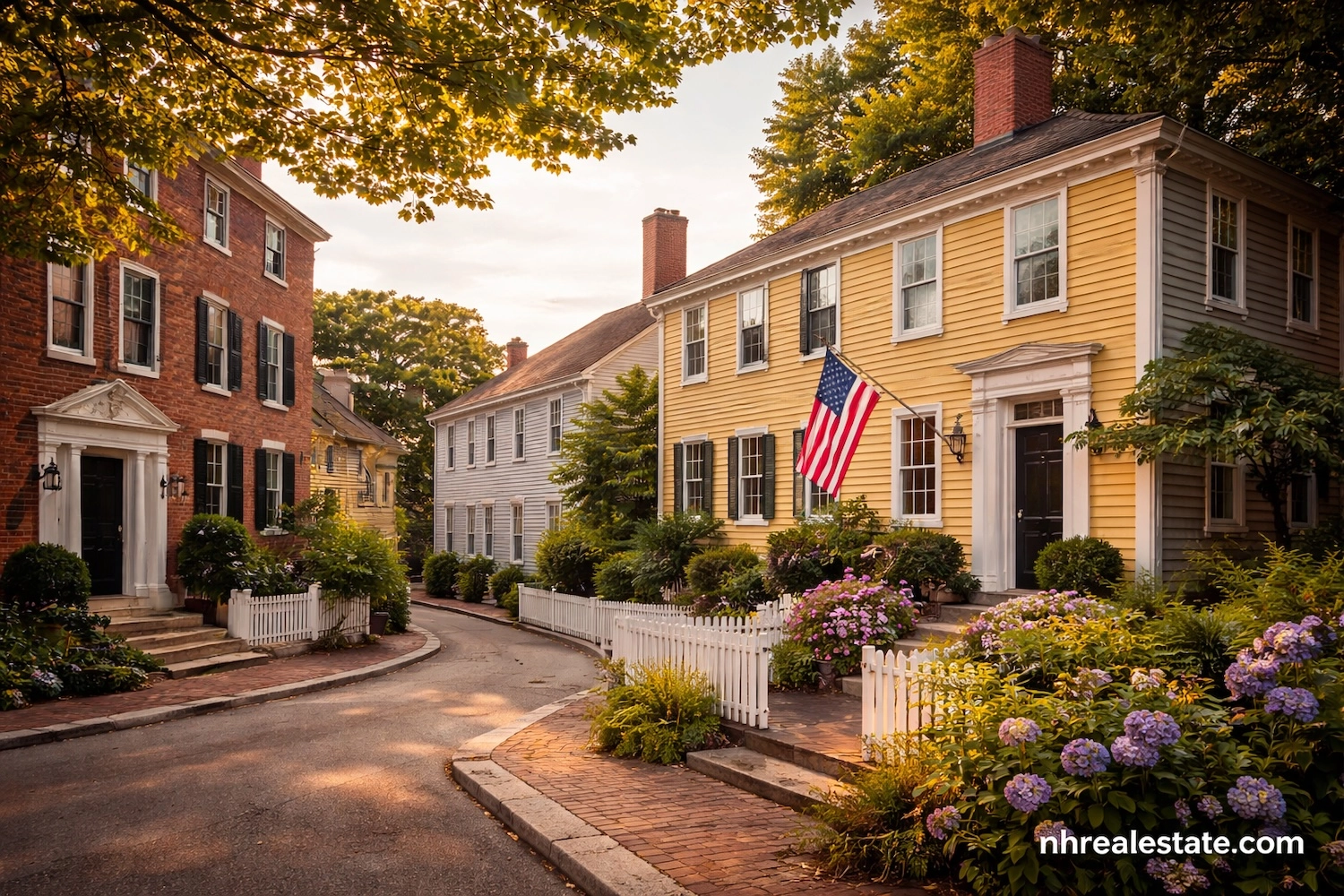
Portsmouth has been continuously inhabited since 1623, making it one of the oldest settlements in the United States. That history isn't confined to museums and plaques — it lives in the housing stock. More than 1,500 properties in the city were built before 1900, and 135 predate 1800. For buyers drawn to architectural character, hand-crafted detail, and a sense of place that no new construction can replicate, Portsmouth's historic homes represent something genuinely rare.
But buying a historic home is not like buying a new one. The rewards are significant, and so are the responsibilities. This guide covers what prospective buyers should understand before making an offer on one of Portsmouth's oldest properties.
Where Portsmouth's Historic Homes Are Concentrated
Historic homes are not evenly distributed across Portsmouth. The heaviest concentrations run through the city's oldest neighborhoods, primarily along a corridor that stretches from downtown through the West End:
| Street | Pre-1900 Properties | Character |
|---|---|---|
| State Street | 169 | Downtown's grand boulevard — Federal, Georgian, and colonial architecture |
| Islington Street | 93 | West End corridor — mixed commercial and residential, wide range of conditions |
| Middle Street | 65 | Residential backbone — some of the best-preserved colonials in the city |
| Market Street | 58 | Commercial heart — many buildings converted to condos and mixed-use |
| Union Street | 48 | Established residential — strong owner-occupancy |
| South Street | 46 | Coastal corridor — larger lots, some of the most valuable historic properties |
| Cabot Street | 45 | West End residential — more affordable end of the historic market |
The key takeaway: if you're looking at properties built before 1900, you're almost certainly looking in the downtown core, the South End, the West End, or the Lincoln/Jones/Broad Street area. Portsmouth's suburban neighborhoods — Middle Road, The Woodlands, Elwyn Park — are almost entirely post-war construction from the 1950s onward.
What Makes Historic Homes Different
The median pre-1900 home in Portsmouth is 1,764 square feet — actually larger than the median post-1960 home at 1,556 square feet. That surprises many buyers, who expect older homes to be smaller. In fact, Portsmouth's historic homes were often built with generous proportions: high ceilings, wide-plank floors, multiple fireplaces, and formal room layouts that reflect a different era of domestic life.
The median assessed value of $927K for pre-1900 homes is comparable to the post-2000 median of $997K, which means you're not necessarily paying a premium or getting a discount for age alone. The value equation for historic homes comes down to condition, location, and the extent to which the property has been thoughtfully maintained or updated.
The Inspection: What to Look For
A standard home inspection is a starting point, not an endpoint, when buying a pre-1900 home. Buyers should consider specialists in several areas:
Foundation and structure. Many of Portsmouth's oldest homes sit on stone or brick foundations that have shifted over centuries. A structural engineer can assess whether movement is historic and stable or active and concerning. Uneven floors and slightly off-plumb walls are normal in 200-year-old buildings — but the degree matters.
Mechanicals and systems. Electrical, plumbing, and HVAC in pre-1900 homes have typically been updated at least once, but the quality and recency of those updates varies enormously. Knob-and-tube wiring, galvanized steel pipes, and gravity-fed heating systems may still be present in homes that haven't been comprehensively renovated. Updating these systems is the single largest expense most historic-home buyers face.
Environmental considerations. Lead paint is present in virtually every pre-1978 home, and asbestos insulation is common in homes built before the 1980s. These materials are manageable — in many cases they can be safely encapsulated rather than removed — but buyers should factor testing and potential remediation into their budget and timeline.
Roof and envelope. The roof, siding, and windows are where deferred maintenance shows up fastest in older homes. A new roof on a historic home can cost significantly more than on a modern one due to architectural details, flashing complexity, and material requirements. Wood-framed windows — while beautiful — require ongoing upkeep or eventual replacement, either of which has cost implications.
The Historic District Question
Portions of downtown Portsmouth fall within the city's Historic District, which is overseen by the Historic District Commission (HDC). If your property is within the district, exterior changes — including windows, siding, roofing materials, additions, and demolition — require HDC approval. This is an important consideration for buyers planning renovations.
The HDC process adds time and may limit material choices (vinyl siding, for example, is generally not approved in the district). However, many homeowners view the oversight positively because it protects the character of the streetscape and, by extension, property values. A beautifully restored Federal-era home is worth more when it sits on a block of other well-maintained historic properties than when it's sandwiched between modern alterations.
Properties outside the Historic District have no such restrictions, even if the home itself is historically significant. Buyers should verify whether a specific property falls within the district boundaries before making assumptions about renovation flexibility.
Insurance and Financing
Insuring a historic home can require more effort than a standard policy. Some insurers specialize in historic properties and offer replacement-cost policies that account for the higher cost of replicating period details, custom millwork, and specialty materials. Standard policies may underinsure a historic home if they're based on modern construction replacement costs.
Financing is generally straightforward for historic homes in good condition. Conventional mortgages, FHA, and VA loans all work for properties that pass standard appraisal requirements. Where financing gets more complex is with properties that need significant work — a home with active structural issues, outdated electrical systems, or environmental concerns may not meet conventional appraisal standards, potentially requiring renovation-specific loan products like FHA 203(k) or conventional renovation loans.
The Rewards
For all the considerations above, there's a reason historic homes command strong demand in Portsmouth. The craftsmanship in a well-preserved colonial or Federal-era home is simply not available in new construction — hand-carved mantels, wide pine floorboards, original plaster moldings, and hardware that was forged by hand. These details create a sense of character and authenticity that resonates deeply with the right buyer.
There's also a practical argument: Portsmouth's pre-1900 homes have survived for over a century. The ones still standing have already demonstrated structural durability. Many have been through multiple renovations and systems upgrades, meaning a well-maintained historic home may actually present fewer surprises than a quickly built house from the 1970s or 1980s.
And the location advantage is real. Because Portsmouth's oldest homes are concentrated in the most walkable, culturally rich neighborhoods, buying historic almost always means buying into the city's best addresses. That combination of character, location, and scarcity is what keeps demand — and values — strong in this segment of the market.
The Bottom Line
Buying a historic home in Portsmouth is not for every buyer, and that's fine. It requires a willingness to invest in maintenance, patience with the realities of old construction, and an appreciation for the irreplaceable character that comes with it. The 649 single-family homes built before 1900 represent some of the most architecturally significant residential properties in New Hampshire — and for the right buyer, they offer a living experience that no modern development can match.
The most important step is working with an agent and inspector who have specific experience with historic properties. The questions to ask, the things to look for, and the potential costs to anticipate are meaningfully different from a standard home purchase. Get that expertise on your side, and buying historic in Portsmouth can be one of the most rewarding real estate decisions you'll make.
This article is one of 13 in-depth neighborhood profiles based on our analysis of 9,324 property records in Portsmouth, NH. Read the full Portsmouth NH Neighborhoods Guide →
Related Articles
The South End & Bow Street: Living in Downtown Portsmouth → Condo vs. House in Portsmouth: Which Is Right for You? → Portsmouth NH Neighborhoods Guide →We are committed to compliance with all federal, state, and local fair housing laws. We do not discriminate against any person because of race, color, religion, sex, handicap, familial status, national origin, age, marital status, sexual orientation, or gender identity. All neighborhoods in Portsmouth are open to all persons.