


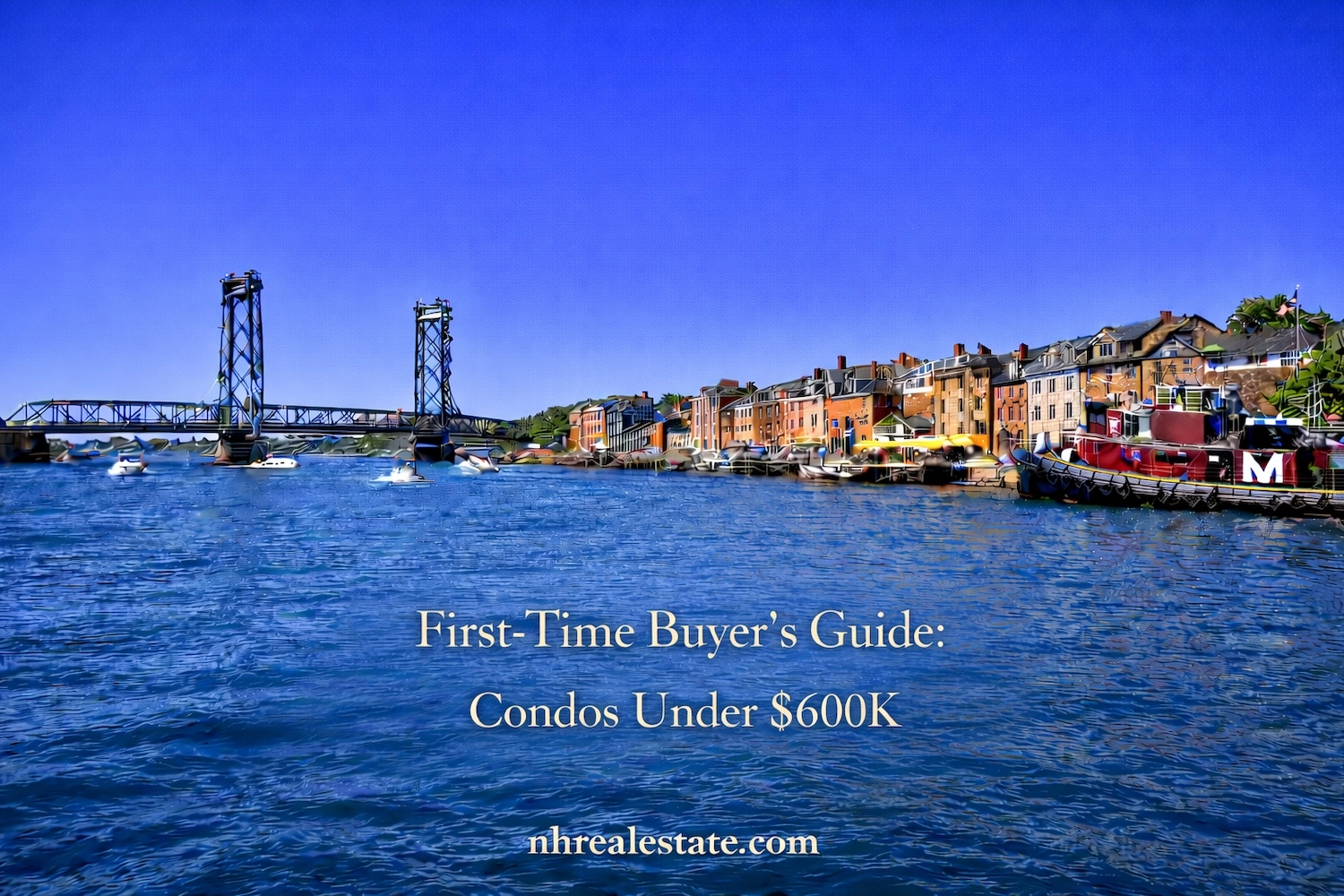
First-Time Buyer's Guide: Condos Under $600K in Portsmouth
Nearly half of Portsmouth's 2,600+ condo properties are priced under $600K. Here's how to navigate them as a first-time buyer.
The Market Reality: 45% of Portsmouth Condos Are Under $600K
Portsmouth has approximately 2,638 condo properties. Of those, roughly 1,188—nearly 45 percent—are priced under $600,000. That's significant market reality: there is substantial inventory in the sub-$600K range, across multiple neighborhoods, building types, and price segments. First-time buyers have genuine options.
The sub-$600K market spans the entire spectrum of Portsmouth condo living. At the affordable end, White Cedar and Springbrook properties cluster around $312,000 median. At the premium end of this range, you're finding better-condition properties in newer buildings or more desirable neighborhoods. Understanding this range and what your down payment, mortgage qualification, and personal priorities can achieve is essential.
The Neighborhoods Where Under-$600K Condos Are Found
Sub-$600K condos span Portsmouth's geography. Let's be geographic about it:
White Cedar/Springbrook ($312K median): The most affordable segment. These established communities offer entry-level ownership with lower prices and reasonable HOA fees. They're suburban, quiet, and family-oriented.
Spinnaker Way ($560K median): Marina-adjacent waterfront condo living. You're near the working waterfront, close to downtown, and paying a premium for that location—but still under $600K in many cases. Waterfront living requires understanding the trade-offs of shared walls, HOA fees, and working harbor environment.
Other neighborhoods: The broader SRB zone (suburban residential) and outlying areas all have sub-$600K condo inventory. You'll find properties across Portsmouth's geography at this price point.
The availability across multiple neighborhoods means you're not forced to choose between "this specific location or nothing." You can evaluate what matters to you—walkability, waterfront, community feel, school proximity, or budget maximization—and find options accordingly.
What to Expect at Different Price Points
The sub-$600K market is wide—from $300K to $600K. Expectations should adjust accordingly:
$300-400K Range: Expect modest units, likely one-two bedrooms, original or minimally renovated. These are entry-level properties—solid construction but not luxury. HOA fees are typically $200-300 monthly. Location is often suburban rather than downtown. Buildings are often established (20+ years old) but well-maintained. This is genuine first-time buyer territory.
$400-500K Range: Better condition properties, possibly renovated kitchens or bathrooms, likely two-three bedrooms. More amenities or better location. HOA fees range $250-350. You're getting substantial property improvement over the $300K range. These properties appeal to move-up buyers or those prioritizing condition.
$500-600K Range: Quality renovated units, desirable locations (possibly waterfront or near-downtown), possibly three bedrooms, newer construction or well-maintained buildings. HOA fees are $300-400. You're at the premium end of the sub-$600K market—quality property in sought-after locations. This attracts move-up buyers and investors.
Knowing where your budget sits in this spectrum helps you understand what you're actually getting and how to compare properties realistically.
FHA Financing Considerations for First-Time Buyers
Many first-time buyers use FHA financing, which allows down payments as low as 3.5% and more flexible credit requirements than conventional loans. FHA loans have limits, and they do require that the condo building meet FHA approval standards.
The FHA limit for Portsmouth properties is $726,000. That means 1,506 of Portsmouth's 2,638 condos qualify for FHA financing. Within the sub-$600K market, FHA eligibility is nearly universal—you won't struggle to find FHA-approved properties at these prices.
FHA loans also require a property appraisal and inspection, which work in your favor as a buyer. The property must meet certain standards, systems must be functional, and deferred maintenance must be addressed. This provides protection against buying a property with hidden problems.
When evaluating properties, confirm with your lender whether specific buildings meet FHA approval. Most established communities do, but occasionally a building's HOA structure or financial status creates FHA barriers. Your lender will navigate this, but it's worth knowing upfront.
Conventional Financing Alternatives
Conventional loans (non-FHA) typically require 5-10% down and have stricter credit/income requirements but offer benefits like no mortgage insurance requirements, more flexibility on property condition, and potentially lower interest rates for well-qualified borrowers.
For first-time buyers who can qualify and have down payment savings, conventional financing is worth exploring. The monthly payment can be lower without FHA mortgage insurance, which compounds over a 30-year loan.
What to Scrutinize in Older Condo Buildings
Most sub-$600K condos aren't new construction—they're in established buildings with some age. That's not bad, but it requires informed inspection and evaluation:
Roof Condition and Age: A 25+ year old roof is a liability. Ask the building's age and when the roof was last replaced. Plans for future roof replacement should show in the reserve fund.
Parking Lot and Concrete: Cracked, crumbling asphalt indicates deferred maintenance. Major parking lot work is expensive and often creates special assessments. Look at the condition and ask when last resurfacing occurred.
Windows and Siding: Single-pane windows mean higher heating costs. Original vinyl siding shows age. Modern replacement windows/siding are nice but shouldn't be required at these prices. Just understand what you're evaluating.
Heating Systems: Old oil heat or aging gas heating systems may need replacement soon. HVAC systems past 15 years are risky. Know the age and condition.
Plumbing and Electrical: Original galvanized or cast-iron plumbing is increasingly problematic. Outdated electrical panels in old buildings suggest upgrade needs. These aren't dealbreakers, but they're cost realities to understand.
HOA Reserves: Ask whether the building has funded reserves for the major expenses above. A building with deferred maintenance and underfunded reserves is a risk.
Getting a thorough home inspection is essential. Budget $400-600 for a professional inspection—it's the best money you can spend as a first-time buyer. The inspection report will detail all these issues and give you leverage to negotiate repairs or price adjustment.
The True Cost of Ownership: More Than Just Mortgage
When evaluating a sub-$600K condo, calculate your total monthly housing cost, not just the mortgage:
Mortgage payment: P&I based on your down payment and rate
Property taxes: Portsmouth's rate varies by neighborhood, but budge approximately 0.65% of property value annually
HOA fees: Typically $200-400 monthly depending on building
Insurance: Homeowner's insurance (separate from building insurance in condos): typically $700-1,200 annually
Utilities: Electric, heat, water/sewer (if not included in HOA): $150-250 monthly depending on efficiency
Example: A $500K property with 5% down on a conventional loan, at 6% rate, with $300 monthly HOA and $75/month taxes might have a total monthly housing cost around $3,500-3,700. That's meaningful information compared to just the mortgage number.
Questions to Ask About the Building and HOA
When you're seriously considering a condo, your agent should ask the HOA these questions:
- What are the current monthly HOA fees and what's included?
- Have fees increased in the past 3 years? By how much?
- What is the reserve fund percentage? (Should be 70%+ funded)
- Are any special assessments planned or in discussion?
- When was the roof last replaced and when is the next replacement anticipated?
- When was the parking lot/asphalt last resurfaced?
- What is the delinquency rate (units behind on fees)?
- Is the building FHA-approved?
- What percentage of units are owner-occupied vs. rented?
- What utilities are included in HOA fees?
Transparency and clear answers matter. If the HOA is evasive or dismissive, that's a warning sign.
Down Payment and Closing Cost Realities
FHA financing allows 3.5% down. On a $400,000 condo, that's $14,000 down payment. On a $500,000 condo, it's $17,500. Those numbers are accessible for many first-time buyers who've been saving.
But don't forget closing costs. Expect to pay 2-5% of the purchase price in closing costs: appraisal, loan origination, title insurance, attorney fees, inspections, and various lender-required items. On a $500,000 property, that could be $10,000-25,000. Budget for it or negotiate with the seller to cover some costs.
Total cash needed: down payment plus closing costs. Knowing this upfront prevents disappointing surprises at the closing table.
The Bottom Line for First-Time Buyers
The sub-$600K Portsmouth condo market is substantial, diverse, and genuinely accessible for first-time buyers. Nearly half of Portsmouth's condo inventory is in this range, meaning real options across neighborhoods, prices, and building types.
Success as a first-time buyer requires: understanding your mortgage qualification and true total cost; getting a professional inspection; scrutinizing HOA financials and building condition; asking detailed questions; and making informed decisions rather than impulse purchases.
The properties are out there. The financing is available. The market is accessible. What matters is approaching it informed, realistic, and methodical. Do that, and you'll find a condo that works for you and builds equity in Portsmouth for years to come.
Equal Housing Opportunity: Bean Group Real Estate is committed to fair and equitable treatment in all aspects of real estate services. We comply with all federal fair housing laws, including the Fair Housing Act, and New Hampshire's fair housing statute (RSA 354-A), which prohibit discrimination based on race, color, religion, sex, national origin, familial status, disability, sexual orientation, gender identity, marital status, and age. All persons are welcome to inquire about available properties without regard to protected class status.