


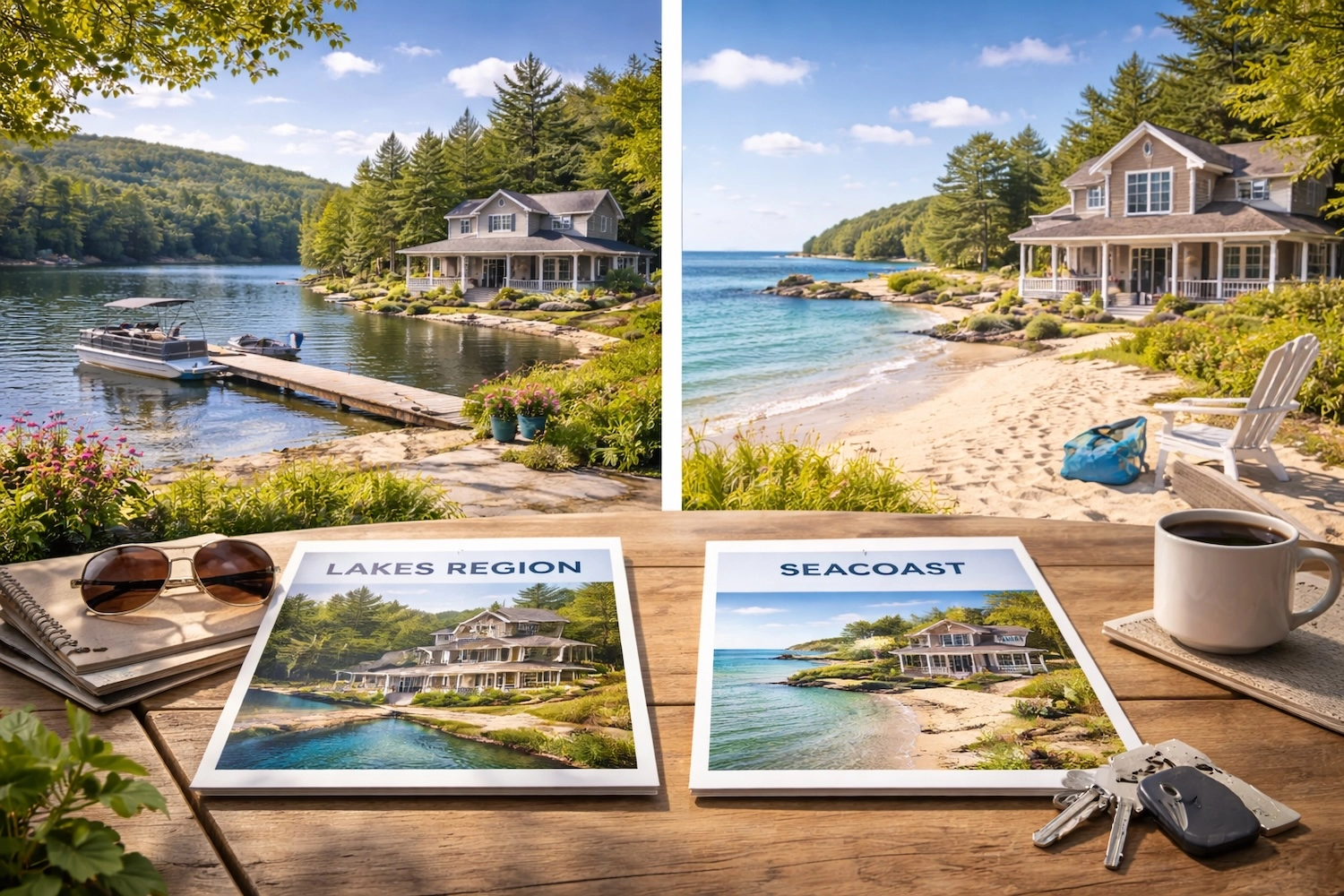
Lakefront and Waterfront Living in New Hampshire: A Comprehensive Guide to Lakes Region and Seacoast Properties
Imagine waking each morning to the soft shimmer of sunlight dancing across the water, your coffee in hand on a private balcony as loons call across the lake. This is the reality of waterfront living in New Hampshire—a lifestyle that thousands of homebuyers have pursued in recent years, driving significant growth in the state’s most coveted waterfront markets. Whether you’re drawn to the scenic beauty of Lake Winnipesaukee, the peaceful shores of Squam Lake, the exclusive Seacoast communities of Portsmouth, or the quieter charm of lakes like Sunapee and Josylvia, New Hampshire offers diverse waterfront living experiences. This comprehensive guide explores the current market dynamics, pricing trends, regulatory requirements, and practical considerations for buying waterfront property in New Hampshire in 2025 and beyond.
Understanding the New Hampshire Waterfront Market in 2025
New Hampshire’s real estate market has experienced remarkable growth over the past five years, with the statewide median single-family home price climbing to $566,250 in June 2025—up 4.9% from June 2024’s previous record of $540,000. However, this growth masks significant regional variation, with waterfront properties commanding substantially higher prices than inland homes. The overall state housing market now shows a cooling trend, with prices rising just 3.9% in 2025 compared to historical averages, signaling a transition from the explosive appreciation of prior years to a more normalized market dynamic.
The state’s attractive tax environment continues to drive demand. New Hampshire remains one of only nine states with no state income tax and no state sales tax—a significant advantage for wealthy buyers relocating from higher-tax states. Combined with the region’s strong outdoor recreation, four-season climate, and proximity to major metropolitan areas, these economic fundamentals support sustained demand for waterfront properties despite cooling price appreciation.
Current inventory levels tell an important story about the market. Active listings in New Hampshire jumped 19.6% from August 2024 to August 2025, rising from 2,705 to 3,235 homes. Despite this increase, the overall supply remains critically constrained at just two months—far below the five to seven months necessary for a balanced buyer’s market. In the Lakes Region specifically, the supply situation is even tighter, with only a 1.7-month inventory. This shortage continues to support prices, though it gives motivated sellers less leverage than in prior years.
Lake Winnipesaukee: New Hampshire’s Premier Waterfront Market
Lake Winnipesaukee, New England’s largest lake at 71,000 acres, remains the crown jewel of New Hampshire waterfront real estate. The lake stretches across 21 miles and touches 12 municipalities, including Gilford, Laconia, Alton, and Meredith, offering diverse communities with varying price points and lifestyles. In 2025, the Lake Winnipesaukee market remained active with prices reflecting both the premium location and changing buyer preferences. The median sales price on Lake Winnipesaukee reached $2.75 million, with individual properties ranging from approximately $665,000 to $8.1 million.
The market dynamic on Lake Winnipesaukee has shifted measurably in 2025 compared to the pandemic-era frenzy of 2020-2023. The spring market showed renewed activity, though no longer the aggressive multiple-offer scenarios that characterized the boom years. Even properties with strong features and desirable locations now see negotiated deals, with some sellers adjusting prices to align with market expectations. This represents a normalization after years of appreciation, creating opportunities for buyers willing to be patient and strategic.
Waterfront properties across Winnipesaukee vary significantly by location and town. Gilford and Alton tend to offer more modest cottage communities and smaller cottages, while Meredith provides upscale waterfront options with sophisticated amenities. Conversely, properties in towns like Danbury or smaller communities further north on the lake may offer better value while still providing full lake access. Properties with 100 feet or more of shoreline typically command significant premiums, with dock privileges and deep water access being critical value drivers.
Squam Lake and Lake Sunapee: Upscale and Serene Alternatives
Squam Lake, a pristine 6,765-acre lake located northwest of Lake Winnipesaukee, represents the state’s most exclusive and expensive waterfront market. The lake touches Ashland, Holderness, Center Harbor, and Moultonborough, with each community offering distinct characteristics. In 2025, Squam Lake recorded just five sales with a median price of $5.9 million—making it the priciest of New Hampshire’s major lakes by significant margin. This rarefied market serves primarily high-net-worth buyers seeking the ultimate in privacy, natural beauty, and exclusivity. Squam Lake’s shallower areas and stricter development regulations compared to Winnipesaukee have preserved its character while limiting waterfront supply.
Lake Sunapee, a 10-square-mile lake straddling the Grafton and Sullivan County line with waterfront in New London, Newbury, Sunapee, and Georges Mills, offers an excellent middle ground between Lake Winnipesaukee’s activity and Squam Lake’s exclusivity. While specific 2025 median price data for Lake Sunapee was unavailable from recent reports, the lake continues to attract buyers seeking pristine water quality, strong recreational opportunities including sailing and fishing, and an established community of waterfront homeowners. The lake’s reputation for excellent water quality and quieter, less commercial atmosphere appeals strongly to families and retirees seeking long-term waterfront homes rather than investment properties.
The Seacoast Waterfront Premium: Portsmouth and Coastal Communities
New Hampshire’s Seacoast region commands the state’s highest property values, with the median single-family home price reaching $689,000 as of August 2025—a 7.7% increase from the $640,000 median in August 2024. Portsmouth specifically demonstrates even stronger valuations. In May 2025, the median sales price for Portsmouth properties reached $1,200,000—a striking 38.7% year-over-year increase from May 2024’s $865,000. More recent data from December 2025 shows Portsmouth homes selling for a median price of $875,000, up 4.2% compared to the prior year, indicating continued strength in this premium market.
New Castle, New Hampshire’s most exclusive waterfront community, exemplifies the Seacoast’s premium positioning. With a median home value of $1,198,048—up 3.7% over the past year—New Castle properties offer unparalleled access to the Atlantic Ocean, deep water harbors, and exclusive community amenities. These communities attract buyers valuing easy maritime access, sophisticated coastal culture, and the unique appeal of living where New England heritage meets modern waterfront luxury.
The Seacoast market has shown remarkable resilience through 2025, benefiting from limited waterfront supply, strong buyer demand from out-of-state relocators, and the region’s established reputation as one of New England’s most desirable communities. New listings on the Seacoast jumped 19.8% from August 2024 to August 2025, with 333 homes entering the market compared to 278 in the prior year—yet even this increase has not significantly loosened inventory constraints.
The Lakes Region Beyond the Big Three: Hidden Gems Like Lake Josylvia
While Lake Winnipesaukee, Squam Lake, and Lake Sunapee dominate media attention, numerous other lakes throughout the Lakes Region and central New Hampshire offer exceptional waterfront living at more accessible price points. Lake Josylvia (also known as Clement Pond), located in Hopkinton, exemplifies these secondary market opportunities. These smaller lakes, typically ranging from 100 to 1,000 acres, offer compelling advantages: quieter water, stronger sense of community, lower property prices, and exceptional natural beauty.
Properties on these secondary lakes often provide excellent value relative to the big three, with waterfront homes selling well below Lake Winnipesaukee medians while offering comparable natural amenities and recreational opportunities. For buyers prioritizing peaceful solitude over high-profile market status, or seeking entry points into waterfront ownership with limited capital, these lakes represent increasingly attractive options. Properties on smaller lakes average significantly less than the region’s headline prices, with 2025 median prices varying by lake and town but generally ranging from $400,000 to $1.2 million for waterfront homes across the broader Lakes Region.
Lakes Region Market Fundamentals: County-Level Analysis
The Lakes Region encompasses three primary counties, each with distinct market characteristics:
- Belknap County (including Laconia, Gilford, and Meredith) recorded 312 single-family home sales through mid-2025 with a median price of $519,500, representing a strong market with moderate price appreciation.
- Carroll County (including Alton, Moultonborough, and Center Harbor) documented 361 single-family home sales with a median price of $492,000, offering generally more affordable waterfront entry points while maintaining strong market activity.
- Grafton County (including Ashland, Holderness, and communities surrounding Lake Sunapee) saw 372 single-family home sales with a median price of $453,500, typically the most affordable county-level market for Lakes Region waterfront seekers.
These county medians provide important context for waterfront shoppers. Waterfront properties in all three counties command significant premiums over inland equivalents—typically ranging from 50% to 200% above county medians depending on lot size, shoreline footage, water quality, and community prestige. However, the base county prices demonstrate that Grafton and Carroll Counties offer more affordable pathways to waterfront ownership compared to Belknap County’s traditionally premium positioning.
Regulatory Requirements: The Shoreland Water Quality Protection Act
Waterfront property ownership in New Hampshire involves specific regulatory obligations that every buyer must understand before purchasing. The Shoreland Water Quality Protection Act (RSA 483-B), enacted in 1991 to protect water quality and shoreline ecosystems, applies to all public waters including lakes, ponds, rivers, and tidal waters with surface areas exceeding 10 acres.
Protected Shoreland Zone: The act establishes a protected shoreland extending 250 feet landward from the reference line (the edge of the water body at full volume). Properties within this zone face specific development and maintenance restrictions designed to maintain water quality and prevent pollution.
Vegetation and Buffer Requirements: Within 50 feet from the reference line, property owners must maintain a waterfront buffer with specific tree coverage standards. The regulations use a 25-by-50-foot grid system with a point-based approach. Trees and saplings may be removed provided remaining vegetation achieves a minimum score of 25 points within each grid segment. Between 50 and 150 feet from the reference line, at least 25% of the area must be maintained in an unaltered state, preserving native vegetation and wildlife habitat.
Setback Requirements: All primary structures must be set back at least 50 feet from the reference line, and septic systems must be located at least 75 feet away. These setbacks provide crucial buffers protecting water quality from contamination and surface runoff.
Impervious Surface Limits: No more than 20% of the parcel within the 250-foot zone may consist of impervious surfaces (driveways, roofs, patios, decks) without an approved stormwater management plan. This requirement prevents excessive runoff that can degrade water quality.
Fertilizer and Pesticide Restrictions: Fertilizer application is legally prohibited within 25 feet of the reference line, and pesticide use faces similar restrictions. These rules prevent nutrient pollution and chemical contamination that degrades aquatic ecosystems.
Dock Permits and Waterfront Access
One of the most important considerations for waterfront buyers involves dock privileges and permitting requirements. New docking structures—including seasonal and permanent docks, boat lifts, and jet-ski lifts—require wetlands permits from the New Hampshire Department of Environmental Services. Repairs and modifications to existing docks may also trigger permitting requirements, though grandfathered docks (those predating current regulations) and repair/replacement of existing legal structures often avoid new permitting.
Dock Capacity: The quantity of boat slips permissible on a waterfront lot depends on average shoreline frontage. Property owners may have 2 docking slips for the first 75 feet of frontage, plus one additional slip for each additional 75 feet of shoreline. A 150-foot waterfront lot, therefore, could support 3 docking slips—significant value for buyers planning to maintain personal watercraft or rent slips to offset maintenance costs.
Permanent vs. Seasonal Docks: An important distinction governs dock permanence. Permanent docks are only permissible on waterbodies exceeding 1,000 acres in size. Smaller lakes like Josylvia may restrict property owners to seasonal docks, which must be removed during winter months. This requirement, while protecting lake bottoms from damage, affects waterfront utility and should factor into purchasing decisions.
Permitting Process: Some docking projects qualify for “permit by notification,” an expedited process allowing standard form submission. This speeds approvals for routine dock projects, while new or complex structures may require full environmental assessment. Local zoning boards and planning departments add additional requirements beyond state regulations, as towns may impose greater setbacks, floodplain restrictions, or construction standards.
Property Tax Considerations and Seasonal vs. Year-Round Classification
Waterfront property taxation in New Hampshire involves important distinctions between seasonal and year-round classifications. Town assessors may classify seasonal dwellings differently from primary residences, sometimes resulting in higher assessment rates for properties assessed as seasonal-only. However, once a property is winterized and used year-round, assessments often increase substantially as assessors reclassify it as a primary residence.
The financial implications deserve careful analysis. A seasonal waterfront property might carry lower annual taxes than an equivalent year-round home, but the differential could disappear if plans change and year-round occupation becomes desired. Buyers should obtain detailed tax information from town assessors before purchasing, projecting tax costs under both seasonal and potential year-round scenarios.
Additionally, waterfront properties sometimes face special assessment considerations related to septic systems, water quality programs, and lake association memberships. Many waterfront communities charge property owners annual fees to support lake maintenance, water quality monitoring, and public access preservation. These fees typically range from $200 to $500 annually on smaller lakes but can exceed $1,000 on larger, more developed lakes like Winnipesaukee. Buyers should review all existing assessment and fee obligations during due diligence.
Waterfront Considerations: Infrastructure, Maintenance, and Year-Round Living
Waterfront ownership creates unique infrastructure challenges. Septic system design requires careful engineering to meet the 75-foot setback requirement while ensuring adequate drainage on shoreline properties with potentially poor soil conditions. Shoreline stabilization using environmentally compliant methods may cost $5,000 to $15,000 or more, depending on erosion severity and property dimensions. The Shoreland Water Quality Protection Act prohibits many traditional methods, requiring property owners to use vegetated or natural stabilization approaches rather than bulkheads or rip-rap in many situations.
Dock maintenance and waterfront structures demand ongoing attention. Seasonal dock removal and spring reinstallation creates spring and fall work cycles. Year-round docks require winter preparation and spring inspection. Boathouses, boat lifts, and other waterfront structures require regular maintenance to withstand New England weather extremes.
Winter waterfront living presents additional challenges. Snow removal from long driveways, ice on access roads, and water supply freezing issues affect year-round properties in northern locations. Some waterfront properties, particularly on remote lakes or in mountains, can become difficult or impossible to access during severe winter weather. Buyers planning year-round occupation should understand these risks and plan accordingly.
Market Trends and Future Outlook for 2026 and Beyond
Looking forward, several trends suggest the waterfront market will continue evolving in 2026 and beyond. Mortgage rate projections play an important role. As of December 2025, the average 30-year fixed mortgage rate stood at 6.22%, with Fannie Mae projecting rates could decline to 5.9% by late 2026. Lower rates would improve buyer affordability and potentially accelerate demand, though modest home value growth is projected. Zillow projects home values will rise approximately 1.2% in 2026, while Redfin forecasts similar 1% growth—dramatically below historical averages and reflective of the market’s transition from appreciation-driven dynamics.
Inventory levels will likely remain constrained. With only two months of supply statewide and just 1.7 months in the Lakes Region, sustained low inventory will continue supporting prices despite moderate appreciation. New Hampshire’s ongoing population inflow, driven by its tax advantages and lifestyle appeal, suggests demand will remain solid even as national housing trends moderate.
Environmental pressures on lakes will increasingly influence waterfront values. Water quality concerns, invasive species management, and lake preservation efforts will likely drive property values toward properties with excellent water quality and strong lake protection programs. Lakes investing in aquatic weed management and water quality monitoring will likely outperform lakes facing environmental challenges.
The Waterfront Buying Process: Key Considerations
Purchasing waterfront property requires additional due diligence beyond standard residential transactions. Prospective buyers should prioritize several critical steps:
- Shoreland Compliance Verification: Confirm the property complies with all Shoreland Water Quality Protection Act requirements. Request documentation of buffer zones, impervious surface coverage, and any prior violations or enforcement actions. Noncompliance could require expensive remediation.
- Dock and Access Rights: Verify existing dock permits and grandfathered status. Confirm available docking slips and seasonal vs. permanent dock authorization. Determine if access rights are appurtenant to the property or subject to shared easements.
- Water Quality and Testing: If the property relies on well water, request testing results for contamination risks. Research the lake’s water quality history and any active environmental concerns including invasive species or algae blooms.
- Survey and Setback Verification: Obtain a professional survey confirming structure setbacks meet current regulations. Setback violations could require costly modifications or affect future resale value.
- Tax Assessment Review: Obtain detailed tax assessment information including any special assessments, lake association fees, and projected taxation under year-round occupation scenarios.
- Septic System Inspection: Require professional inspection of septic systems, which may be older or more complex on waterfront properties. Systems failing to meet 75-foot setback requirements could necessitate expensive replacement.
- Flood Zone Determination: Verify FEMA flood zone classification and obtain flood insurance quotes. Waterfront properties face elevated flood risk, and insurance costs can significantly impact carrying expenses.
- Winter Access Assessment: For properties in northern locations, confirm winter accessibility and infrastructure capabilities. Discuss seasonal road maintenance with neighbors and town officials.
Why Waterfront Living Appeals to Discerning New Hampshire Buyers
Despite regulatory complexity and maintenance requirements, waterfront living continues attracting buyers willing to invest significant capital and accept ongoing obligations. Waterfront properties offer intangible benefits that transcend financial analysis: daily connection to natural beauty, recreational opportunities literally at the doorstep, and the psychological restoration that water-adjacent living provides. For retirees, families seeking distinctive lifestyle changes, and high-net-worth individuals pursuing aspirational properties, waterfront ownership justifies the premium pricing and regulatory requirements.
The New Hampshire waterfront market demonstrates this appeal through sustained demand across multiple lake systems and price tiers. Whether seeking Lake Winnipesaukee’s established prestige, Squam Lake’s serene exclusivity, the Seacoast’s sophisticated coastal culture, or quieter lakes like Sunapee and Josylvia, buyers consistently choose waterfront locations as lifestyle centerpieces.
Working with Experienced Waterfront Specialists
The complexity of waterfront transactions—encompassing shoreland regulations, permit requirements, specialized financing, and environmental considerations—demands collaboration with real estate professionals experienced in lakefront and coastal properties. Agents specializing in waterfront real estate understand the regulatory landscape, can identify properties with favorable compliance histories, and know which lake communities offer the best value and lifestyle fit for different buyer profiles.
Bean Group, brokered by eXp Realty, specializes in New Hampshire waterfront properties across the Lakes Region and Seacoast. With deep knowledge of specific lake markets, regulatory requirements, and community characteristics, Bean Group can guide buyers through every stage of waterfront property acquisition—from initial market exploration through closing and beyond. Whether you’re seeking your first waterfront property or expanding an established portfolio, Bean Group’s expertise in Lakes Region and Seacoast markets ensures access to the finest opportunities and professional support navigating the unique complexities of waterfront real estate.
Contact Bean Group today to explore waterfront opportunities across Lake Winnipesaukee, Squam Lake, Lake Sunapee, Lake Josylvia, the NH Seacoast, and countless other pristine lakes throughout New Hampshire. Whether you seek primary residence, vacation retreat, or investment property, our team is ready to help you find the perfect waterfront home and guide you confidently through every step of the purchasing process.
Continue your research: Use the New Hampshire waterfront homes guide to continue from statewide lifestyle research into current search and buyer due diligence.