


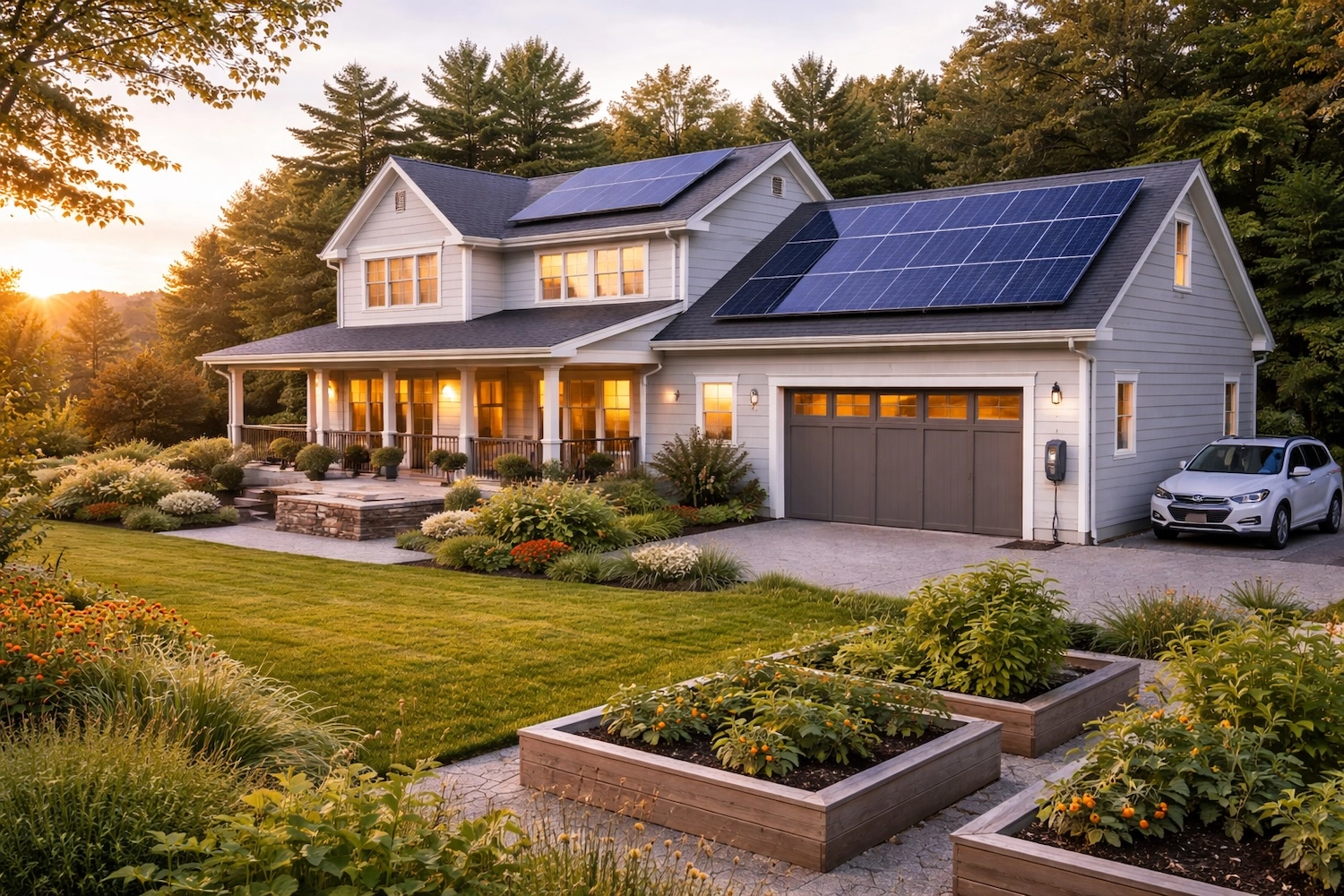
Energy-Efficient & Solar-Ready Homes in New Hampshire: A Data-Driven Value Analysis
New Hampshire homeowners face one of the Northeast's most demanding climates. Winter temperatures plunge below zero, heating seasons stretch from October through April, and energy bills can easily exceed $3,500 to $4,500 annually for homes relying on oil, propane, or inefficient electric resistance heating. Yet today's energy-efficient homes equipped with solar readiness offer a path to dramatically reduce these costs while increasing property value and home comfort. As utility rates climb and building codes tighten, understanding energy efficiency investments has become essential for both buyers and existing homeowners seeking long-term financial stability. This comprehensive guide explores the real costs, documented returns, and practical steps to maximize value through energy efficiency and solar technology in New Hampshire's challenging climate.
The Economics of High Energy Costs in New Hampshire
New Hampshire's median home price of approximately $535,000 reflects strong regional demand, yet hidden energy expenses often reduce true affordability. A typical colonial or ranch home from the 1970s through 1990s, heated with oil or propane and lacking modern insulation standards, consumes roughly 1,000 to 1,500 gallons of heating oil per winter at current prices (approximately $3.50–$4.00 per gallon in 2025), translating to $3,500–$6,000 annually. Homes with electric resistance heating or older forced-air furnaces face comparable or worse utility expenses.
In contrast, a well-designed energy-efficient home incorporating high-performance insulation, advanced HVAC systems, and proper air sealing can reduce heating energy consumption by 40% to 60% compared to code-minimum construction. For the median New Hampshire homeowner, this translates to $1,400–$2,400 in annual heating savings alone—or approximately $28,000 to $48,000 over a 20-year ownership period, not accounting for the continuing rise in energy prices.
Understanding Energy Efficiency: Foundation to Finish
True energy efficiency results from an integrated approach across multiple building systems. The term refers to a home's ability to maintain comfort while minimizing energy consumption. In New Hampshire's cold climate, the building envelope—the barrier separating conditioned interior space from outdoor elements—is paramount.
The Building Envelope: Where Heat Loss Begins
Energy flows through five primary pathways in a typical home: through the attic, basement/foundation, walls, windows and doors, and air leaks at penetrations and joints. Modern construction addresses each:
- Attic insulation: Older homes often feature only R-19 to R-30 insulation in attics, inadequate for New Hampshire's heating demands. Code-minimum construction now requires R-38 to R-49. High-performance homes routinely achieve R-60 to R-100 through dense-packed cellulose, spray foam, or rigid board insulation. This single improvement can reduce heating costs by 15% to 25%.
- Wall insulation and thermal bridging: Traditional 2-by-4 framing with fiberglass batting provides modest protection. Advanced strategies include continuous exterior rigid foam insulation that eliminates thermal bridging through studs, or dense-packed cellulose blown into walls. Modern high-performance homes achieve effective R-values of R-25 to R-35 in walls.
- Foundation and basement: Ground-sourced heat loss often receives insufficient attention. Insulating rim joists (the band joist where rim board meets foundation) and adding 2 to 4 inches of rigid foam to foundation walls reduces basement heat loss significantly. New high-performance homes incorporate 6 to 10 inches of insulation below slab or on crawl space walls.
- Air sealing: A building envelope's effectiveness depends critically on controlling uncontrolled air infiltration. Blower-door testing, which depressurizes homes to measure air leakage, has become standard in quality construction. Modern code-minimum homes achieve approximately 7 air changes per hour (ACH) at 50 pascals pressure. High-performance homes target 1.5 to 3 ACH. This is achieved through meticulous sealing of rim joists, penetrations, electrical outlets, and mechanical chases, combined with properly installed air barriers.
Advanced Windows and Doors
Windows are responsible for approximately 25% to 40% of residential heat loss in cold climates. High-performance windows address this through:
- Triple-pane glazing: Older homes feature single-pane windows, contributing significantly to heat loss. Double-pane units reduce loss by roughly 50%. Triple-pane units with insulated frames reduce loss by 65% to 75% compared to single-pane, with U-values typically in the 0.15 to 0.25 range (lower is better).
- Low-emissivity (low-E) coatings: Microscopic metallic layers on glass reflect radiant heat inward during winter while allowing solar gains to penetrate. Winter and summer variants optimize seasonal performance.
- Insulated frames: Vinyl, fiberglass, or foam-core frames with multiple chambers conduct far less heat than aluminum. Frame insulation value is often as important as glass performance.
- Advanced door assemblies: Triple-weatherstripped doors with foam-filled frames minimize infiltration at entry points.
Mechanical Systems: The Heart of Efficiency
Building envelope improvements create the potential for efficiency; mechanical systems capture and deliver those gains:
- Cold-climate heat pumps: Air-source heat pumps have evolved dramatically. Modern cold-climate units, including both ductless mini-split and centrally-ducted systems, maintain capacity and efficiency even when outdoor temperatures fall to -13°F or lower. Unlike traditional heat pumps, which lose efficiency in cold weather, cold-climate units incorporate variable-speed compressors, improved refrigerants, and intelligent controls. A cold-climate heat pump replacing an inefficient 20-year-old furnace can reduce heating energy by 40% to 60% while simultaneously providing cooling.
- High-efficiency boilers and furnaces: If heat pumps are not feasible, modern condensing boilers (gas or propane) achieve efficiencies above 95%, compared to 70-80% for systems from the 1980s and 1990s. Annual savings from this upgrade alone can reach $500 to $800 for typical households.
- Heat recovery ventilation (HRV) and energy recovery ventilation (ERV): Tight building envelopes require controlled ventilation to maintain indoor air quality. HRV/ERV systems transfer heat from outgoing stale air to incoming fresh air, recovering 75% to 85% of heat that would otherwise escape. For a typical New Hampshire home, this translates to 10% to 15% additional savings on ventilation losses.
- Heat pump water heaters: Electric resistance water heating is highly inefficient. Heat pump water heaters achieve 2.0 to 3.5 times the efficiency of resistance units, with modest operational costs even in cold climates. NHSaves currently offers a $750 rebate on qualifying heat pump water heater installations (2025).
Controls and Smart Automation
A well-designed home performs optimally only when occupants use it effectively. Smart controls include:
- Programmable and learning thermostats that adjust schedules based on occupancy patterns and weather forecasts
- Occupancy sensors that disable lighting and reduce ventilation in unoccupied rooms
- Smart electrical panels and submetering that provide real-time visibility into energy use
- Integration with solar systems to prioritize use of on-site generation
- Remote monitoring that alerts occupants to heating system malfunctions or unusual consumption patterns
The Combined Impact: Quantifying Efficiency Gains
When these improvements work in concert, the results are substantial. A home that improves from a HERS score of 130 (approximately 30% more efficient than code-minimum new construction) to a score of 50 (highly efficient) can reduce annual site energy consumption by more than 60%. For a household currently spending $4,000 annually on heating and cooling, this equates to $2,400 in savings—every single year.
Solar-Ready Design: Building Tomorrow's Generation Today
Solar readiness means designing and constructing a home to accommodate photovoltaic (PV) installation efficiently, whether the owner installs panels immediately or waits. This approach costs little during new construction but can save thousands during future installation.
Key Solar-Ready Design Elements
- Roof orientation and pitch: South-facing and west-facing roofs with minimal shading from trees or structures receive optimal sunlight. Roofs pitched between 30 and 45 degrees are ideal for New Hampshire's latitude. Builders can design homes to prioritize solar-suitable roof planes.
- Structural load capacity: Solar panels and racking systems weigh approximately 4 to 8 pounds per square foot. Roof trusses and framing must accommodate this load. During design, engineers specify trusses capable of supporting panels; retrofit installations often require structural reinforcement, an expensive and disruptive process.
- Electrical infrastructure: Solar-ready homes include pre-installed conduit running from the attic to the main electrical panel, sparing future installers from wall penetrations and drywall repair. The main service panel should have capacity for a 100+ ampere breaker dedicated to the solar inverter and battery backup system. Upgrading panels costs $2,000 to $3,000 when done during construction but can exceed $6,000 in a retrofit.
- Roof penetration management: Vent stacks, plumbing vents, and chimneys should be located on the north side or clustered to preserve contiguous south-facing roof space for the array.
- Utility interconnection planning: Designing the location of the combiner box and inverter near the electrical panel minimizes wiring runs and reduces installation costs.
Net Metering and New Hampshire's Solar Advantage
New Hampshire law mandates net metering, allowing homeowners to receive credits for excess electricity fed to the grid. During sunny days, a solar array may generate more power than the home consumes; that excess power flows to the grid and is credited at the retail electricity rate. During winter nights, the home draws power from the grid at the same rate, effectively using grid credits generated during summer months. This virtual battery storage system is far more economical than purchasing and maintaining physical battery systems for most homeowners.
Current Solar Costs and Incentives in New Hampshire
As of early 2026, a typical residential solar installation in New Hampshire costs approximately $3.05 per watt installed, or roughly $15,250 for a 5 kW system. This is above the national average but reflects New England's higher labor and permitting costs, as well as regional pricing.
Federal Solar Tax Credit and Incentives
The 30% federal solar Investment Tax Credit (ITC) has been a cornerstone of solar economics. However, recent federal policy changes mean homeowners should verify current incentive details, as credits and their phase-outs may have changed from 2025 through 2026. Prospective solar customers should confirm current federal incentives with their tax advisor or installer before making decisions.
New Hampshire and Regional Incentives
New Hampshire itself does not currently offer a state-level solar tax credit. However, property tax exemptions exist in some municipalities that exclude solar installations from property tax assessments, preventing the added system value from triggering higher annual taxes. Homeowners should inquire with their town assessor about local policies.
Additionally, New Hampshire participates in utility rebate programs through NHSaves, though rebates for solar systems themselves are limited. However, rebates for supporting efficiency improvements (insulation, air sealing, heat pumps) can total up to $6,000, effectively reducing the net cost of a whole-home efficiency and solar strategy.
Solar ROI in New Hampshire: The 25-Year Perspective
Despite New England's higher upfront costs, solar economics remain compelling in New Hampshire. A homeowner investing $15,250 in a 5 kW system after federal incentives (assuming a 30% credit), net of incentives approximately $10,675, can expect to save an average of $50,536 over 25 years in avoided electricity purchases. This assumes:
- Approximately 1,150 kWh of generation per installed kilowatt annually (typical for southern New Hampshire)
- Initial electricity rates of $0.16-$0.18 per kWh (2025 New Hampshire average)
- Electricity rate inflation of 2.5% annually (below historical averages)
- No major system repairs or inverter replacement during the 25-year period (typical; systems are warrantied 25 years)
This translates to a simple payback period of approximately 6 to 8 years, with 17 to 19 years of nearly free electricity generation afterward. Internal rates of return typically exceed 10% annually, competitive with conservative investments.
Energy-Efficient Homes and Resale Value: What the Data Shows
One of the strongest arguments for efficiency and solar investments is their measurable impact on property values. Recent research paints a compelling picture:
Overall Energy Efficiency Premium
Freddie Mac's comprehensive economic analysis of single-family homes (2013-2017, the largest national study of its kind) found an average resale price premium of 2.7% for rated energy-efficient homes. More significantly, homes at higher efficiency levels commanded premiums of 3% to 5% compared to less-efficient rated homes. Regional studies confirm these trends:
- Maryland (2012-2015): Energy Star-certified homes sold for 2% to 5% premiums
- Texas (Austin/Round Rock, 2009-2016): 6% average premium
- Pacific Northwest (Oregon, Idaho, Washington): Premiums up to 8%
Applied to New Hampshire's $535,000 median home price, even a conservative 2.7% efficiency premium equates to approximately $14,445 in added resale value. A 5% premium would add $26,750.
Solar Panel Premium
Homes with installed solar panels consistently sell for measurable premiums. Recent studies show:
- National averages: 4% to 6% premium, adding approximately $15,000-$20,000 in value for typical homes
- 2025 SolarReviews study: 6.9% average premium
For a New Hampshire $535,000 home, a 5% solar premium represents approximately $26,750 in added value at resale. Notably, these premiums are not merely appraisal adjustments; they reflect what actual buyers are willing to pay, as evidenced by comparing sold prices of solar and non-solar homes in comparable markets.
ENERGY STAR Certification Impact
Homes certified by ENERGY STAR, which requires documented efficiency meeting specific standards, experience additional resale strength. Across multiple markets, ENERGY STAR certifications correlate with 2% to 5% price premiums, and in some regions have reached 6% to 8%. More importantly, 79% of homebuyers rank whole-home ENERGY STAR certification among the top five most-wanted green features, indicating strong and growing buyer demand.
Market Trends: 2025-2026 Outlook
The market for efficient homes is accelerating. A 2025 survey by the National Association of REALTORS found that 58% of real estate professionals report that highlighting energy-efficient features in listings adds measurable value. Energy-efficient homes are increasingly perceived as baseline expectations rather than luxury upgrades, particularly in competitive markets like New Hampshire's.
Cost vs. ROI: Do Efficiency Investments Pay Off?
Improving a home's energy efficiency requires upfront investment. A comprehensive retrofit of an older home including attic insulation (R-60), air sealing, foundation insulation, high-performance windows, and a cold-climate heat pump system might cost $35,000 to $55,000 depending on home size and existing conditions.
However, the payback analysis clearly justifies the investment:
- Direct utility savings: A 50% reduction in heating and cooling costs on a $4,000 annual energy bill saves $2,000 per year. Over 20 years, accounting for modest energy price inflation (2% annually), cumulative savings exceed $50,000.
- Reduced maintenance: Modern HVAC systems operate more efficiently and require less frequent service. Heat pumps eliminate annual furnace tune-ups and oil tank maintenance. Expected maintenance cost savings: $1,500 to $3,000 over the retrofit period.
- Improved comfort: High-performance homes eliminate cold drafts, uneven temperature zones, and excessive humidity. This non-financial value is significant for families but is challenging to quantify.
- Resale value premium: A $50,000 retrofit that enables a 3% to 5% resale value increase on a $535,000 home generates $16,050 to $26,750 in added property value. Combined with utility savings, the investment is recovered within 15 to 25 years, with ongoing savings accruing thereafter.
- Financing advantage: Utility savings often exceed the increased mortgage payment from financing efficiency upgrades. A homeowner financing $50,000 at 6% over 20 years adds approximately $300 per month to the mortgage; utility savings of $150 to $200 per month offset 50% to 67% of this cost.
Government Incentives and Programs: Maximizing Value
Multiple programs help offset the cost of efficiency and solar investments in New Hampshire:
Federal Incentives (Inflation Reduction Act)
The Inflation Reduction Act, signed into law in 2022, provides robust tax credits for energy improvements:
- Insulation and air sealing: 30% credit, up to $1,200
- Windows and doors: 30% credit, up to $600 total
- Heat pumps (for heating/cooling and water heating): 30% credit, up to $2,000
- Home energy audits: 30% credit, up to $150
NHSaves Program: New Hampshire's Primary Efficiency Resource
NHSaves, funded by New Hampshire's utility companies (Eversource, Liberty Utilities, NH Electric Co-op, and Unitil), offers rebates and incentives including:
- Comprehensive energy audits: No-cost professional audits conducted by certified auditors using blower-door testing, thermal imaging, and other diagnostics. Audits identify cost-effective upgrades tailored to each home.
- Air sealing and insulation rebates: 100% reimbursement of air sealing costs and 75% rebate on insulation installation, up to $3,000 total for weatherization improvements.
- Heat pump rebates: Up to $1,200 per ton for ductless mini-split systems; $1,000 per ton for centrally-ducted systems. A typical residential mini-split installation (1.5 to 2 tons) qualifies for $1,200 to $2,400 in rebates.
- Heat pump water heater rebates: $750 per qualified unit (2025 rates).
- Thermostat and controls: Rebates for smart thermostats and advanced controls.
- Combined rebate cap: Residential customers may access up to $6,000 in total NHSaves rebates across multiple upgrade categories.
NHSaves Process (2025): Installations must be completed between January 1 and December 31, with rebate forms postmarked by January 31 of the following year. Processing typically takes 6 to 8 weeks after approval.
State and Municipal Programs
New Hampshire's Community Development Finance Authority offers 0% financing for efficiency improvements up to $15,000, available to homeowners with incomes at or below 100% of state median income. Additionally, some municipalities offer property tax exemptions or abatements for solar installations, preventing the added system value from increasing annual property taxes.
Evaluating Energy Efficiency When Buying a Home
For homebuyers, understanding a property's efficiency is as important as foundation condition or roof age. Key evaluation steps:
Request Seller Documentation
Ask for the seller's utility bills for the past 24 months. Comparing utilities (heating season averages, summer cooling costs) reveals the home's actual operating expenses and can indicate efficiency issues. A home heating $500+ monthly in winter or showing unusual consumption variations may warrant further investigation.
Review HERS Scores and Certifications
If available, request the home's Home Energy Rating System (HERS) score. The HERS Index ranges from 0 to 150:
- Score of 100 = code-minimum new construction
- Score of 50-80 = high-performance home (significantly more efficient than code)
- Score of 0 = net-zero home (produces as much energy as it consumes)
Lower scores indicate superior efficiency. If the home carries ENERGY STAR, LEED for Homes, Passive House, or Department of Energy Zero Energy Ready certification, these represent independently verified efficiency levels.
Professional Energy Assessment
For significant purchases, hire a home energy rater or certified building analyst to conduct a professional HERS assessment (approximately $400 to $800). This investment is repaid many times over in avoided surprises and negotiation leverage. The assessment identifies air tightness, insulation levels, equipment performance, and specific upgrade opportunities.
Visual Inspection Indicators
During showings, observe:
- Windows and doors: Single-pane windows and loose weatherstripping signal inefficiency. Multi-pane, insulated-frame units indicate modern construction or recent upgrades.
- HVAC equipment: A furnace or boiler with a manufacturing date visible on the unit indicates age. Equipment older than 20 years is approaching end-of-life. Well-maintained, high-efficiency units are a positive sign.
- Attic access and visible insulation: Request attic access and observe insulation depth. R-30 or less suggests older construction; R-50+ indicates modern standards.
- Basement and rim joist condition: Evidence of water infiltration, mold, or severely deteriorated insulation indicates past moisture problems and poor envelope control.
- Thermostat type: A programmable or smart thermostat suggests efficiency-conscious ownership. A simple mechanical dial may indicate deferred maintenance.
Solar Readiness Assessment
Evaluate roof orientation, pitch (30-45 degrees is ideal), age, and shading from nearby trees or structures. Request site maps or aerial photos to assess solar potential. For established homes without solar, confirm roof condition; installing solar on a roof nearing end-of-life is uneconomical. Confirm adequate space and structural support near the main electrical panel for future inverter and combiner equipment.
Upgrading an Existing Home: A Practical Roadmap
For homeowners not ready to move but eager to reduce energy costs, a phased approach maximizes value:
Step One: Energy Audit
Hire a certified energy auditor or building analyst for a comprehensive assessment. NHSaves offers no-cost audits through its program partners. The audit uses blower-door testing, thermal imaging, and equipment assessment to identify the most cost-effective improvements for your specific home.
Typical audit findings include:
- Air leakage locations (rim joists, attic penetrations, ductwork leaks)
- Insulation levels in each assembly (attic, walls, basement)
- Heating/cooling equipment efficiency and condition
- Window and door performance
- Ventilation adequacy and indoor air quality status
- Water heating efficiency
- Recommended improvements ranked by cost-effectiveness (ROI)
Step Two: Weather Sealing and Insulation
Most audits recommend air sealing as the first improvement. Sealing the attic floor is typically first priority: air leaks at rim joists, around recessed lighting, and through ductwork penetrations. A typical 2,000 square-foot home might achieve $500 to $1,500 in annual heating savings from attic air sealing and insulation, with a payback period of 3 to 5 years before accounting for utility incentives.
NHSaves rebates cover 100% of air sealing costs and 75% of insulation costs, dramatically reducing out-of-pocket expense. A homeowner spending $3,000 on air sealing and insulation might receive $2,000+ in rebates, lowering true cost to $1,000 and shortening payback to 1 to 2 years.
Step Three: Heating System Upgrade
If the home's heating system is 15+ years old, replacement should be considered. Oil furnaces and boilers from the 1990s operate at 70-80% efficiency; replacing with a high-efficiency propane or natural gas system achieves 90-95% efficiency, yielding 15-25% heating cost reductions. For the $4,000 annual heating bill scenario, this saves $600 to $1,000 per year.
Cold-climate air-source heat pumps, increasingly popular in New Hampshire, offer both heating and cooling in a single system. Though requiring $8,000 to $12,000 per ton for installation (approximately $12,000 to $18,000 for a typical 1.5-2 ton system), NHSaves rebates of $1,200 to $2,400 plus 30% federal tax credit reduce net cost significantly. A homeowner spending $15,000 might receive $1,500 in rebates and $1,500 in federal credits, reducing net cost to $12,000, with cumulative heating and cooling savings of $1,500 to $2,500 annually.
Step Four: Window and Door Replacement
Replacing single-pane or deteriorated double-pane windows with modern triple-pane, low-E units costs approximately $500 to $800 per opening. A home with 15 windows might spend $7,500 to $12,000. ROI is longer (10-15 years) due to high costs, but federal 30% credits and utility rebates can offset 30% to 40% of expenses. Window replacement is often timed with siding replacement or major renovations to minimize disruption costs.
Step Five: Solar Installation
Once the home's efficiency is optimized, solar installation is more effective. A high-performance home requires a smaller solar array (and thus lower cost) to meet the same percentage of consumption compared to an inefficient home. Additionally, pre-planning during earlier efficiency work (e.g., upgrading electrical panel capacity, installing conduit runs) reduces solar installation costs.
Case Study: A Retrofit Success Story Spanning Five Years
Consider the experience of a four-bedroom colonial built in 1983 in central New Hampshire. At purchase, the home featured:
- Fiberglass batting in walls (R-11), minimal attic insulation (R-13)
- Single-pane windows in bedrooms, older double-pane windows on first floor
- 20-year-old oil furnace with 72% efficiency rating
- Electric baseboard resistance heating in finished basement
- Annual heating bill: $4,200; cooling: $1,200 (central AC added in 2000, oversized and inefficient)
Year One: Audit and weather sealing ($3,000 out-of-pocket)
- NHSaves energy audit identified $8,000 in cost-effective improvements
- Air sealed attic floor, sealed basement rim joists, sealed ductwork leaks
- Added 12 inches of blown cellulose to attic, achieving R-48
- NHSaves rebate: $2,000 (100% air sealing, 75% insulation)
- Result: 18% reduction in heating costs ($756 annual savings)
- Simple payback: 4 years before rebates, 2 years after
Year Two: Heating system replacement ($14,000 out-of-pocket)
- Replaced oil furnace with high-efficiency propane boiler (95% AFUE)
- Added zone control to basement, allowing lower winter temperature in unoccupied space
- NHSaves rebate: $1,000 (equipment); Federal tax credit: $2,000 (home improvement credit)
- Net cost: $11,000
- Result: 28% reduction in heating costs ($1,176 annual savings)
- Combined with Year One savings: $1,932 annual utility reduction
- Simple payback: 5.7 years (Year One + Two improvements combined)
Year Three: Windows and smart thermostat ($8,500 out-of-pocket)
- Replaced 8 oldest single-pane windows with triple-pane, low-E units
- Installed smart programmable thermostat with learning capability
- NHSaves rebate: $200 (small, window rebates are limited); Federal credit: $1,800 (30% of window cost)
- Net cost: $6,500
- Result: Additional 8% heating cost reduction ($336 annual savings); thermostat optimization yielded another 5% savings ($93)
- Cumulative annual savings: $2,361
Year Five: Solar installation ($18,000 out-of-pocket)
- Installed 6.5 kW solar array, sized to offset 80% of remaining electrical consumption
- Upgraded main electrical panel during previous siding replacement project (cost absorbed there)
- Pre-installed conduit from earlier planning saved $2,000 in installation labor
- Federal tax credit: 30% (assuming available) = $5,400
- Net cost: $12,600
- Annual electricity generation: 7,500 kWh (valued at $0.17/kWh average rate)
- Annual solar benefit: $1,275 direct savings + utility bill credits
- Simple payback: 10 years; 25-year cumulative value: $31,875 (accounting for electricity rate inflation)
Five-Year Summary:
Total out-of-pocket investment: $36,000 (across 5 years, avoiding cash-flow pressure). Total rebates and incentives: $8,400. Net investment: $27,600. Cumulative annual utility savings: $2,361 (from Years 1-3) + $1,275 (solar, Year 5) = approximately $3,636 annually.
Within 7.6 years, the home recovers its efficiency and solar investments through utility savings alone. Beyond that point, savings continue to accrue. Over 25 years, cumulative utility savings exceed $90,000. Additionally, the home's resale value improved by an estimated $16,000 to $26,750 (3-5% premium for efficiency and solar), and the home's comfort, air quality, and marketability increased substantially.
New Hampshire Solar Incentives and Current Status (2025-2026)
New Hampshire's solar landscape continues to evolve. Key points:
- Net metering remains in effect: Homeowners receive retail-rate credits for excess generation, making battery backup economically optional for most.
- Property tax considerations: Some municipalities offer exemptions preventing solar systems from increasing assessed property value. Homeowners should confirm local policy with their assessor before installation.
- Federal incentives are subject to change: The 30% federal solar credit has historically been extended, but recent policy changes mean homeowners should verify current incentives with tax advisors or installers before committing to projects.
- Combining incentives: Stacking federal tax credits for solar installation ($2,000 per home) with rebates for supporting efficiency improvements (air sealing, insulation, heat pumps, water heater) through NHSaves creates significant overall benefit. A homeowner combining $50,000 in efficiency and solar work might access $8,000 to $10,000 in federal credits and $6,000 in NHSaves rebates, reducing net cost by 28% to 32%.
The Long-Term Value Proposition: Energy Efficiency and Solar in New Hampshire
Energy efficiency and solar readiness represent a fundamental shift in residential real estate value. In New Hampshire's challenging climate and high-energy-cost environment, homes that reduce heating and cooling consumption while generating their own electricity are increasingly recognized as superior long-term investments by buyers, appraisers, and lenders.
The financial case is compelling: utility savings alone recover efficiency investments within 7 to 15 years depending on scope. Resale value premiums of 3% to 5% often exceed the cost of efficiency improvements. Combined federal and state incentives reduce out-of-pocket costs by 25% to 40%. Beyond dollars, efficiency improvements deliver comfort, healthier indoor air quality, reduced maintenance burden, and environmental benefit.
For new construction, designing with energy efficiency and solar readiness costs 2% to 5% more than code-minimum building but creates homes valued at 5% to 10% premiums and operating at 40% to 60% lower energy costs. For existing homeowners, phased improvements allow spreading costs across multiple years while accruing savings immediately, with payback periods of 5 to 10 years for comprehensive retrofits.
Building codes continue to tighten, energy costs continue to rise, and buyer awareness of efficiency benefits continues to grow. Homes that meet or exceed current efficiency standards will increasingly stand out in New Hampshire's competitive real estate market. Whether you are buying, building, or improving a home, prioritizing energy efficiency and solar readiness is a sound financial decision aligned with sustainability and long-term value creation.
Ready to Explore Energy-Efficient Homes in New Hampshire?
The Bean Group team specializes in helping New Hampshire buyers and sellers navigate energy efficiency and solar features. Whether you are searching for an already-efficient home, planning retrofits, or seeking guidance on solar readiness for a property under renovation, our agents bring local market expertise and technical knowledge to ensure informed decisions. Contact us today to discuss your energy efficiency goals, request an energy efficiency consultation, or browse our current listings of high-performance homes in New Hampshire.