


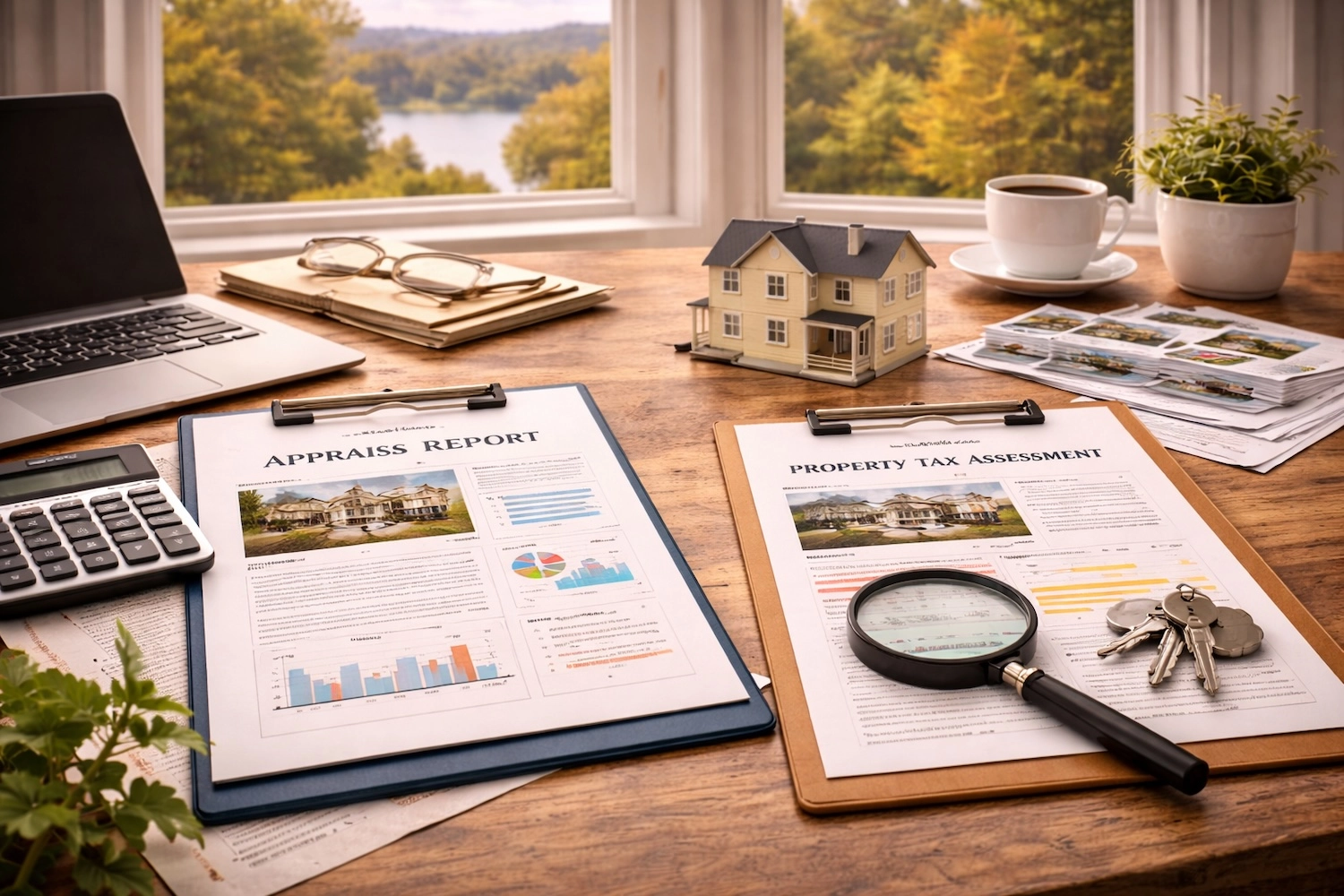
Appraisals vs. Assessments in New Hampshire: Understanding Home Values, Taxes, and the Path Forward
When buying or refinancing a home in New Hampshire, one of the most important and often misunderstood steps is the valuation process. Two distinct evaluations shape every property transaction and tax bill: the appraisal and the assessment. While both determine the home’s monetary value, they serve fundamentally different purposes in the real estate ecosystem, and the differences carry significant financial implications for buyers, sellers, and homeowners. Understanding these distinctions can help you navigate negotiations, manage expectations, and protect your financial interests in one of the nation’s most dynamic real estate markets.
Appraisals vs. Assessments: Understanding the Core Difference
The confusion between appraisals and assessments is understandable, but the distinction is critical. Each process follows its own regulatory framework, timeline, and methodology, producing values that often differ substantially. For a homeowner with a $500,000 property, these differences could mean thousands of dollars in tax consequences or transaction outcomes.
Appraisals: Market-Focused Lending Valuations
An appraisal is a professional valuation conducted by a licensed or certified appraiser to estimate the property’s current market value. Mortgage lenders require appraisals to ensure that the loan amount requested aligns appropriately with the property’s fair market value. This protects the lender’s investment and helps establish the loan-to-value (LTV) ratio, a critical metric for mortgage approval and interest rate determination.
Appraisals are performed after a purchase contract is in place, typically ordered through the lender’s underwriting team. The appraiser’s report examines recent comparable sales, the property’s physical condition, location desirability, upgrades, and broader market trends. Because market conditions shift rapidly, appraisals are valid for a limited time—usually 90 to 180 days—making them true point-in-time snapshots rather than permanent valuations. In New Hampshire’s current market, with median single-family home prices near $249,700, an appraisal cost typically ranges from $500 to $825 depending on the property size and loan type, with FHA and VA loans sometimes requiring specialized appraisals in the $400 to $900 range.
Assessments: Tax-Based Municipal Valuations
An assessment is an official valuation performed by a municipal tax assessor to determine the property tax obligation. Assessments are tied directly to a community’s tax budget and property tax rate structure. Unlike appraisals, which aim for precision in individual property values, assessments rely on mass appraisal techniques—analyzing broad market data and standardized property characteristics across the entire municipality to establish relative values for taxation purposes.
Assessments are updated on cycles established by each municipality, typically annually or every three to five years during comprehensive revaluation cycles. New Hampshire law mandates that all properties within a municipality undergo complete reappraisal every five years to ensure they remain at “full and true value,” though some towns conduct annual reviews. The assessment does not necessarily reflect the exact current market value and may lag behind recent market movements—a property assessed two years ago may significantly undervalue or overvalue the current market, depending on local market trends.
The Appraisal Process: Step-by-Step
Understanding each stage of the appraisal process helps you prepare your property effectively and anticipate the timeline and outcomes.
Step 1: Engagement and Assignment
The lender engages an appraiser, typically through the loan underwriter or a third-party appraisal management company. The appraiser receives a detailed assignment outlining the property address, loan amount, and appraisal purpose. By federal law, appraisers must be independent and impartial, adhering to the Uniform Standards of Professional Appraisal Practice (USPAP) and ethical guidelines that prevent conflicts of interest. This requirement protects both the lender and the borrower from inflated or artificially deflated values.
Step 2: Property Inspection and Data Collection
The appraiser schedules an in-person visit to the property, typically lasting 30 minutes to two hours depending on the home’s size and complexity. During the inspection, the appraiser evaluates and documents:
- Overall structure and architectural style
- Square footage of living space (gross living area or GLA)
- Number and layout of rooms, bathrooms, and bedrooms
- Condition of major systems: plumbing, heating, cooling, electrical, and roofing
- Quality and condition of finishes, appliances, and fixtures
- Presence of upgrades or deficiencies requiring adjustment
- Exterior condition, lot size, and landscaping
- Any unique features such as views, waterfront access, or detached structures
The appraiser may measure rooms with a tape measure or laser measurement device and take photographs documenting the property’s condition. They also review building permits and records to verify the legality of renovations and additions. For a property in the $300,000 to $500,000 range common in New Hampshire markets, this inspection process is thorough and methodical.
Step 3: Comparable Sales Analysis
The appraiser researches recent sales of similar properties in the neighborhood and surrounding areas. These “comps” provide the foundation for value estimation. The appraiser makes adjustments for differences between the subject property and comparable properties, accounting for factors such as:
- Lot size and location (premium for riverfront, mountain views, or proximity to amenities)
- Square footage and year built
- Condition and age of major systems
- Number of bedrooms, bathrooms, and special features like decks, garages, or finished basements
- Market condition adjustments if sales occurred during different phases of the market cycle
In New Hampshire, where property values vary significantly by county and region—with Rockingham County properties commanding median taxes near $7,945 annually while Grafton County averages around $3,900—the selection of appropriate comparables is crucial to defensible appraisals.
Step 4: Approaches to Value
In residential appraisals, the sales comparison approach is most common and carries the greatest weight. However, appraisers may also consider:
- Sales Comparison Approach: Analyzing recent sales of similar properties to establish value through comparison and adjustment.
- Cost Approach: Estimating the cost to rebuild the property from the ground up, minus physical deterioration and external obsolescence. This method is particularly useful for new construction or newer homes.
- Income Approach: Used for multi-family properties or rental homes, based on the net operating income the property generates.
Step 5: Final Report and Delivered Opinion of Value
The appraiser compiles all findings into a formal appraisal report, typically delivered within 3 to 7 business days. This report includes photographs, property descriptions, comparable sales data, the appraiser’s analysis, and the final opinion of value. The lender uses this report to confirm that the loan amount aligns with the property’s value and to establish the loan-to-value ratio. A low appraisal (below the contract purchase price) can jeopardize financing and trigger renegotiations.
Factors That Significantly Affect Appraised Values
While market conditions are largely beyond your control, several factors directly influence how an appraiser values your property. Understanding these elements helps you present your home in the best light and may explain why appraisals come in higher or lower than expected.
Location and Neighborhood Characteristics
Location remains the paramount driver of property value. Proximity to excellent schools, employment centers, shopping districts, and public amenities elevates value significantly. Properties in well-maintained neighborhoods with good property upkeep command premiums over comparable homes in declining or high-traffic areas. In New Hampshire, locations near Manchester, Portsmouth, and Concord typically appraise higher than rural properties, all other factors being equal. Waterfront and lakefront properties command substantial premiums—sometimes 40% to 100% above comparable non-waterfront homes. The 2024-2025 market data confirms this, with coastal properties in the Seacoast region appraising at substantially higher ratios than inland towns.
Condition and Deferred Maintenance
A well-maintained home with updated systems—roof, HVAC, plumbing, electrical—appraises significantly higher than one with visible deferred maintenance. The appraiser assigns value adjustments for items such as a roof nearing the end of its lifespan, outdated HVAC systems, or electrical systems that don’t meet modern standards. A property with $50,000 in deferred maintenance might appraise $40,000 to $60,000 lower than an identical home in excellent condition. Conversely, recent renovations of kitchens and bathrooms typically return 50% to 80% of renovation costs in appraisal value.
Size, Layout, and Functional Utility
Appraisers carefully consider gross living area (GLA) and how space is utilized. Open floor plans with flexible living spaces command premiums over chopped-up, cramped layouts. A four-bedroom, two-bathroom home with 2,200 square feet appraises higher than a three-bedroom, one-bathroom home of 1,800 square feet in the same neighborhood. The ratio of bedrooms and bathrooms to total square footage matters; overbuilt homes with too many small bedrooms may not appraise at a premium. Likewise, a one-bath home significantly limits appeal and value.
Upgrades and Special Features
High-end finishes, energy-efficient systems, finished basements with egress windows, decks, detached garages, and fireplaces all influence appraised value. However, the market’s appetite for these features varies. A $100,000 chef’s kitchen in a $350,000 home might be overimproved, while the same kitchen in a $600,000 home is expected. Energy-efficient windows, heat pumps, and solar photovoltaic systems increasingly appeal to New Hampshire buyers and appraisers, as rising utility costs make efficiency a tangible financial benefit. A home certified Energy Star or LEED may appraise 3% to 5% higher than a comparable non-certified home.
Broader Market Conditions
Economic factors and local supply-and-demand dynamics heavily influence values. In a seller’s market with limited inventory—such as New Hampshire experienced in 2021-2023—appraised values trend higher and appraisals typically come in above contract prices. In a buyer’s market with excess inventory, appraisals may lag contract prices. Current interest rates also affect buyer demand and thereby values. With mortgage rates fluctuating between 5.5% and 7.0% in 2024-2026, demand has moderated, and appraisals reflect more conservative value estimates than during lower-rate periods.
Understanding New Hampshire’s Property Assessment and Tax System
Property taxes in New Hampshire represent a unique and significant financial obligation for homeowners. With no state income tax and no state sales tax, New Hampshire relies heavily on property tax revenue to fund schools, municipal services, and infrastructure. The average effective property tax rate in New Hampshire is 1.46% to 1.86% of assessed fair market value annually—the fourth-highest rate in the nation. For a homeowner with a property assessed at $300,000, this translates to an annual tax bill of $4,380 to $5,580, making assessment accuracy crucial to household budgets.
How Assessments Are Determined
Each municipality employs a town assessor or assessing department responsible for evaluating all properties within the town’s borders. Assessors use mass appraisal techniques, applying standardized methodologies to entire property populations rather than conducting individual appraisals. They analyze public sales data, property characteristics, and market trends to establish assessed values intended to reflect fair market value as of April 1 each year (the statutory valuation date in New Hampshire).
Assessors physically inspect properties at intervals, gathering data on structure, square footage, improvements, and condition. This data feeds into computer-assisted mass appraisal (CAMA) systems that apply algorithms and comparables analysis across the municipality. The goal is to ensure that all properties are assessed equitably relative to each other and to current market value.
Revaluation Cycles and Frequency
New Hampshire law (RSA 21:34-a) requires that all properties within a municipality be completely reappraised every five years to ensure they remain at full and true value. However, many municipalities conduct annual assessments, and some undertake triennial (three-year) revaluations. When a revaluation occurs, the New Hampshire Department of Revenue Administration (DRA) monitors the process to ensure compliance with state standards. The DRA provides experienced appraisers to validate methodologies and ensure acceptable results. A detailed report is issued documenting procedures used and monitoring steps taken.
The acceptable equalization range established by the NH Assessing Standards Board is 90% to 110%, meaning the ratio of assessed value to fair market value must fall within this band. Any municipality falling outside this range triggers corrective action to adjust valuations.
The Equalization Ratio and What It Means
The equalization ratio is a critical but often misunderstood metric. It represents the relationship between assessed values and actual market values within a municipality. Calculated by the NH Department of Revenue Administration through annual ratio studies, the equalization ratio allows for comparison of assessment levels across different towns and helps apportion county taxes and state education property taxes fairly.
To understand your property’s equalized assessment, divide your local assessed value by the municipality’s equalization ratio. For example, if your home is assessed at $360,000 and your town’s equalization ratio is 90%, your equalized assessment (approximate market value) would be $360,000 ÷ 0.90 = $400,000. This calculation reveals whether your property is undervalued or overvalued relative to the town’s overall assessment level.
The DRA compiles equalization data annually, publishing reports by municipality, county, and ranking order. These reports are available to assessors, appraisers, attorneys, and the public, providing transparency in how assessment standards are applied across the state. As of 2024-2025, equalization ratios vary significantly by municipality and county, reflecting different assessment practices and market conditions. Some towns consistently appraise near 100% of market value, while others run in the 85% to 95% range.
The Property Tax Abatement Process: When Assessments Are Wrong
New Hampshire law provides a statutory remedy when a property owner believes the assessment is incorrect or disproportionate to market value. The property tax abatement process, governed by RSA 76:16 and RSA 76:16-a, offers a structured path to challenge and potentially reduce assessed values and resulting tax obligations.
RSA 76:16: Initial Abatement Application to the Municipality
Property owners dissatisfied with their assessed value must first apply for an abatement at the municipal level. The filing deadline is critical: the application must be on file with the selectmen or assessors by March 1st of the year following notice of tax. “Notice of tax” refers to when the final tax bill (typically the December bill) is mailed. Filing before the final bill is issued or after March 1st will result in an automatic denial for untimely filing.
The original abatement application form, available from the assessor’s office or the Board of Tax and Land Appeals, must be signed and submitted as a physical original—photocopies, faxed copies, and email submissions are not accepted. The application must clearly state the reason for the abatement request and include supporting evidence, such as:
- Recent appraisals showing a lower market value than the assessment
- Comparable sales data demonstrating the property’s actual market value is lower than assessed
- Documentation of physical defects, deferred maintenance, or functional obsolescence
- Evidence of disproportionate assessment relative to similar properties in the municipality
- Proof of poverty and inability to pay, if that is the grounds claimed
The burden of proof rests with the property owner. Simply disagreeing with the assessment is insufficient; the owner must demonstrate “good cause,” which the courts have defined as either: (1) establishing that the assessment is disproportionate to the municipality’s level of assessment and the property’s true market value, or (2) establishing poverty and inability to pay the tax. The first criterion is most commonly used, requiring the property owner to prove that their property is assessed at a higher ratio to market value than the town’s overall assessment level.
Municipal Assessment Review and Decision
Upon receiving the abatement application, the selectmen or assessors must review the claim and render a written decision. The municipality has until July 1st to grant or deny the abatement. If the assessor finds merit in the claim, they may reduce the assessment and issue a revised tax bill reflecting the lower value. If denied, a written explanation must be provided outlining the reasons for the denial.
RSA 76:16-a: Appeal to the Board of Tax and Land Appeals
Property owners unsatisfied with the municipal decision may appeal to the New Hampshire Board of Tax and Land Appeals (BTLA), a quasi-judicial body established to hear property tax disputes. The appeal must be filed between July 1st and September 1st following notice of tax. The appeal is de novo, meaning the BTLA conducts its own review of the evidence and is not bound by the municipal assessor’s decision.
To succeed at the BTLA, the property owner must submit credible evidence that the assessment is incorrect. Acceptable evidence includes recent independent appraisals, arm’s length sales data, cost of construction records, or expert testimony about property value. The BTLA will weigh this evidence against the municipality’s evidence and issue a written decision. If the BTLA grants the abatement, it will issue a revised valuation; if denied, the original assessment stands.
Superior Court Appeal (RSA 76:17)
If the property owner is dissatisfied with the BTLA decision, one further appeal is available: to the New Hampshire Superior Court. This appeal must also be filed between July 1st and September 1st and not both to the BTLA and Superior Court. Superior Court appeals are limited to questions of law, not reappraisal of value, making this remedy rarely successful unless the BTLA or municipality committed clear legal error.
Timeline Summary for Property Tax Abatement
- By March 1st: Abatement application to municipality due
- By July 1st: Municipality must render decision
- July 1st to September 1st: If dissatisfied, appeal window to BTLA or Superior Court
- No earlier than July 1st, no later than September 1st: BTLA or Superior Court appeal must be filed
Current Appraisal Costs and Timelines in New Hampshire
Understanding the financial and temporal aspects of appraisals helps buyers budget appropriately and manage expectations during the purchase or refinance process.
Appraisal Costs by Property Type and Loan Program
Appraisal fees vary based on property complexity, loan type, and lender requirements. For 2025-2026, typical costs in New Hampshire are:
- Single-Family Homes: $550 to $850, with $650 as the average
- FHA Loans: $400 to $900 (may require specialized FHA-certified appraisers)
- VA Loans: $400 to $900 (VA appraisals may carry different requirements)
- Refinancing: $350 to $600 (slightly lower than purchase appraisals for simpler transactions)
- Multi-Family Properties (2-4 units): $750 to $1,200
- Condominiums: $600 to $900 (may require condo-specific analysis)
Appraisal costs are typically paid by the borrower, either at closing or, in some cases, due upfront when the appraisal is ordered. Some lenders allow the costs to be rolled into the loan, though this increases the total amount financed.
Appraisal Timeline and Turnaround
The appraisal process typically unfolds as follows:
- Order to Inspection: 2 to 5 business days (time for the appraiser to schedule)
- Inspection Duration: 30 minutes to 2 hours on-site
- Report Preparation: 3 to 7 business days after inspection
- Total Timeline: 7 to 14 business days from order to delivery is typical
Rush appraisals may be available for an additional fee (typically $100 to $300), delivering results within 2 to 3 business days. However, this accelerated timeline should not compromise the appraiser’s thoroughness or the quality of the analysis.
Preparing Your Property for a Favorable Appraisal
While you cannot control market conditions or your property’s location, strategic preparation can present your home in the best possible light and support a favorable appraisal value.
Address Maintenance and Visible Defects
An appraiser forms a first impression upon arrival. Simple maintenance tasks significantly influence perception and value:
- Repair leaky faucets, running toilets, and visible plumbing issues
- Replace burned-out light bulbs and install working fixtures in all rooms
- Touch up chipped or peeling paint, both interior and exterior
- Clean or replace clogged gutters and downspouts
- Repair roof shingles, broken siding, and damaged window frames
- Address any obvious structural issues such as cracked foundations or settling cracks
These items signal whether the property has been maintained and cared for over time, directly influencing the appraiser’s assessment of overall condition.
Enhance Curb Appeal
The property’s exterior is the appraiser’s first and lasting impression. Invest in:
- Lawn and landscape maintenance: mow regularly, trim overgrown shrubs, remove dead plants
- Clean driveway and walkways; pressure wash if needed
- Paint or stain the front door and porch railings
- Ensure house numbers are clearly visible and mailbox is in good condition
- Remove trash, debris, and unnecessary outdoor items from the yard
Document All Improvements and Upgrades
Gather documentation of renovations, repairs, and upgrades completed over your ownership period. Organize by category:
- HVAC system replacement or upgrade
- Roof replacement with date and material specifications
- New windows and doors
- Kitchen or bathroom renovations with receipts and contractor information
- Electrical system updates (panel upgrade, new circuits, etc.)
- Plumbing upgrades or repairs
- Addition of decks, patios, or other structures with permits
- Insulation or weatherization improvements
- Solar panel installation or other energy upgrades
This documentation helps the appraiser understand the property’s condition and age of major systems, which directly affect value. A recent roof replacement (15-20 year lifespan remaining) significantly impacts condition ratings compared to an aging roof nearing replacement.
Declutter and Clean Thoroughly
While appraisers evaluate property condition, not décor, a clean and uncluttered home makes it easier for them to see the actual structural condition, room sizes, and layout. Remove personal items, excess furniture, and clutter from closets and storage areas to present an unobstructed view of the property’s systems and components.
Provide Comparable Sales Information
If you’re aware of recent comparable sales in your neighborhood that would support a higher value, compile this information. Include:
- Address, sale price, and sale date
- Property size (square footage) and lot size
- Number of bedrooms and bathrooms
- Notable features and condition
- Any unique factors affecting value (waterfront, views, special condition)
Present this information professionally to the appraiser. They may have already researched these sales, but it doesn’t hurt to highlight comparables that support your property’s value. The appraiser will ultimately determine which comparables are most appropriate, but providing relevant data demonstrates that you’ve done your research.
When Appraisals Come in Low: Strategies and Options
A low appraisal—one that comes in below the contract purchase price or the lender’s expectations—can derail a transaction or refinance. If you face this situation, several options are available:
Understand the Implications
If you’re buying and the appraisal is $30,000 below the $400,000 contract price, the lender will only loan against the appraised value of $370,000. If you agreed to put 20% down ($80,000), you now need to bring $110,000 to closing (to make up the appraisal shortfall). Many buyers cannot adjust, and the transaction falls apart. Similarly, if refinancing, a low appraisal may prevent you from accessing home equity you expected to use for renovations or debt consolidation.
Request a Reconsideration of Value (ROV)
Under federal guidelines, you can formally request that the appraisal be reconsidered. This is not a dispute but a request for the appraiser’s supervisor to review the report for factual errors, overlooked comparable sales, or incorrect property descriptions. You must identify specific errors or missing information that could have materially affected the value conclusion. Vague disagreement or emotional appeals rarely succeed. To strengthen an ROV:
- Identify arm’s length comparable sales the appraiser missed, with documentation
- Point out factual errors in the subject property description or condition ratings
- Explain market conditions or local factors the appraiser may have undervalued
- Provide recent independent appraisals or professional evaluations supporting higher value
Negotiate a Lower Purchase Price
If you’re the buyer, the appraisal value becomes a negotiating tool. Approach the seller with the appraisal report and request a price reduction to match the appraised value. Many sellers will cooperate to preserve the sale. This is a common outcome in markets where appraisals lag appreciation—the seller recognizes that the price may have been optimistic and prefers selling at appraised value to prolonging the listing.
Increase Your Down Payment
If you have additional funds available, increasing your down payment to bridge the appraisal gap allows the transaction to proceed. Rather than a $30,000 appraisal shortfall creating a $110,000 closing cost, bringing an additional $30,000 closes the gap and you proceed with a higher-than-expected down payment. This option works if you have liquid assets available and the higher down payment doesn’t strain your finances.
Switch Lenders or Appraisers
Some buyers consider ordering a second appraisal from a different appraiser. While this is technically possible, it is expensive (another $500-$850 in appraisal fees) and time-consuming. Additionally, the second appraisal may come in even lower. Switching lenders is more effective if your original lender’s underwriting is strict. Different lenders may have more flexibility or utilize appraisers familiar with your local market, though the loan estimate and terms may differ.
Walk Away
If the appraisal is significantly lower than expected and negotiation fails, walking away may be prudent. In New Hampshire, if the property fails to appraise for the purchase price, you may have a contractual right to terminate without penalty, depending on the contract language and whether your mortgage contingency language covers appraisal gaps. Consult your real estate attorney before terminating to ensure you understand the legal implications.
Case Study: A Riverside Property's Journey from Assessment Challenge to Investment Success
A couple purchased a modest riverside bungalow in Grafton County for $420,000, planning extensive renovations. The bank’s appraisal came in at $380,000, creating a $40,000 shortfall. Similar recently renovated properties along the river were selling for $480,000 to $520,000, but the subject property’s dated condition—1970s plumbing, original electrical, no HVAC system, and deferred maintenance throughout—justified the appraiser’s conservative value.
Rather than dispute the appraisal, the buyers used it strategically. They approached the seller with the appraisal report and negotiated a price reduction to $385,000, which matched the appraised value plus a modest reduction. This lowered their loan-to-value ratio and reduced closing costs. Over the next 18 months, they invested approximately $95,000 in renovations: new HVAC system ($8,500), complete kitchen remodel ($28,000), both bathrooms updated ($18,000), new roofing ($12,000), and electrical and plumbing systems upgraded ($28,500).
Two years after purchase, when they refinanced, a new appraisal valued the property at $510,000—reflecting the riverside location, improved condition, modern systems, and appreciation in the local market. The dramatic increase in value ($510,000 vs. $380,000 original appraisal) demonstrated how condition and upgrades directly impact appraised value, and how strategic use of the appraisal process (and municipal assessment appeal, which they later pursued) optimized their financial position.
Assessment Appeals in Practice: Understanding Your Rights
While appraisals primarily affect mortgage transactions, assessments directly impact property tax obligations year after year. A $100 reduction in assessed value might sound modest, but multiplied by the town’s tax rate, it can translate to $140 to $200 in annual tax savings. Over a 30-year ownership period, that’s $4,200 to $6,000 in cumulative tax reduction—substantial enough to warrant an assessment appeal if the assessment is indeed disproportionate.
When to Pursue an Assessment Appeal
Consider appealing your assessment if:
- Your property’s assessed value significantly exceeds comparable properties in your neighborhood
- Your property’s equalized assessment (assessed value ÷ equalization ratio) substantially exceeds recent arm’s length sales prices
- You have a recent independent appraisal showing fair market value substantially below assessed value
- The assessor made factual errors in the property description (square footage, age, number of bathrooms, etc.) that inflate value
- Your property has deferred maintenance or significant defects that the assessment may not fully reflect
In contrast, if your assessed value aligns with comparable properties and market value, an appeal is unlikely to succeed and wastes time and resources.
Building a Strong Abatement Case
To maximize your chances of a successful appeal, gather credible evidence:
- Recent Appraisal: Order an independent appraisal if possible. The cost ($600-$850) is justified if it supports a lower value by $5,000 or more (resulting in annual tax savings of $70-$150 or more).
- Comparable Sales: Research recent arm’s length sales of similar properties. Document sales prices, sale dates, and property characteristics.
- Equalization Ratio Analysis: Calculate your property’s equalized assessment and compare it to recent sales. If your equalized assessment is $420,000 but similar properties sold for $385,000, you have a defensible case.
- Photos and Documentation: Photograph and document any deferred maintenance, physical defects, or functional obsolescence that reduces value.
- Professional Opinion: If you have a contractor estimate for needed repairs, include it to demonstrate deferred maintenance costs.
Presenting Your Case
When presenting your abatement application, be organized, professional, and fact-based. Emotional arguments or complaints about taxes don’t persuade assessors or appeals boards. Focus on objective evidence: comparable sales, appraisals, and equalization ratio calculations. Explain clearly why your property is assessed at a higher ratio to market value than the municipality’s overall assessment level.
The Intersection of Appraisals and Assessments: How They Inform Each Other
While appraisals and assessments serve different purposes, they are not entirely separate. Municipal assessors use sales data (the same market information appraisers rely on) to calibrate mass appraisal models and determine assessment levels. Conversely, appraisers are aware of municipal assessment levels and may consider them as a reference point when examining local market value trends.
In efficient markets where assessments are current and accurate, assessed values track closely with appraised values. In municipalities that revalue infrequently or use outdated methodologies, assessments may drift significantly from market value. New Hampshire’s requirement for revaluation every five years helps keep assessments reasonably current, but the lag between the April 1 valuation date and the present can create discrepancies if market conditions shift rapidly.
For property owners, understanding both processes ensures you can:
- Negotiate effectively in purchase transactions based on appraisal values
- Budget accurately for property tax obligations based on assessed values and equalization ratios
- Challenge either valuation if you believe it to be incorrect
- Make strategic decisions about renovations and improvements based on how they affect both lender and assessor valuations
New Hampshire’s Unique Position: No Income Tax, Heavy Reliance on Property Tax
New Hampshire’s lack of state income tax and sales tax means the state depends heavily on property tax revenue. This creates particular pressure on accurate assessment practices because every dollar of assessment generates significant tax revenue. The median single-family home, assessed at around $250,000, with an effective property tax rate of 1.46% to 1.86%, generates $3,650 to $4,650 in annual tax revenue per property—a substantial sum for municipalities.
This reality underscores the importance of assessment accuracy and the formal appeal processes established by law. Property owners should take assessments seriously and be prepared to challenge them when warranted. The DRA’s oversight of equalization and revaluation cycles, while imperfect, provides a check on municipal assessment practices and ensures some level of statewide consistency.
For buyers and refinancing homeowners, this also means that New Hampshire property values may be more stable over time relative to states with income taxes, as property tax revenue pressures don’t create incentives for aggressive assessment increases. However, municipalities facing budget pressures may still incrementally raise assessments, making vigilance important.
Conclusion: Empowering Yourself in Home Valuations
Understanding the distinction between appraisals and assessments—and the distinct purposes each serves—empowers you as a buyer, seller, or homeowner. While you cannot control broader market conditions or your property’s location, you can prepare your home for favorable appraisals, understand how assessments affect your tax obligations, and challenge valuations when warranted through established legal processes.
If you are purchasing a home in New Hampshire, expect an appraisal to take 7 to 14 business days and cost $500 to $850. Use this time strategically: present your property in the best condition, document improvements, and gather comparable sales data. If the appraisal comes in low, you have options: request a reconsideration of value, negotiate a lower purchase price, increase your down payment, or (as a last resort) walk away from the transaction.
If you own a home, monitor your assessment relative to market value and comparable properties. Understand your town’s equalization ratio and recent revaluation practices. If you believe your assessment is incorrect, don’t hesitate to file an abatement application by March 1st. Gather credible evidence, present your case professionally to the assessor, and appeal to the Board of Tax and Land Appeals if necessary. The potential tax savings justify the effort.
New Hampshire’s property tax system is complex but navigable with knowledge and preparation. Whether buying, selling, or owning, armed with understanding of how homes are valued for both lending and taxation purposes, you can make more strategic decisions that protect your financial interests and position you for long-term real estate success.
Ready to explore your property’s value and potential in New Hampshire’s dynamic real estate market? The expert agents at Bean Group | brokered by eXp Realty are committed to helping you navigate appraisals, assessments, and all aspects of NH real estate transactions. Whether you’re buying your first home, managing an investment property, or selling to capture market gains, our team brings deep knowledge of local markets, assessment practices, and strategic negotiation to maximize your outcomes. Contact Bean Group today to discuss your real estate goals and discover how we can help you achieve them with confidence and clarity.